

Most Recent
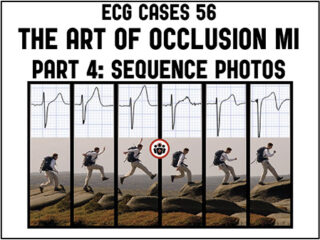
ECG Cases 56 – Art of Occlusion MI Part 4: Sequence Photos
In this month's ECG Cases Dr. McLaren explores how sequence photos help identify Occlusion MI. He illustrates through cases how hyperacute T waves and subtle ST elevation with reciprocal ST depression can provide an early snapshot of occlusion MI – and might remain the only sign of occlusion. How resolution of ischemic symptoms along with regional T wave inversion (or reciprocally tall anterior T waves) can indicate spontaneous reperfusion, while subacute and persisting symptoms with Q waves and T wave inversion indicate refractory occlusion. And how spontaneous reperfusion is at risk for reocclusion, with recurrence of ischemic symptoms accompanied by ST/T pseudonormalization and then hyperacute T waves and ST elevation.
EM Quick Hits 65 Occipital Nerve Block, PoCUS in Pulmonary Embolism, Myelopathy, Team Resuscitation, Incidental Neutropenia, Peer Programs
On this month's EM Quick Hits podcast: Dr. Mathew MacArther on Occipital Nerve Block, Dr. Ian Chernoff on PoCUS in Pulmonary Embolism, Dr. Hans Rosenberg on Myelopathy, Dr. Shawn Segeren on Team Resuscitation, Dr. Brit Long on Incidental Neutropenia and Dr. Kylie Booth on Peer Programs. Please help ensure continued Free Open Access of the entire EM Cases Learning System by donating here: https://emergencymedicinecases.com/donation/
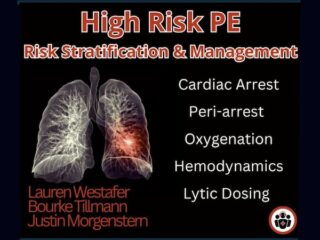
Ep 204 High Risk Pulmonary Embolism Management
There are many nuances in the management of patients with pulmonary embolism in cardiac arrest, peri-arrest or simply in shock: We need to optimize oxygenation and airway management, hemodynamic support, acid/base management, thrombolysis and/or catheter-directed therapies that Anton dives into with guest experts Dr. Lauren Westafer, Dr. Bourke Tillmann and Dr. Justin Morgenstern... EM Cases is proudly FOAMEd - Please consider a donation: https://emergencymedicinecases.com/donation/
ECG Cases 55 The Art of Occlusion MI Part 3 – Impression
In this ECG Cases blog Dr. Jesse McLaren guides us through 6 illustrative cases delving into overall impression in identifying occlusion MI. He discusses how using multiple OMI findings such as acute Q wave, subtle STE, reciprocal STD, hyperacute T waves, and reciprocal TWI to contribute to your overall impression, can double the sensitivity of STEMI criteria for acute coronary occlusion...
EM Quick Hits 64 Whole Blood Transfusions, Calcium Before Diltiazem in Afib, Thoracotomy Pearls, Uterine Casts, OMI Scale & Proportionality
In this month's EM Quick Hits podcast: Zafar Qasim & Andrew Petrosoniak on whole blood transfusion in trauma, Justin Morgenstern on calcium pre-treatment to prevent diltiazem-induced hypotension, Kiran Rikhraj on dynamic LV outflow tract obstruction, Anand Swaminathan on resuscitative thoracotomy, Andrew Tagg on uterine casts, and Jesse McLaren on scale & proportionality in occlusion MI ECG interpretation. **Please support EM Cases to continue to be free open access by making a donation: https://emergencymedicinecases.com/donation/
Ep 203 Intermediate Risk Pulmonary Embolism Risk Stratification, Management and Algorithm
How do you predict which intermediate-risk patients will suddenly deteriorate? What role do risk scores, biomarkers, imaging, and hemodynamics play in decision-making? Should these patients receive anticoagulation alone, or is thrombolysis warranted? When should you consider catheter-directed or surgical interventions? This podcast focuses us to think critically about risk stratification, early interventions and escalation in care in PE. We include an algorithm in the show notes. Not all patients fit neatly into classification boxes, making clinical judgment crucial. Join Dr. Lauren Westafer, Dr. Justin Morgenstern, Dr. Bourke Tillman and Anton as they explore the key decision points, pitfalls, and lifesaving strategies for managing intermediate-risk PE in the ED...
