


Episode 53 Pediatric POCUS
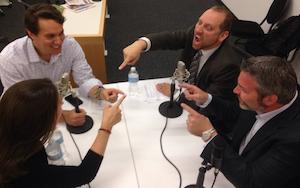
In this Episode, a follow up to Episode 18 Point of Care Ultrasound Pearls and Pitfalls, which covered pericardial effusion, pneumothorax, undifferentiated shock, cardiac arrest & DVT, we bring you 4 of North America’s Pediatric Point of Care Ultrasound gurus recorded live from Toronto during the first ever P2 Conference (PEM POCUS) - Pediatric Emergency Medicine Point of Care Ultrasound. The format will be a bit different for this episode. I’ve asked each our P2 gurus to describe a case that illustrates their favorite point of care ultrasound application, why they think it is useful, how it improves patient care, a step by step description of how to perform the application, the pearls and pitfalls of the application, and bit about what the literature says about the application. Dr. Jason Fischer on ultrasound-guided nerve blocks, Dr. Alyssa Abo on pediatric lung POCUS, Dr. Adam Sivitz on pediatric appendicitis POCUS and Dr. Alex Arroyo on intussesception.

A Rational Approach to Emergency Ebola Preparedness
In this special 15 minute EM Cases podcast on Ebola preparedness we bring you an interview with Professor Howard Ovens, the director of emergency medicine at Mount Sinai Hospital in Toronto. As an EM physician who took care of many SARS patients and the chief of the ED during the SARS outbreak, Dr. Ovens has a very rational approach to how to prepare our emergency departments for patients who present with fever who have been traveling in an Ebola outbreak region, including triaging and personal protective equipment (PPE).
Episode 52: Commonly Missed Uncommon Orthopedic Injuries
We rarely discuss medico-legal issues on EM Cases because it misguides us a bit from good patient centered care – which is what emergency medicine is really all about. Nonetheless, missed orthopedic injuries are the most common reason for an emergency doc to be sued in Canada. This is partly because missed orthopedic injuries are far more common than missed MIs for example, but it’s also because it’s easy to miss certain orthopedic injuries – especially the ones that aren’t super common. And orthopedics is difficult to learn and remember for the EM practitioner as there are so many injuries to remember. And so, you guessed it – on this episode we’re going to run through some key not-so-common, easy to miss orthopedic injuries, some of which I, personally had to learn about the hard way, if you know what I mean. After listening to this episode, try some cognitive forcing strategies – for every patient with a FOOSH that you see, look for and document a DRUJ injury. Wait, hold on….I don’t wanna give it all away at the top of the post. Let’s hear what EM doc and sports medicine guru Ivy Cheng, and the orthopedic surgeon who everyone at North York General turns to when they need help with a difficult ortho case, Hossein Medhian, have to say about Commonly Missed Uncommon Orthopedic Injuries.

Episode 51 Effective Patient Communication – Managing Difficult Patients
If you believe that coping with some of the people we deal with in emergency medicine is difficult or impossible, you’re not alone. We all feel this way from time to time. Managing difficult patients can be a challenge to the health care provider and to the entire ED. The hostile aggressive patient, the demanding patient, the know-it-all, the excessively anxious patient, and the incessant complainer, are some of the folks that we need to know how to manage effectively. If we fail to handle these patients appropriately, they may receive suboptimal care, grind patient flow to a halt, and delay care of other patients. If the staff has to deal with a multitude of these patients on a given shift, there’s a sort of swarm-based escalation in frustration and sometimes, unfortunately, a total breakdown of effective patient communication and care. But don't fret. In this one-of-a-kind podcast on effective patient communication and managing difficult patients, Dr. Walter Himmel, Dr. Jean-Pierre Champagne and RN Ann Shook take us through specific strategies, based on both the medical and non-medical literature, on how we can effectively manage these challenging patients. As a bonus, we address the difficult situation of breaking bad news with a simple mnemonic and discuss tips on how to deliver effective discharge instructions to help improve outcomes once your patient leave the ED.
Episode 50 Recognition and Management of Pediatric Sepsis and Septic Shock
Kids aren't little adults. Pediatric sepsis and septic shock usually presents as 'cold shock' where as adult septic shock usually presents as 'warm shock', for example. In this episode, a continuation of our discussion on Fever from with Ottawa PEM experts, Sarah Reid and Gina Neto, we discuss the pearls and pitfalls in the recognition and management of pediatric sepsis and septic shock. We review the subtle clinical findings that will help you pick up septic shock before it's too late as well as key maneuvers and algorithms to stabilize these patients. We cover tips for using IO in children, induction agents of choice, timing of intubation, ionotropes of choice, the indications for steroids in septic shock, and much more.....

Episode 49 Effective Patient Communication, Patient Centered Care and Patient Satisfaction
If you believe that coping with some of the people we deal with in emergency medicine is difficult or impossible, you’re not alone. We all feel this way from time to time. We all work in stressful environments where it may feel as though we have too little time for effective patient communication, patient centered care and patient satisfaction. You and your patients may often have mismatched views of what’s important. You may have a specific medical agenda and they might have a very different agenda. Then there’s the difficult patient – we all know who these people are – the hostile aggressive patient, the demanding patient, the know-it-all, the excessively anxious patient, and the incessant complainer, among others. If we don’t know how to handle these patients appropriately, they may receive suboptimal care, grind patient flow to a halt, and delay care of other patients. And of course, if the staff has to deal with a multitude of these patients on a given shift, there’s a sort of swarm-based escalation in frustration and sometimes, unfortunately, a total breakdown of effective care. These frustrations don’t only come out when we’re presented with multiple sequential difficult patients, but for some of us, the more we practice, the more we become desensitized to the needs of all of our patients and their families and, we run the risk of destroying the doctor-patient relationship, as well as making most of our patient interactions frustrating, unsatisfying, – even detrimental to our health and the outcomes of our patients. How you communicate in the ED can improve patient outcomes and enhance job satisfaction, yet there is little education on patient centered care for EM practitioners. After listening to this episode, it is my hope that what you learn from the literature and from expert opinion,and then apply to the way you communicate with your patients, will effectively make you a happier health care professional. Dr.Walter Himmel, Dr. Jean Pierre Champagne and RN Ann Shook guide us in this round table discussion on effective patient communication, patient centered care and patient satisfaction – this has evolved my practice into what I perceive as a higher level of personal satisfaction as well as patient care….I hope it will do the same for you.
