


Ep 160 Geriatric Trauma 2 Rib Fractures, Pelvic Fractures, Prognostication, Elder Abuse, Discharge Planning
In Geriatric Trauma Part 2 we answer questions such as: what are the indications for transfer to a trauma center in older patients with rib fractures and why? Can we accurately prognosticate older trauma patients in the ED? How can we best engage family members in goals of care discussions for the older trauma patient? What are the risk factors for elder abuse that we need to be aware of in the ED? How can we best minimize the risk for recurrent falls and bounce backs for the older trauma patient who is discharged from the ED? and many more...
Ep 159 Geriatric Trauma Part 1: The Under-Triaging Problem, Resuscitation, Airway, Head and C-spine Imaging, Clearing the C-spine
Just as pediatric patients are not small adults, geriatric patients are not just old adults. In this Part 1 of our 2-part EM Cases podcast series on Geriatric Trauma, Dr. Barbara Haas, Dr. Camilla Wong and Dr. Bourke Tillman answer questions such as: why are older patients under-triaged to trauma centers and how does that affect outcomes? What is the utility of the Shock Index in older patients? How should we adjust airway management for the older trauma patient? Which older patients do not require head or c-spine imaging after a ground level fall? Why is it challenging, yet of utmost importance, to clear the c-spine of a geriatric trauma patient as soon as possible? When can anticoagulation medications be safely resumed after an older person has sustained a minor head injury? and many more...
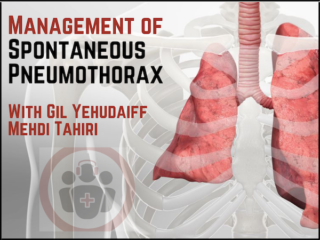
Ep 158 Management of Primary Spontaneous Pneumothorax
In this main episode podcast we discuss the conservative management of large spontaneous pneumothorax, when a pigtail chest tube with Heimlich valve is indicated, detection of persistent air leak, removal of chest tube, surgical indications for spontaneous pneumothorax, management pitfalls and more...
Ep157 Neuromuscular Disease for Emergency Medicine
There is a long list of rare neuromuscular diseases. Nonetheless, there are a few that you are likely to see in the ED, that are relevant to Emergency Medicine because they require timely diagnosis and treatment. In this Part 2 of our 2-part series on acute motor weakness with Roy Baskind and George Porfiris, we keep it short and simple by limiting our discussion to the key clinical clues and management strategies of two of the more common acute life-threatening neuromuscular diseases, myasthenia gravis and Guillain Barré syndrome, and how to distinguish them from their mimics...
Ep156 ED Approach to Acute Motor Weakness
In this Part 1 of our 2-part podcast on Acute Motor Weakness we introduce a five step approach to acute motor weakness with Dr. Roy Baskind Dr. George Porfiris: 1. Does the complaint of weakness represent a true loss of motor power? 2. The geography of weakness - patterns of motor power loss 3. Timing, course and fatigability of acute motor weakness 4. Distinguish upper versus lower motor neuron weakness by degree and speed of movement 5. Differentiate the types of lower motor neuron lesions - peripheral neuropathy vs neuromuscular junction vs myopathy, as well as review the indication for endotracheal intubation for the patient with neuromuscular weakness...

Ep 155 Treatment of Bradycardia and Bradydysrhythmias
In Part 1 of our 2-part series on bradycardia and bradydysrhythmias we discussed a practical approach with electrophysiologist Paul Dorian and EM doc Tarlan Hedayati. In this, part 2, we discuss details of treatment. We answer questions such as: When should pacing be prioritized over medications and vice versa? What are the latest recommendations about dosing of atropine and when is atropine likely to be detrimental? How is the treatment of bradycardia different in the patient with hypothermia? Cardiac ischemia? Myxedema coma? AV nodal blocker overdose? What are the most common pitfalls in utilizing transcutaneous and transvenous pacing? and many more...
