

Written by Dinesh Krishna. Edited by Nav Sahsi and Anton Helman, September 2026.
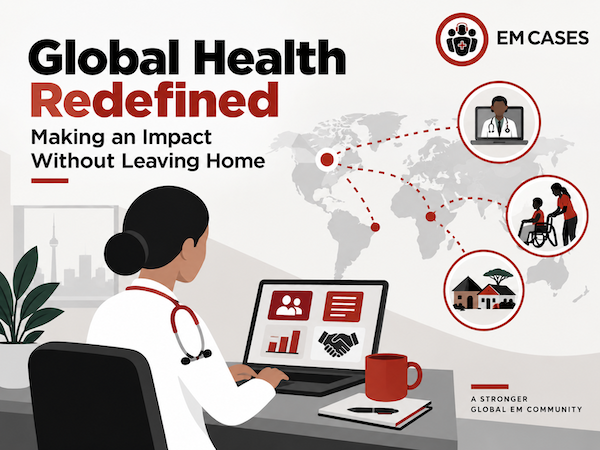
Global Health Redefined: Making an Impact Abroad Without Leaving Home
I used to think global health required a passport. I pictured long days in remote clinics, months away from home, and the kind of work that demanded a willingness to leave everything familiar behind. This was the global health I had heard about from many of my Emergency Medicine colleagues, physicians who worked with organizations like Médecins Sans Frontières and International Federation of Red Cross, bringing health care to some of the world’s most vulnerable communities. But as my career evolved, so did my life. Challenging shifts in the ED, a life partner, and two small children made extended deployments overseas increasingly difficult to imagine. Slowly, I began to believe that global health was something I cared about deeply but could no longer realistically pursue.
I was wrong. The barrier was not my ability to contribute to global health. The barrier was my narrow definition of what global health entailed. I discovered another path – one that did not require months away from my family or plane tickets across the world. A path where meaningful global health work could happen from my own home. My global health work has not involved the adrenaline of working in a remote clinic or the adventure of practicing medicine overseas. Instead, it has involved the quieter, less visible work behind the scenes: countless meetings, presentations, fundraising efforts, grant applications, emailing and strategic discussions.
At first glance, these tasks may seem far removed from the traditional image of global health. But the impact on me and the community being served has been just as profound. I have seen how ideas developed thousands of kilometres away can translate into real opportunities and improved lives. This is the story of how I discovered that global health does not always require leaving home and how sometimes the most meaningful journeys begin without ever boarding a plane.
I grew up with an acute awareness of the impact of disability on people and their families’ lives. My mom used to tell me about her two siblings in India who had muscular dystrophy. She described their challenges of accessing an education because they weren’t allowed to go to school with their wheelchairs and how her parents had to educate them at home. Despite the challenges, my uncle became a successful accountant, and my aunt became an economics professor. They both left their careers to start Amar Seva Sangam (ASSA), a non-profit, non-governmental organization in rural India in the state of Tamil Nadu, that advocates for and provides services including education, rehabilitation and vocational training for people with disabilities, services that they were often denied to them and so many others. To help support the work done by ASSA, my mom founded a Canadian charity, called Handi-care Intl in 1992 which raised money to support projects at ASSA and other disability organizations in Canada and India.
Next, was an impactful trip visiting family in India. It was 2014 and I was in my 4th year of practice as an Emergency Medicine physician, working at North York General Hospital in Toronto, Canada. I took a family trip to India with my wife and two small children. We had the opportunity to visit my uncle and aunt who were working and staying at Amar Seva Sangam (ASSA). At ASSA, we had the privilege of seeing the healthcare, rehab and education services on the 30-acre ASSA campus. We then travelled to a village, a two hour drive from campus, where we met a mother and her seven year old daughter with cerebral palsy. My uncle told me that they couldn’t come to campus to get medical care, PT, speech and OT services because they didn’t have any accessible transportation. He floated the idea of tele-medicine/rehab but told me that their organization didn’t have the funding to implement a solution.
Following this visit, I became determined to find a solution to the problem my uncle had vividly illustrated and help bridge the gap in services available to people with disabilities in rural India. I applied for funding from Grand Challenges Canada, funded by the Government of Canada, which supports bold ideas with big impact globally, to create a tele-medicine/rehab solution. With a $120,000 seed grant, we developed a software solution called the Enabling Inclusion app which connects community workers and families with the expertise of physicians, physiotherapists, occupational therapists, speech therapists and psychologists. Not only does this app connect people with disabilities to experts, but the app acts as a case management tool and electronic medical record. It is a platform where community workers, health care providers, patients and their family members can access, input and plan assessments, rehab goals, therapy and care plans, appointments, assistive device needs and much more. The initial pilot, which lasted 2 years, enrolled 351 people with disabilities and was enough of a success for us to try to scale up the impact.
Over the following 10 years, I have led a team in India in applying for three additional transition-to-scale grants totalling $2.3 million CAD with Grand Challenges Canada (GCC), with each new grant funding new technology upgrades, expansion to new geographies and population, research projects and new partnerships with academic institutions, other NGOs and government departments in India. This wasn’t the global health I had imagined during residency. There were no tents, no remote clinics, and no dramatic rescues. Instead, there were Zoom meetings, spreadsheets, grant proposals, and endless revisions. Yet these unglamorous tasks were helping thousands of people access health care they otherwise would never receive. To supplement these grants, I also became deeply involved in Handi-care Intl. to organize fundraising activities in Toronto, including Walkathons and gala dinners. These events have been a lot of fun to organize and have allowed me to engage my colleagues and friends in Canada. What began as a small pilot gradually spread beyond anything we imagined. Other NGOs wanted to use the Enabling Inclusion platform and methodology. Then state governments adopted it. Eventually, the work expanded beyond India to Ethiopia. Today, more than 27 NGOs are using the solution and more than 215,000 people with disabilities have been reached through the solution.
Working on this project enhanced my career in unexpected ways. It got me involved in something I never had any interest in – research. As physicians, we are trained to focus on individual patients in front of us. Global health required me to think differently, to demonstrate impact at the population level through careful measurement, evaluation, and research. Unfortunately, I had no research experience. I tried to educate myself and started to learn more about how to ask research questions and conduct studies. Then, I did what all good EM physicians do: I called for help. I reached out to University of Toronto, McGill University and University of British Columbia Rehab Faculties and built partnerships to conduct collaborative studies with support of their students and faculty. In India, the local team built out partnerships with various Indian academic institutions. Through these engagements, I have now been involved with and co-authored 20 publications in peer reviewed journals. I am still no research expert by any means and have mostly piggybacked off the expertise of others. However, dabbling into research has been a fun new challenge in my career.
Global health has taken me to India five more times, as well as to conferences, meetings and workshops around the world. Turns out – maybe I did need that passport after all! But those trips are not the work, they are the fun part, where I can travel and see the world and often bring my family along with me. The real work happens before I have finished my first cup of tea: early morning video calls with colleagues in India, reviewing grant applications, writing manuscripts, discussing new ideas, and helping solve problems together across continents. None of this resembles the traditional image of global health or the image I used to have, but its impact, I believe is every bit as real. Emergency Medicine has taught me to make decisions in minutes. Global health has taught me that meaningful change often takes years. Together, they have given me a career that is more varied, more challenging, and ultimately more fulfilling than I ever imagined.
If you’ve ever thought that global health wasn’t compatible with your career or your family life, I hope my story encourages you to think differently. Organizations around the world need clinicians who can teach, mentor, write grants, conduct research, build partnerships, fundraise, develop educational resources, and help solve problems remotely. The world needs more than physicians willing to travel. It needs physicians willing to contribute their skills wherever they happen to be.
If you would like to support the work being done, please visit https://handicareintl.org/.

Leave A Comment