emergency medicine education

EM Quick Hits 73 MedMal Case Peds Headache, Phenobarb in Alcohol Withdrawal, Peer Support Programs, Asymptomatic Bacteriuria, Mechanical Ventilation, Coaching the EM Mind Part 3

In this month’s EM Quick Hits Podcast, Mike Weinstock dissects a pediatric headache medical malpractice case, Zoe Polsky reviews the use of phenobarbital for alcohol withdrawal, and Kylie Booth and Nour Khatib discuss how a Peer-to-Peer program can support emergency clinicians. Plus, Matthew McArther clarifies when to treat asymptomatic bacteriuria in older adults, Shawn Segeren shares practical approaches to mechanical ventilation in the emergency department, and Sara Gray and Katie Lin return for Part 3 of “Coaching the EM Mind,” with strategies for building strong teams and support networks... Please consider a donation to EM Cases here: https://emergencymedicinecases.com/donation/

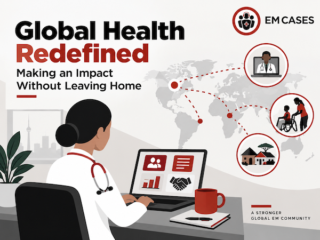
Global EM 12 – Global Health Redefined: Making an Impact Abroad Without Leaving Home

Global health doesn’t always require a passport or months working abroad. EM physician Dr. Dinesh Krishna’s journey shows how telemedicine, research, grant writing, fundraising and international partnerships can create meaningful global health impact from home—and help bring rehabilitation and disability services to more than 215,000 people without spending extended periods of time away from home in this month's Global EM blog...

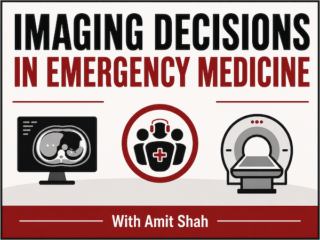
Ep 222 Imaging Decisions in Emergency Medicine

When to image, when to wait, and what to do when the ideal test isn’t available are often far more nuanced than they appear. In this EM Cases episode, Dr. Amit Shah joins Anton to tackle some of the toughest everyday imaging decisions: How much should cumulative radiation exposure influence our decision to order another CT? In suspected appendicitis, when is it safe to wait for ultrasound rather than obtain CT overnight? Can the emerging traumatic brain injury biomarkers GFAP and UCH-L1 help avoid CT, particularly in rural and remote settings? And in suspected cauda equina syndrome, how can PVR and CT lumbar spine be combined to risk-stratify patients when MRI isn’t immediately available—and when should a reassuring PVR or CT not reassure us? Plus, practical shared decision-making strategies, the role of the “tincture of time,” and much more... Please consider a donation to EM Cases to support ongoing high-quality Free Open Access Medical Education: https://emergencymedicinecases.com/donation/

Ep 221 EM-Primary Care Health Systems Strategies, Myths, Misperceptions and Solutions

There are few things more frustrating for an Emergency Physician than caring for patient after patient who lands in the ED not because it’s necessarily the best place for their care, but because every other door in the health care system was closed, confusing or impossible to find. Emergency Medicine and Primary Care often operate in different worlds—one built around rapid diagnosis and uncertainty, the other around continuity and prevention—but our patients move constantly between the two. In this special EM Cases podcast, EM–Primary Care Health Systems Strategies, we step outside the usual ED lens with Dr. Tara Kiran (host of the Primary Focus podcast) and Dr. Danielle Martin to ask how we can deliver the right care, in the right place, at the right time. We challenge assumptions about what drives ED use and explore team-based primary care, after-hours cooperatives, call-first triage, virtual care, information sharing and warm handoffs. Drawing on models from Canada, the Netherlands, Denmark and elsewhere, we finish with practical strategies to reduce fragmentation, improve continuity and make the system work better for patients and providers. Please consider a donation to EM Cases to support our mission of providing high quality free open access medical education here: https://emergencymedicinecases.com/donation/. Disclaimer: This episode was recorded in October 2025, prior to Dr. Danielle Martin becoming a candidate for government office. The views and opinions expressed by Dr. Martin in this discussion were her own at the time of recording and do not represent or reflect the views, policies, or positions of the Government of Canada.

ECG Cases 63 – WPW, Tachyarrhythmias and Ischemic Mimics

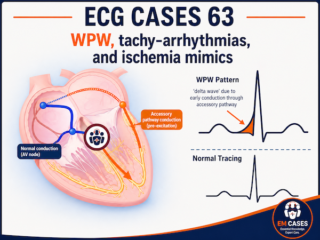
Five patients present with possible Wolff-Parkinson-White—but the ECGs tell five very different stories. From palpitations mislabeled as anxiety to narrow- and wide-complex tachyarrhythmias, pseudo-infarction patterns, and a true occlusion MI hidden by pre-excitation, these cases highlight the many faces of WPW. Learn how to recognize intermittent pre-excitation, distinguish AVRT from AF with WPW, choose the right treatment—and avoid potentially dangerous AV nodal blockers...

EM Quick Hits 72 EMC²: Peds Neurocritical Care, Pulmonary Hypertension, Cytokine Release Syndrome, Peds Wrist Fracture, Bradycardia ECG Interpretation, Coaching the EM Mind Part 2

In this month’s EM Quick Hits Podcast, Amna Karabegovic joins us for an EMC² case of pediatric altered LOA and neurocritical care, Anand Swaminathan simplifies the high-risk management of pulmonary hypertension and right ventricular failure, and Brit Long reviews how to recognize and treat Cytokine Release Syndrome. Plus, Andrew Tagg on whether uncomplicated pediatric distal radius fractures need reduction, Jesse McLaren on a systematic approach to ECG interpretation in the bradycardic patient, and Sara Gray and Katie Lin return for Part 2 of “Coaching the EM Mind,” with practical strategies for managing stress and optimizing psychological safety on shift… Please consider a donation to ensure EM Cases continues to be high quality Free Open Access Medical Education here: https://emergencymedicinecases.com/donation/

Ep 220 Facial Injuries: Assessment, Management and Disposition

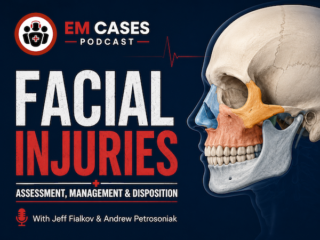
Facial trauma is common in emergency medicine, but the biggest pitfalls are often not the fractures themselves—they're the threatened airway, vision-threatening ocular injuries, missed septal hematomas, and subtle soft tissue injuries hiding beneath the skin. Which facial fracture is most likely to cause delayed airway obstruction? Why does the physical examination often matter more than the CT scan? Which injuries require urgent consultation or transfer, and which can safely go home? In this episode of EM Cases, Anton is joined by Dr. Jeff Fialkov and Dr. Andrew Petrosoniak for a practical, top-down approach to facial trauma covering airway, bleeding, vision-threatening injuries, fracture assessment, soft tissue injuries, and disposition. Please consider a donation to EM Cases to ensure ongoing high quality Free Open Access Medical Education here: https://emergencymedicinecases.com/donation/

ECG Cases 62 – ACLS Arrhythmia Pitfalls, Part 5: Stable Narrow Complex Tachycardias

Stable narrow complex tachycardias are not always what they seem. In this ECG Cases, Dr. Jesse McLaren explores the key pitfalls in distinguishing sinus tachycardia, atrial fibrillation, atrial flutter, and SVT, with 8 real-world cases highlighting common ECG interpretation errors, secondary causes, and the crucial management decisions that can prevent patient harm... Please consider a donation to EM Cases to ensure continued Free Open Access Medical Education here: https://emergencymedicinecases.com/donation/

Journal Jam 24 Antibiotics for Strep Throat: Evidence, Myths and Misperceptions

Antibiotics for strep throat seem like a simple decision—but the evidence is anything but simple. In this Journal Jam podcast with Dr. Casey Parker and Dr. Justin Morgenstern, we critically appraise the literature behind one of the most common infections seen in emergency medicine. Do antibiotics meaningfully improve symptoms? Do they prevent peritonsillar abscess, post-streptococcal glomerulonephritis, or rheumatic fever? How reliable are the studies informing our practice? We explore publication bias, limitations of the Centor score, antibiotic harms, and the importance of local epidemiology, helping clinicians move beyond dogma toward more nuanced, evidence-based decision-making... Please consider a donation to EM Cases to ensure ongoing high quality free open access medical education here: https://emergencymedicinecases.com/donation/

Ep 218 Substance Use Disorder in the ED – Stigma, Compassion and System Change

Emergency physicians pride themselves on recognizing and treating life-threatening illness under pressure. Yet one of the most lethal, common, and treatable conditions presenting to our EDs still often receives fragmented, stigmatized care: substance use disorder. The opioid crisis has evolved into an era of increasingly toxic and unpredictable drug supplies, including ultra-potent synthetic opioids such as nitazenes. Between 2016 and 2021, more than 27,000 Canadians died from opioid toxicity, while opioid-related ED visits continue to rise sharply. Patients discharged with untreated opioid use disorder face mortality rates approaching 5% within 12 months. Despite this, substance use disorder is still not consistently approached with the same urgency and systems-based care as other chronic high-risk illnesses. In this episode, Dr. Bjug Borgundvaag, Tish Mizon and Kari Herbert discuss how stigma affects care in the ED and how trauma-informed communication, person-first language, compassionate care, peer navigators and Bridge-style addiction programs can improve outcomes for both patients and clinicians. Please support EM Cases ongoing Free Open Access Medical Education learning platform with a donation here: https://emergencymedicinecases.com/donation/

Donate Subscribe
Go to Top