



Episode 81 – A Balanced View on Recent EM Literature with Joel Yaphe
EM Cases - A Balanced View on recent EM Literature with Joel Yaphe Being an optimist, I'm constantly searching for EM literature that will change my practice in a positive way and ultimately improve the care that I deliver. The past year was filled with promising papers, some of which received a lot of attention. I'm not the only one who is biased towards craving a positive paper - so are the researchers, the journal editors and the public. We all want our field to mightily move forward! Enter Dr. Joel Yaphe. An EM Residency Program Director at University of Toronto and an ED doc who I admire for his balanced, sensible and practical approach to appraising the literature. In this episode Dr. Yaphe, at University of Toronto's Update in EM Conference - Whistler, leads us through a few key articles from the past year including the REVERT trial to convert SVT, medical expulsive therapy for urolithiasis, steroids in anaphylaxis, and analgesics for low back pain, and discusses whether they should (or rather, should not) change our practice. He challenges authors' conclusions and questions whether the findings are relevant to our patients....

Episode 80 – Presentation Skills
Whether you’re a first year resident or a veteran of EM, you’ve probably given, or will be giving at least one presentation at some point in your career. On the one hand, presentations can be intimidating, time consuming to prepare for and frightening to perform, but on the other hand, if you’re well-prepared and know the tricks of the trade, they can be fun, educational and hugely rewarding. Giving a memorable and educational talk requires skill. It requires serious thoughtful planning, dedicated practice and creativity. The good news is that these skills can be easily taught. What we know about giving great talks comes from non-medical fields. We can learn about how to use our voices, eyes and body language effectively during a presentation from stage actors. We can learn how to build great slides from experts in design. We can learn how to use stories to help engage an audience and improve their retention of the material from writers, broadcasters and storytellers. We can learn how to inspire people from professional speech writers, and we can employ strategies to help improve retention of the material from cognitive neuroscientists and educators. As EM providers, we’re much too busy to read dozens of books on effective presenting, so with the help of two EM physicians and master educators, Dr. Eric Letovsky who has studied the art of public speaking and has been giving presentations for more than 30 years, and Dr. Rick Penciner who has been scouring the world’s literature on this topic for 20 years, we’ll distill down for you the key secrets, tips and tricks, theories and approaches, pearls and pitfalls of presentation skills so that the next time you get up in front of your colleagues to give a talk, you’ll blow their minds...
Episode 79 – Management of Acute Pediatric Asthma Exacerbations
In this EM Cases episode on Pediatric Asthma we discuss risk stratification (including the PASS and PRAM scores), indications for CXR, the value of blood gases, MDIs with spacer vs nebulizers for salbutamol and ipatropium bromide, the best way to give corticosteroids, the value of inhaled steroids, the importance of early administration of magnesium sulphate in the sickest kids, and the controversies around the use of ketamine, heliox, high flow nasal cannuala oxygen, NIPPV, epinephrine and IV salbutamol in severe asthma exacerbations. So, with the multinational and extensive experience of Dr. Dennis Scolnik, the clinical fellowship Program Director at The Hospital for Sick Children in Toronto and Dr. Sanjay Mehta, multiple award winning educator who you might remember from his fantastic work on our Pediatric Orthopedics episode, we'll help you become more comfortable the next time you are faced with a child with asthma who is crashing in your ED...

Episode 78 Anaphylaxis and Anaphylactic Shock – Live from The EM Cases Course
Anaphylaxis is the quintessential medical emergency. We own this one. While the vast majority of anaphylaxis is relatively benign, about 1% of these patients die from anaphylactic shock. And usually they die quickly. Observational data show that people who die from anaphylaxis and anaphylactic shock do so within about 5-30mins of onset, and in up to 40% there’s no identifiable trigger. The sad thing is that many of these deaths are because of two simple reasons: 1. The anaphylaxis was misdiagnosed and 2. Treatment of anaphylaxis and anaphylactic shock was inappropriate. So there’s still lots of room for improvement when it comes to anaphylaxis and anaphylactic shock management. With the help of Dr. David Carr of Carr's Cases fame, we’ll discuss how to pick up atypical presentations of anaphylaxis, how to manage the challenging situation of epinephrine-resistant anaphylactic shock, whether or not we should abandon steroids, a rare but ‘must know’ diagnosis related to anaphylaxis, and much more. Plus, we have a special guest apperance by George Kovacs, airway guru, to walk us through an approach to the impending airway obstruction we might face in anaphylaxis.
Episode 77 Fever in the Returning Traveler
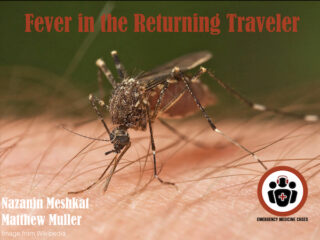
In this EM Cases episode with Dr. Nazanin Meshkat, multinational ED doc and Dr. Matthew Muller, infectious disease specialist, we discuss the most common tropical disease killers that we see in patients who present with Fever in the Returning Traveler. Every year an increasing number of people travel abroad, and travelers to tropical destinations are often immunologically naïve to the regions they’re going to. It’s very common for travelers to get sick. In fact, about 2/3 of travelers get sick while they’re traveling or soon after their return, and somewhere between 3 and 19% of travelers to developing countries will develop a fever. Imported diseases, like Malaria, Dengue, Ebola, and Zyka can be acquired abroad and brought back to your ED in unsuspecting individuals. This is serious stuff - you might be surprised to learn that Malaria is responsible for more morbidity and mortality worldwide than any other illness. According to a study in CJEM most emergency physicians have minimal or no specific training in tropical diseases and emergency physicians indicated an unacceptably low level of comfort when faced with patients with tropical disease symptoms. In fact, 40% of the cases were incorrectly diagnosed or managed. And Canadian ED docs aren’t the only ones who’s skill isn’t stellar in this department - a similar 2006 study of UK physicians showed a 78% misdiagnosis rate. This misdiagnosis rate isn’t wholly because of lack of knowledge – it almost certainly also has to do with the vague presentations and huge amount of overlap between so many tropical disease. You might be thinking that it’s impossible to learn all the thousands of details of the dozens of different tropical diseases - true. However, in the ED, while we don’t need to know every detail of every tropical disease, and don’t necessarily need to make the exact diagnosis right away, we do need to have a rational, organized approach to diagnosing and managing fever in the returning traveler, so that we can identify some of the more common serious illnesses like Malaria, Dengue and Typhoid fever, and start timely treatment in the ED.
Episode 76 Pediatric Procedural Sedation
In this EM Cases episode on Pediatric Procedural Sedation with Dr. Amy Drendel, a world leader in pediatric pain management and procedural sedation research, we discuss how best to manage pain and anxiety in three situations in the ED: the child with a painful fracture, the child who requires imaging in the radiology department and the child who requires a lumbar puncture. Without a solid understanding and knowledge of the various options available to you for high quality procedural sedation, you inevitably get left with a screaming suffering child, upset and angry parents and endless frustration doe you. It can make or break an ED shift. With finesse and expertise, Dr. Drendel answers such questions as: What are the risk factors for a failed Pediatric Procedural Sedation? Why is IV Ketamine preferred over IM Ketamine? In what situations is Nitrous Oxide an ideal sedative? How long does a child need to be observed in the ED after Procedural Sedation? Do children need to have fasted before procedural sedation? What is the anxiolytic of choice for children requiring a CT scan? and many more...
