



Ep 193 The Crashing Asthmatic – Recognition and Management of Life Threatening Asthma
In this part 2 of our 2-part podcast on asthma with Dr. Sameer Mal and Dr. Leeor Sommer, we dig into the recognition and management of life-threatening asthma. We answer such questions as: what are the key elements in recognition of threatening asthma? What are the most time-sensitive interventions required to break the vicious cycle of asthma? What are the best options for dosing and administering magnesium sulphate, epinephrine, fentanyl and ketamine in the management of the crashing asthmatic? What is the role of NIPPV in the management of life-threatening asthma? What are the factors we should consider when it comes to indications for endotracheal intubation of the crashing asthmatic? What role do blood gases play in the decision to intubate? What are the most appropriate ventilation strategies in the intubated asthma patient? and many more... Please support EM Cases with a donation: https://emergencymedicinecases.com/donation/
Ep 192 ED Adult Asthma Management Strategies For Improved Prognosis – A Stepwise Approach
In this part 1 of our 2-part podcast series on Asthma Management we explore a systematic approach to managing patients presenting to the ED with asthma exacerbations. Our discussion will emphasize the critical role of a thorough history and physical examination in effectively stratifying patient risk and guiding treatment/disposition decisions. Additionally, we'll examine the importance of providing comprehensive discharge medications and instructions to mitigate both mortality and morbidity associated with asthma exacerbations. We answer questions such as: which patients, if any, require peak expiratory flow measurements in the ED? Why is it so important to add steroid MDI therapy to oral steroid therapy in patients being discharged from the ED after an asthma exacerbation? What are the most predictive variables to risk stratify patients with asthma exacerbations to help guide treatment and disposition? and many more. Stay tuned for Part 2, where we'll delve deep into the management of the crashing asthmatic. Please support EM Cases FOAMed with a donation: https://emergencymedicinecases.com/donation/
Ep 191 The Future of EM – Systems Thinking
In order fix EM, each of us needs to understand systems issues and systems thinking, and advocate for a better system based on sound systems principles and specific solutions. In this main episode EM Cases podcast Anton is joined by Dr. Alecs Chochinov and Dr. Davie Petrie, two systems thinkers and leaders in EM. They discuss solutions for how to fix EM in 5 spheres: having a coordinated mission, optimizing access points, accountability, disaster preparedness and adaptation/evolution. They answer questions such as: What can we glean from how EM has evolved in the last few decades to help shape the future? How can we utilize virtual care to make it work for us and our patients well? How can we improve our EMS systems? How can we change the system to prevent emergency provider burnout? How can we integrate systems thinking into the daily operations of EDs to improve patient flow and outcomes? and many more... -Support EM Cases with a Donation https://emergencymedicinecases.com/donation/
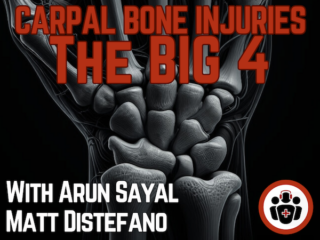
Ep 190 Carpal Bone Injuries – The Big 4
Triquetrum chip fractures, scapholunate injuries, hook of the hamate fractures, and of course, scaphoid fractures can be easily missed with serious consequences for our patients. In this part 2 of our 2-part podcast series on wrist injuries we highlight the "Big 4" most commonly missed and mismanaged carpal bone injuries, elucidating the key historical, physical exam and x-ray findings, as well as management strategies...

Ep 189 Commonly Missed and Mismanaged Wrist Injuries
In this part 1 or our 2-part podcast series on wrist injuries Dr. Arun Sayal and Dr. Matt DiStefano answer such questions as:when should we suspect a DRUJ injury, why is it important to pick up DRUJ injuries in the ED, and how does it change our management? Why is the lateral x-ray view so important in picking up commonly missed wrist injuries? When it comes to distal radius fractures, how are Colles vs Barton's vs Smith's fractures managed differently in the ED? What are the 2 key x-ray signs we should look for on the AP and the 2 key x-ray signs we should look for on the lateral for every wrist injury? and many more...
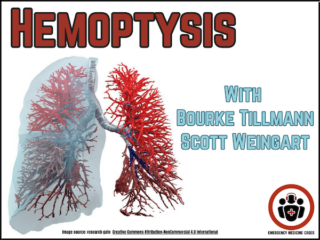
Ep 188 Hemoptysis – ED Approach and Management
Key principles and approach to management of both non-massive and massive hemoptysis with Dr. Scott Weingart and Dr. Bourke Tillmann, who answer questions such as: What are the factors to consider in the decision to intubate patients with massive hemoptysis? How can one reliably distinguish hemoptysis from pseudohemoptysis? What is the evidence for tranexamic acid in patients with hemoptysis? What are the best strategies for suctioning blood from the airway to improve visualization during endotracheal intubation in crashing hemoptysis patients? What is the role of bronchoscopy and how should it be integrated into the hemoptysis management algorithm? How does one's hemorrhage control strategy change when pulmonary embolism is the underlying diagnosis? and many more... Please support EM Cases with a donation: https://emergencymedicinecases.com/donation/
