

Topics in this EM Quick Hits podcast
Mike Weinstock on a MedMal Case of a pediatric headache (1:12)
Zoe Polsky on phenobarbital for alcohol withdrawal (39:09)
Kylie Booth and Nour Khatib on the ED Peer to Peer Program and a wrist injury case (1:13:11)
Matthew McArther on asymptomatic bacteriuria (1:22:34)
Shawn Segeren on mechanical ventilation in the emergency department (1:28:48)
Sara Gray & Katie Lin on Coaching the EM Mind Part 3: team building and support networks (1:36:26)
Podcast: Play in new window | Download (Duration: 2:14:00 — 122.7MB)
Subscribe: Apple Podcasts
Podcast production, editing and sound design by Anton Helman
Podcast written summary & blog post by Sara Brade, edited by Anton Helman, September, 2026
Cite this podcast as: Helman, A. Weinstock, M. Polsky, Z. Booth, K. Khatib, N. McArther, M . Segeren, S. Gray, S. Lin, K. EM Quick Hits 73 MedMal Case, Phenobarb in Alcohol Withdrawal, Peer Support Programs, Asymptomatic Bacteriuria, Mechanical Ventilation, Coaching the EM Mind Part 3. Emergency Medicine Cases. September 2026. https://emergencymedicinecases.com/em-quick-hits-73-sept-2026/. Accessed September 8, 2026.
MedMal Cases: A 15-year-old with a headache
A 15-year-old developed abrupt headache and neck pain immediately after coughing. She arrived by ambulance to the ED in severe distress, with vomiting, neck stiffness and a blood pressure of 174/94 mm Hg. Despite discrepancies between the EMS, nursing and physician histories, she was discharged without imaging, repeat vital signs or documented reassessment. Three weeks later, she died from a ruptured brain aneurysm.
- In headache, time to peak intensity matters more than the reported severity. Ask: “How long did it take from the first pain until it was at its worst?” Time to peak intensity within seconds to minutes is a red flag.
- A patient may deny having the “worst headache of life” despite experiencing a dangerous abrupt-onset headache—especially if distressed due to severe pain.
- Headache triggered by coughing or another Valsalva manoeuvre should prompt consideration of a vascular cause, particularly when it is new, abrupt or associated with neck pain, vomiting or marked distress.
- Children and adolescents do not get a diagnostic “free pass.” Cerebral aneurysms and other vascular catastrophes are rare in this population, but rare diagnoses still occur over a career in emergency medicine.
- Read the EMS and triage documentation. When it conflicts with your history, clarify the discrepancy and document why the accounts differ. Specific contemporaneous observations like “vomiting thin liquids,” generally carry more weight than generic negatives like “no nausea or vomiting.”
- An elevated blood pressure in a child requires reassessment. Repeat it after analgesia and confirm the cuff size. Persistent hypertension may be more than a pain response and can signal an intracranial process.
- Before discharge, perform and document a reassessment: symptoms, repeat vital signs, neurologic examination and response to treatment.
- When the diagnosis remains uncertain, ask: “If this patient returns with a dangerous diagnosis, what is it most likely to be?” Address those diagnoses through targeted history, examination and testing—not an unexamined template-generated list.
- The medical record should explain what dangerous diagnoses you considered, why you judged them unlikely and why discharge was reasonable. If the reasoning does not convince you, pause before discharging the patient.
Bottom line: A new headache that reaches peak intensity rapidly deserves serious consideration regardless of the patient’s age, pain score or use of the phrase “worst headache of life.”
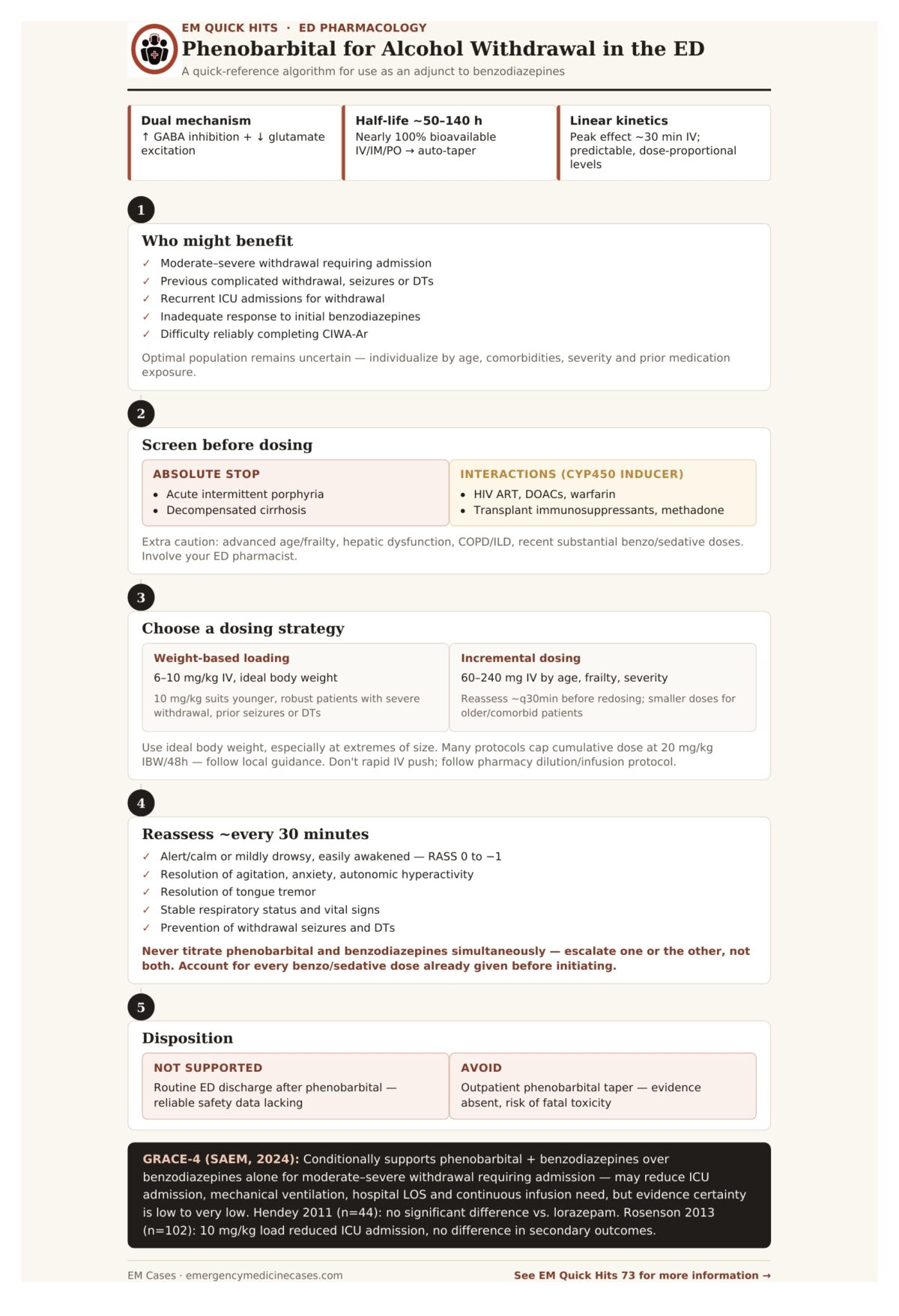
Phenobarbital for alcohol withdrawal in the ED
Benzodiazepines remain the guideline-supported first-line treatment for alcohol withdrawal in the ED. Phenobarbital offers another option—particularly for severe, complicated or benzodiazepine-resistant withdrawal—but requires careful patient selection, dosing and monitoring.
Consider phenobarbital as an adjunct to benzodiazepines for alcohol withdrawal in the ED
- Chronic alcohol exposure alters both major neurochemical pathways involved in withdrawal:
- GABA: the brain’s inhibitory “brake”
- Glutamate: the excitatory “accelerator”
- Benzodiazepines enhance GABA activity but do not directly suppress glutamate.
- Phenobarbital acts on both pathways:
- Enhances inhibitory activity at GABA-A receptors
- Reduces excitatory glutamatergic transmission
- This dual mechanism may benefit patients with severe or benzodiazepine-resistant alcohol withdrawal.
Phenobarbital pharmacology: long half-life and auto-taper
- Phenobarbital has several practical pharmacologic advantages:
- Long half-life of approximately 50-140 hours
- Nearly 100% bioavailability through IV, IM and oral routes
- Predictable, linear pharmacokinetics
- Peak clinical effect approximately 30 minutes after IV administration
- Its long half-life provides a gradual auto-taper, potentially reducing the recurrent withdrawal symptoms seen between shorter-acting benzodiazepine doses.
- IV administration allows clinicians to reassess and repeat doses approximately every 30 minutes.
Phenobarbital dosing for alcohol withdrawal in the ED
Two common ED dosing strategies are used:
- Weight-based loading
- Consider 6–10 mg/kg IV based on ideal body weight
- A 10 mg/kg load may suit a younger, otherwise robust patient with severe withdrawal, previous withdrawal seizures or delirium tremens
- Use ideal—not actual—body weight, particularly at extremes of body size
- Incremental dosing
- Give 60–240 mg IV, depending on age, frailty and withdrawal severity
- Reassess approximately every 30 minutes before redosing
- Smaller initial doses may be appropriate for older adults, patients with medical comorbidities or patients at greater risk of sedation
- Track the total cumulative dose carefully. Many protocols use 20 mg/kg ideal body weight as the maximum cumulative dose, but clinicians should follow local guidance.
- Do not rapidly IV push a large loading dose. Follow institutional pharmacy guidance for dilution and infusion rate.
Clinical endpoints when titrating phenobarbital for alcohol withdrawal in the ED
Titrate treatment to clinical response rather than simply targeting a numerical withdrawal score.
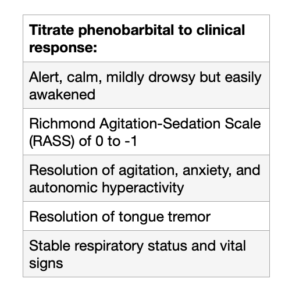
Reassess sedation, respiratory rate, oxygen saturation, hemodynamics and cumulative dosing after every dose.
Which patients in alcohol withdrawal will benefit most from phenobarbital?
Consider phenobarbital in appropriately monitored patients with:
- Moderate to severe alcohol withdrawal requiring admission
- Previous complicated withdrawal
- Previous alcohol-withdrawal seizures
- Previous delirium tremens
- Recurrent ICU admissions for withdrawal
- An inadequate response to initial benzodiazepine treatment
- Difficulty participating reliably in subjective CIWA-Ar assessment
The optimal patient population remains uncertain in the literature, and treatment should reflect the patient’s age, comorbidities, withdrawal severity and previous medication exposure.
Phenobarbital contraindications and drug interactions to know about in the ED
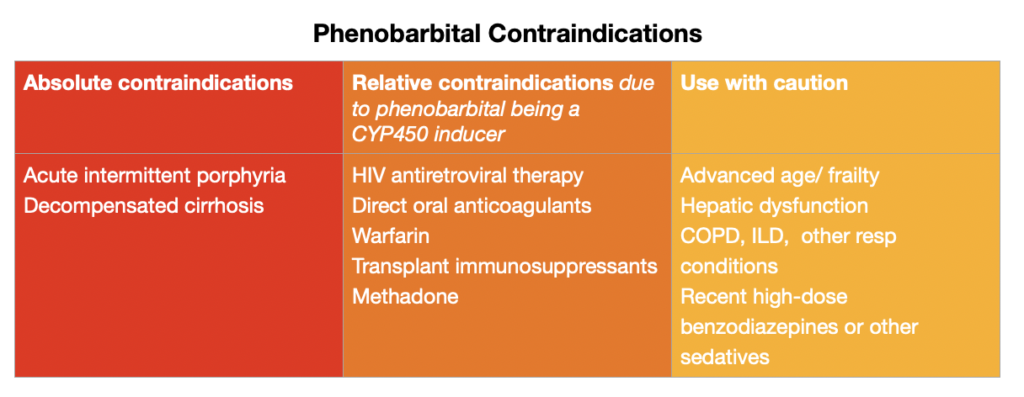
Contraindications to phenobarbital administration are debated in the literature. Involve your ED pharmacist to ensure safe administration.
Avoid simultaneous phenobarbital and benzodiazepine titration when treating alcohol withdrawal in the ED
- Phenobarbital may be introduced after small or moderate benzodiazepine doses when clinically appropriate.
- Once phenobarbital is selected, avoid independently escalating both phenobarbital and benzodiazepines.
- Simultaneous titration can:
- Obscure the patient’s response to each medication
- Produce cumulative sedation
- Increase the risk of respiratory depression
- Account for every benzodiazepine and sedative dose already administered by EMS, nursing staff and other clinicians before initiating phenobarbital.
Evidence for phenobarbital use in alcohol withdrawal is limited
- Hendey et al. (2011):
- Randomized 44 patients to phenobarbital or lorazepam
- Found no significant difference in withdrawal scores, ED length of stay, admission or 48-hour outcomes
- The lorazepam group received relatively small doses, limiting interpretation
- Rosenson et al. (2013):
- Randomized 102 patients receiving a lorazepam protocol to additional phenobarbital or placebo
- A 10 mg/kg phenobarbital load reduced ICU admissions
- Secondary outcomes, including adverse events and hospital or ICU length of stay, did not differ significantly
- Most additional evidence comes from heterogeneous observational and retrospective studies.
- The 2024 GRACE-4 guideline conditionally supports adding phenobarbital to benzodiazepines for moderate to severe alcohol withdrawal requiring hospital admission. However, the evidence certainty is low to very low.
- Existing studies suggest phenobarbital may reduce:
- ICU admission
- Mechanical ventilation
- Hospital length of stay
- Need for continuous sedative infusions
These potential benefits remain uncertain because the supporting studies use different populations, dosing strategies and clinical settings.
Can patients be discharged after receiving phenobarbital in the ED for alcohol withdrawal?
- Practice varies considerably among emergency departments.
- The GRACE-4 guideline could not recommend phenobarbital for patients being discharged because reliable safety evidence is lacking.
- Discharge concerns include:
- Phenobarbital’s long half-life
- Delayed or cumulative sedation
- Concurrent use of alcohol, benzodiazepines, Z-drugs, opioids or other sedatives
- Variable dosing and patient selection in existing studies
- Do not prescribe an outpatient phenobarbital taper. Evidence supporting this practice is absent, and unsupervised use may cause fatal toxicity.
Asymptomatic bacteriuria in functionally dependent older adults: when to treat and when not to treat
Pyuria and bacteriuria are extremely common in functionally dependent older adults; approximately 30–60% of nursing-home residents may have a positive culture at baseline. An incidental positive urinalysis or culture in the ED therefore does not establish that a UTI caused the patient’s presentation in the absence of urinary symptoms.
The 2019 Infectious Diseases Society of America (IDSA) guideline recommends that older adults with delirium or a fall found to have bacteriuria—but no localizing urinary symptoms, fever or hemodynamic instability—undergo assessment for other causes, careful observation, and no antibiotic treatment for the bacteriuria.
Consider alternative causes of delirium or falls, including:
- Medication changes or adverse effects
- Dehydration
- Constipation
- Sleep disruption
- Viral or other systemic illness
- Metabolic abnormalities
- Pain or environmental stressors
Antibiotics in asymptomatic bacteriuria have not been shown to:
- Accelerate delirium resolution
- Reduce morbidity or mortality
- Improve chronic urinary incontinence
Unnecessary treatment with antibiotics may increase:
- C. difficile infection
- Adverse drug effects
- Risk of future drug-resistant infection
Treatment of patients with asymptomatic bacteriuria is generally reserved for:
- Pregnant patients
- Patients undergoing an endoscopic urologic procedure associated with mucosal trauma
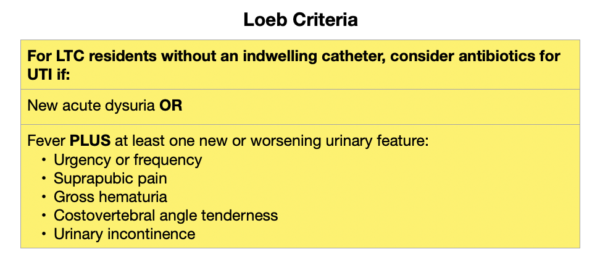
Loeb minimum criteria for suspected UTI in functionally dependent older adults
Mechanical ventilation made simple for the emergency physician
Bagging vs mechanical ventilation for the intubated ED patient
- Manual bagging provides little feedback about delivered volumes or airway pressures.
- Excessive pressure and volume secondary to bagging can cause lung injury.
- Once the tube is secured, transition promptly to controlled mechanical ventilation.
Ventilator modes to know in the ED
Most ED ventilators use an assist-control mode:
- Volume control: Guarantees tidal volume; pressure varies.
- Pressure control: Guarantees inspiratory pressure; tidal volume varies.
- PRVC: Targets tidal volume while adjusting inspiratory pressure.
The settings and pressure monitoring usually matter more than the selected mode.
Initial ED ventilator settings for a patient without primary lung pathology
- Tidal volume: 6 mL/kg predicted body weight; acceptable range 6–8 mL/kg
- Respiratory rate: 12–15/min
- PEEP: 5 cm H₂O
- Inspiratory time: Approximately 1 second
- FiO₂: Initially 50–100%, then titrate down promptly
Adjusting vent settings for different ED clinical scenarios: tachypnea, lung injury, and acidosis
- Pre-intubation tachypnea: Consider an initial rate of 20–25/min to avoid abruptly reducing minute ventilation.
- ARDS, pneumonia or pulmonary edema: Use 6 mL/kg and consider starting PEEP at 8 cm H₂O.
- Severe metabolic acidosis: Preserve minute ventilation with a higher respiratory rate and, if necessary, tidal volume approaching 8 mL/kg while monitoring pressures.
How to interpret peak, plateau, and driving pressures in ED
- High peak with normal plateau: Think bronchospasm, secretions, kinked tubing or biting.
- High peak and high plateau: Think reduced lung compliance from ARDS, edema or pneumonia.
Practical safety targets:
- Plateau pressure <30 cm H₂O
- Aim for driving pressure <15 cm H₂O (driving pressure = plateau pressure − PEEP)
How to recognize and manage air trapping in a mechanically ventilated patient in the ED
- Expiratory flow on the expiratory waveform should return to baseline before the next breath.
- Failure to return to baseline indicates air trapping or auto-PEEP.
- Manage by:
- Lowering the respiratory rate
- Shortening inspiratory time
- Treating bronchospasm
- Optimizing sedation
- Reassessing the waveform
Post-Intubation Ventilator Checklist
- Reassess vital signs.
- Confirm the delivered tidal volume.
- Check minute ventilation—often approximately 5–10 L/min in adults.
- Ensure adequate expiratory time, generally an I:E ratio of at least 1:2.
- Measure plateau and driving pressures.
- Obtain an ABG or VBG within 30 minutes, or sooner if unstable.
Mechanical Ventilation Reference Guide
Coaching the EM Mind Part 3: Building stronger teams and support networks
Psychological safety in teams improves collaboration and patient safety
Successful teams allow members to communicate honestly, ask for help and feel that they belong. Build psychological safety in your team by:
- Welcoming and orienting new team members
- Establishing clear roles and handover processes
- Encouraging respectful questions and honest feedback
- Ensuring everyone can contribute without interruption
- Setting and enforcing consequences for bullying, harassment and incivility
Managing interpersonal conflict within and beyond ED teams requires de-escalation tools
When an interaction becomes confrontational:
- Pause and regulate your own emotions.
- Speak more slowly and lower your vocal tone.
- Name the emotion when appropriate.
- Re-establish the shared goal: “We both want the best outcome for this patient.”
- Use the person’s name—not simply their specialty or service.
- Consider that their behaviour may reflect a difficult day rather than you personally.
Useful reset phrases include:
- “I feel like we got off to the wrong start. Can we start again?”
- “I’m asking for your help because I’m worried about this patient.”
- “Can we return to our shared goal and work through this respectfully?”
Effective teams manage conflict constructively and this includes giving and receiving apologies
A meaningful apology has four parts:
- Name it: “I’m sorry I interrupted you.”
- Explain why it was wrong: “That was disrespectful and may have made you feel unheard.”
- Commit to change: “Next time, I will wait until you finish.”
- Ask for forgiveness: “Will you forgive me?”
A genuine apology requires specific accountability and behaviour change.
How to support your ED team and recognize a colleague in distress
Watch for changes from baseline:
- Tearfulness or unusual irritability
- Withdrawal from colleagues
- Unexpectedly giving away shifts
- Changes in behaviour or performance
Check in privately and kindly:
- “I haven’t seen you lately. How are you doing?”
- “You don’t seem like yourself. Are you okay?”
If you are not the right person to approach them, ask a trusted colleague or friend to check in.
Proactively set up your supports: finding your “failure friends”
A failure friend is someone you can contact during moments of struggle, shame or perceived failure.
Choose someone who is:
- Kind and empathetic
- Trustworthy and confidential
- Familiar with your professional context
Formal peer-support programs and mental-health professionals provide alternatives when a personal support network is unavailable. Structured peer support can help clinicians after stressful clinical events.
How to strengthen ED teams at a systems level: building supportive healthcare organizations
Leaders should:
- Fund and empower a dedicated wellness lead
- Provide training on microaggressions and harassment
- Establish enforceable professionalism policies
- Model vulnerability by asking for help or saying, “I don’t know”
- Create opportunities for team connection and celebration
- Develop confidential peer-support networks
None of the authors have any conflicts of interest to declare


Leave A Comment