

There are few things more frustrating for an Emergency Physician than caring for patient after patient who seems to have landed in the ED not because the ED was necessarily the best place for their care, but because every other door in the health care system was closed, confusing or impossible to find. Emergency Medicine and Primary Care often operate in very different worlds—one built around rapid diagnosis, resuscitation and uncertainty, the other around continuity, prevention and relationships over time—but our patients move constantly between the two. In this special EM Cases podcast, EM–Primary Care Health Systems Strategies, we step outside the usual ED lens with Dr. Tara Kiran and Dr. Danielle Martin to ask how Emergency Medicine and Primary Care can work together to create a system that delivers the right care, in the right place, at the right time. We explore how Emergency Medicine and Primary Care can work together to build a more rational health system. We challenge some common assumptions about what drives ED use, explore team-based Primary Care, after-hours cooperatives, call-first triage, integrated virtual care, better information sharing and warm handoffs, and look to models from Canada, the Netherlands, Denmark and elsewhere for practical ideas. Most importantly, we finish with concrete strategies that ED and Primary Care clinicians can start working on now to reduce fragmentation, improve continuity and make the health care system work better for both patients and the health care providers caring for them…
Podcast: Play in new window | Download (Duration: 1:43:08 — 94.5MB)
Subscribe: Apple Podcasts
Podcast production, sound design & editing by Anton Helman
Written Summary and blog post by Anton Helman August, 2026
Cite this podcast as: Helman, A. Kiran, T. Martin, D. EM-Primary Care Health Systems Strategies, Myths, Misperceptions and Solutions. Emergency Medicine Cases. August, 2026. https://emergencymedicinecases.com/em-primay-care-health-systems-strategies. Accessed October 11, 2026
Disclaimer: This episode was recorded in October 2025, prior to Dr. Danielle Martin becoming a candidate for government office. The views and opinions expressed by Dr. Martin in this discussion were her own at the time of recording and do not represent or reflect the views, policies, or positions of the Government of Canada.
EM–Primary Care Health Systems Strategies: Right Care, Right Place, Right Time
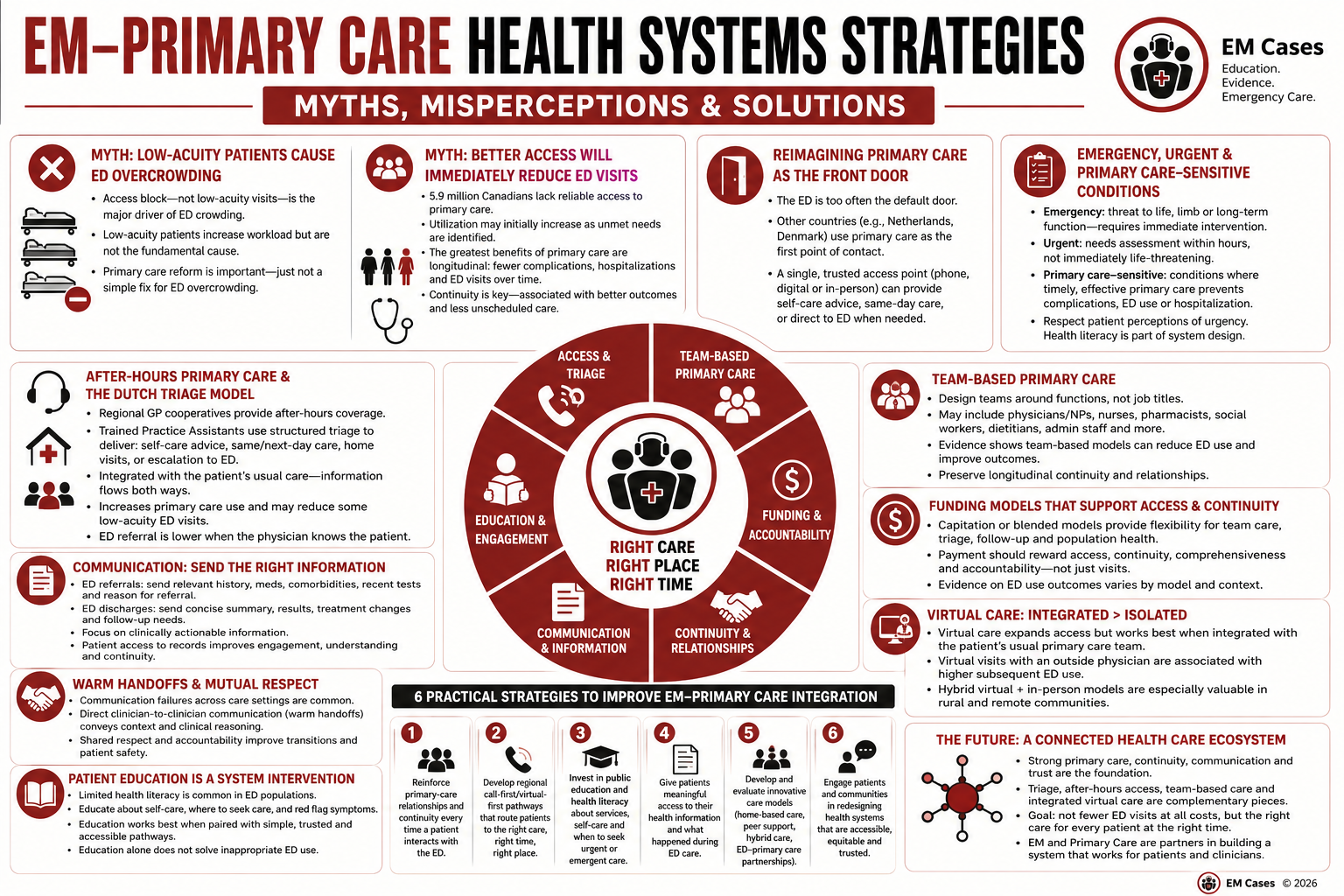
Myth: Low-Acuity Patients Are the Cause of Emergency Department Overcrowding
A common misconception is that ED overcrowding is driven primarily by patients presenting with low-acuity conditions that could potentially be managed in Primary Care. While these presentations contribute to ED volume and workload, the literature consistently identifies access block—the inability to transfer admitted patients from the ED to appropriate inpatient beds—as a major determinant of ED crowding. Consequently, interventions aimed solely at redirecting low-acuity patients to Primary Care are unlikely to substantially resolve ED overcrowding in the absence of strategies addressing hospital capacity, patient flow and access block. Improving access to Primary Care remains important for other reasons, including continuity of care, prevention, chronic disease management, patient experience and long-term population health. However, the rationale for strengthening Primary Care should extend beyond its potential to reduce ED utilization; Primary Care reform should be understood as one component of broader health-system reform rather than a stand-alone solution to ED overcrowding.
Deep dive into ED overcrowding: Episode 129 ED Overcrowding and Access Block – Causes and Solutions.
Myth: Better Primary Care Access Will Immediately Reduce ED Visits
5.9 Canadians lack reliable access to a regular family physician, nurse practitioner or Primary Care team. Expanding Primary
Care access is therefore an important health-systems priority, but its impact should be evaluated over an appropriately long time horizon. Increasing primary care access does not necessarily translate into an immediate reduction in ED utilization. Newly attached patients may have previously unmet health needs requiring diagnostic investigation, specialist consultation or acute assessment. More importantly, many of the benefits of high-quality primary care accrue longitudinally. Effective management of hypertension, diabetes, chronic respiratory disease and other chronic conditions can reduce complications and potentially prevent future hospitalizations and emergency care.
Continuity itself appears to be an important determinant of outcomes. Greater longitudinal continuity with a Primary Care clinician is associated with improved health outcomes and reduced use of unscheduled secondary care. Thus, the principal value of Primary Care is not simply its ability to divert individual episodes of acute illness away from the ED, but its capacity to improve health and health-system performance across the patient’s life course.
Reimagining Primary Care as the Front Door to the Health System
In many North American health systems, the ED has effectively become the default point of access when other components of the system are unavailable or difficult to navigate. Patients may be required to choose among family practices, walk-in clinics, urgent care centres, nurse advice lines, virtual services and EDs, often without sufficient information to determine which service is most appropriate.
Alternative models demonstrate that this configuration is not inevitable. In the Netherlands, for example, Primary Care plays a central role as the first point of contact, supported by regional organization of after-hours services and structured triage. A similar conceptual approach could provide patients with a single, trusted initial access point through which they could receive self-management advice, telephone or virtual assessment, same-day or next-day Primary Care, or direction to emergency services when appropriate. The objective is not to restrict access to emergency care, but to create credible and accessible alternatives so that the ED is not the only reliably available entry point into the health system.
Emergency, Urgent and Primary Care–Sensitive Conditions
Effective system design requires a common conceptual framework for differentiating emergency, urgent and Primary Care–sensitive conditions. An emergency can broadly be understood as a condition posing an immediate threat to life, limb or long-term function and requiring rapid intervention. Urgent conditions require timely assessment but do not necessarily pose the same immediate threat. Primary Care–sensitive conditions are those for which timely, accessible and effective longitudinal Primary Care may prevent disease progression, complications, ED utilization or hospitalization.
These categories are useful for health-system planning but should not be interpreted as rigid classifications at the individual patient level. Patients generally seek care because they perceive a need for assessment, and their ability to determine clinical acuity before evaluation is necessarily limited. Health systems should therefore combine accessible triage with public education and health literacy initiatives that help patients identify conditions suitable for self-management, those requiring timely professional assessment and symptoms requiring emergency care.
After-Hours Primary Care and the Dutch Triage Model: Build a Bridge, Not Another Walk-In Clinic
Comprehensive after-hours Primary Care does not require individual family physicians to be continuously available. Regional cooperatives can share responsibility while preserving continuity with a patient’s usual Primary Care system. The Netherlands provides a well-established model: regional General Practitioner (GP) cooperatives use centralized telephone triage, with specially trained Practice Assistants applying structured protocols to determine whether patients require self-care advice, same-day or delayed Primary Care assessment, physician consultation, home assessment or escalation to emergency services.
The key distinction is between integrated after-hours care and isolated episodic care. Ideally, after-hours clinicians have access to relevant patient information and communicate important findings back to the regular Primary Care team. Evidence suggests that expanded after-hours Primary Care increases Primary Care utilization and may reduce some lower-acuity ED use, although effects on overall ED utilization are heterogeneous. Referral to the ED may also be less likely when the after-hours physician already knows the patient, reinforcing the importance of relational continuity. The broader lesson from the Dutch model is that triage, navigation and after-hours access should function as coordinated components of Primary Care rather than as disconnected alternatives to the ED.
Team-Based Primary Care: Design Around Functions, Not Professional Titles
The increasing complexity of contemporary Primary Care makes it difficult for an individual physician to provide comprehensive, accessible and longitudinal care independently. Team-based models distribute clinical and administrative functions among professionals whose skills are matched to patient and population needs. Such teams may include physicians, nurse practitioners, nurses, pharmacists, social workers, dietitians and appropriately trained medical office personnel. Canadian evidence suggests that Primary Care reform incorporating interdisciplinary teams can improve some measures of health-system performance and may reduce ED utilization, although effects vary across models and populations.
Rather than prescribing a universal professional composition, teams can be designed around the functions required by the population they serve. A smaller core or “mini-team,” for example, might include a physician or nurse practitioner working closely with nurses and trained administrative personnel capable of structured triage. More specialized professionals can then be integrated according to local needs. Importantly, team-based care should preserve rather than dilute continuity. Strong longitudinal and relational continuity remains associated with better outcomes and reduced unscheduled secondary care utilization.
Funding Models Should Reward Access and Continuity
Payment mechanisms influence how Primary Care is organized and which activities health systems incentivize. Traditional fee-for-service models predominantly reward individual encounters, whereas capitation and blended models can provide greater flexibility to organize services around a defined population. Under capitated models, practices receive funding based principally on the population for which they are responsible rather than solely on the number of face-to-face encounters delivered. This can create greater flexibility for telephone triage, nursing care, team-based management and other services that may not fit traditional encounter-based payment structures. However, evidence comparing Primary Care funding models is complex, and capitation should not be assumed to be intrinsically superior. Canadian studies demonstrate that associations between funding models, Primary Care organization and ED utilization vary considerably. The more defensible principle is that funding mechanisms should be aligned with desired health-system objectives, including timely access, continuity, comprehensiveness, interdisciplinary care and accountability for defined populations.
Virtual Primary Care Works Best When It Is Integrated With In-Person Care
Virtual care can improve accessibility, but its impact appears to depend substantially on how it is integrated into the broader Primary Care system. Virtual encounters delivered by a patient’s existing physician or Primary Care team retain important advantages: access to longitudinal clinical information, knowledge of the patient, capacity for follow-up and the ability to arrange subsequent in-person assessment. Conversely, stand-alone virtual services that function as virtual walk-in clinics may provide access without continuity. An Ontario population-based study found that virtual encounters with an outside family physician were associated with greater subsequent ED utilization than virtual encounters with the patient’s own family physician. This association does not establish that outside virtual care itself causes ED utilization, but it supports the importance of continuity and integration when designing virtual services. Virtual care should therefore be viewed primarily as one modality within longitudinal Primary Care rather than a substitute for it. Hybrid models combining virtual and in-person services may be particularly valuable in rural and remote communities, where geographic barriers limit conventional access.
Better ED–Primary Care Communication and Warm Handoffs
Transitions between EM and Primary Care are a recurrent vulnerability in health care delivery. Effective information exchange should prioritize timely, clinically actionable information rather than indiscriminate data transmission. When patients are referred to the ED, EM physicians need relevant history, medications, recent investigations and the reason for referral; following discharge, Primary Care clinicians need a concise summary of the ED assessment, treatment changes and required follow-up. Effective information transfer should emphasize clinically actionable information rather than indiscriminate data transmission. Systematic reviews of discharge communication and ED-to-outpatient transitions have identified substantial opportunities to improve the quality, timeliness and content of information exchanged across care settings. Systematic reviews suggest that patient access to electronic health records can improve aspects of engagement, communication, self-management and empowerment. Patient-accessible records may therefore serve not only as an autonomy intervention but also as an additional mechanism for improving continuity across otherwise fragmented systems.
Technology alone, however, cannot ensure effective transitions. In selected cases, direct clinician-to-clinician communication or a “warm handoff” can convey clinical reasoning and context that standardized documentation cannot. Communication failures across acute and outpatient care are well documented, and strengthening mutual trust, communication and shared accountability between EM and Primary Care remains an important component of safer integrated care.
Patient Education Is a Health Systems Intervention
Health-system navigation assumes a level of health literacy that cannot be taken for granted. Limited health literacy is common among ED populations and may influence patients’ understanding of diagnoses, discharge instructions and appropriate subsequent care. Patient and public education should therefore be considered part of health-system design. This may include education about available Primary Care services, appropriate self-management of common minor illnesses, the roles of pharmacists and other health professionals (who, in some jurisdictions provide medication prescriptions for minor illnesses), and recognition of symptoms requiring urgent or emergency assessment. However, education alone should not be expected to solve inappropriate or avoidable health care utilization. Reviews of interventions intended to reduce ED use demonstrate heterogeneous results, and the effectiveness of educational interventions depends on the broader availability and accessibility of appropriate alternatives. Public education is therefore most likely to be effective when combined with simple, trusted and readily accessible pathways to care.
6 Practical Strategies to Improve ED–Primary Care Integration
The available evidence does not support a single intervention capable of resolving fragmentation between EM and Primary Care. Instead, improvement will likely require multiple complementary interventions addressing continuity, access, communication, navigation and accountability. Based on the evidence and health-system models discussed above, clinicians and health systems can consider the following:
- Design ED processes to preserve continuity with Primary Care. Emergency care should function as one component of a patient’s longitudinal health care rather than as an isolated episode whenever possible.
- Develop integrated regional call-first or virtual-first pathways. These systems should direct patients toward self-care, Primary Care, virtual assessment, home-based care or emergency services according to clinical need while preserving continuity and mechanisms for escalation.
- Invest in patient and public health literacy. Education should help patients understand available services, appropriate self-management and indications for emergency assessment, while recognizing that education must be accompanied by accessible alternatives.
- Provide patients with meaningful access to their health information. Patients should understand what occurred during an ED visit, relevant investigation results, changes in treatment and required follow-up, and should be able to share this information across care settings.
- Develop and rigorously evaluate innovative models of integrated care. Home-based care, peer-support programs, hybrid virtual/in-person services and formal ED–Primary Care partnerships should be implemented with appropriate evaluation of patient outcomes, equity, utilization and cost.
- Engage patients and communities in health-system redesign. Patient engagement can identify barriers to access and continuity that may not be apparent to clinicians or administrators and can help ensure that new models address patient-defined priorities.
The Future of Emergency Medicine and Primary Care Is a Connected Health Care Ecosystem
Nearly a decade ago, the SMACC debate between Scott Weingart and Simon Carley, Is Emergency Medicine a Failed Paradigm? asked whether the specialty had become too broad—expected simultaneously to resuscitate the critically ill and absorb every failure elsewhere in the health care system. The answer emerging from this EM Cases podcast is not necessarily to narrow Emergency Medicine. It may instead be to widen the system around it. Patients do not live in silos, and neither should their clinicians. Team-based longitudinal Primary Care, regional after-hours systems, intelligent triage, integrated virtual care, useful information exchange and warm handoffs can create alternatives to a system in which every road eventually leads to the ED.
The relationship between EM and Primary Care should not be conceptualized principally as a competition over which service should manage particular categories of patients. Both specialties care for overlapping populations but perform different and complementary health-system functions. The evidence summarized above supports several recurring principles: strong longitudinal Primary Care is associated with better health-system performance; continuity is associated with improved outcomes and reduced unscheduled care; organized after-hours and triage systems can provide alternatives to ED care for selected patients; integrated virtual care appears preferable to episodic virtual care without continuity; and effective information exchange is essential during transitions between acute and longitudinal care. The objective of integration should therefore not be to minimize ED utilization at all costs. The goal should be to construct a health system in which patients can reliably access the appropriate level of care without being required to independently navigate a fragmented collection of services.
In this framework, the ED is neither the health system’s default front door nor an isolated destination. It is one component of a connected health care ecosystem organized around the needs of patients rather than the boundaries between specialties. The most important infrastructure may ultimately be neither an app nor an algorithm. It is relationships: between patients and Primary Care teams, between Emergency Physicians and Family Physicians, and between services that accept shared responsibility for the same population. Continuity matters. Communication matters. Trust matters. The goal is not to keep patients out of the ED at all costs. It is to create a health system in which patients can reliably find the right care, in the right place, at the right time—and in which the ED no longer has to compensate for every closed door elsewhere in the system.
“Every system is perfectly designed to get the results it gets.” — Paul Batalden
Primary Focus podcast with Dr. Tara Kiran for more on primary care reform
References
- Javidan AP, Hansen K, Higginson I, Jones P, Lang E. The International Federation for Emergency Medicine report on emergency department crowding and access block: a brief summary. Int J Emerg Med. 2021;14(1):4. doi:10.1186/s12245-020-00312-x.
- Chan SS, Cheung NK, Graham CA, Rainer TH. Strategies and solutions to alleviate access block and overcrowding in emergency departments. Hong Kong Med J. 2015;21(4):345-352. doi:10.12809/hkmj144399.
- Duong D, Vogel L. National survey highlights worsening primary care access. CMAJ. 2023;195(16):E592-E593. doi:10.1503/cmaj.1096049.
- Starfield B, Shi L, Macinko J. Contribution of primary care to health systems and health. Milbank Q. 2005;83(3):457-502. doi:10.1111/j.1468-0009.2005.00409.x.
- Sandvik H, Hetlevik Ø, Blinkenberg J, Hunskaar S. Personal GP continuity improves healthcare outcomes in primary care populations: a systematic review. Br J Gen Pract. 2025. doi:10.3399/BJGP.2024.0418.
- Smits M, Rutten M, Keizer E, Wensing M, Westert G, Giesen P. The development and performance of after-hours primary care in the Netherlands: a narrative review. Ann Intern Med. 2017;166(10):737-742. doi:10.7326/M16-2776.
- Kao YH, Lin WT, Chen WH, Wu SC, Tseng TS. Continuity of outpatient care and avoidable hospitalization: a systematic review. Am J Manag Care. 2019;25(4):e126-e134.
- Hong M, Thind A, Zaric GS, Sarma S. The impact of improved access to after-hours primary care on emergency department and primary care utilization: a systematic review. Health Policy. 2020;124(8):812-818. doi:10.1016/j.healthpol.2020.05.015.
- Carter R, Riverin B, Levesque JF, Gariepy G, Quesnel-Vallée A. The impact of primary care reform on health system performance in Canada: a systematic review. BMC Health Serv Res. 2016;16:324. doi:10.1186/s12913-016-1571-7.
- Strumpf E, Ammi M, Diop M, Fiset-Laniel J, Tousignant P. The impact of team-based primary care on health care services utilization and costs: Quebec’s family medicine groups. J Health Econ. 2017;55:76-94. doi:10.1016/j.jhealeco.2017.06.009.
- Huntley A, Lasserson D, Wye L, et al. Which features of primary care affect unscheduled secondary care use? A systematic review. BMJ Open. 2014;4(5):e004746. doi:10.1136/bmjopen-2013-004746.
- Glazier RH, Green ME, Frymire E, et al. Low-acuity emergency department use among patients in different primary care models in Hamilton and Ontario. Healthc Manage Forum. 2021;34(4):234-239. doi:10.1177/08404704211012027.
- Danner M, Rummer A, Mangiapane S, von Stillfried D. How do interventions in primary care or in emergency departments impact less urgent patients’ emergency care utilization? A systematic review. BMC Health Serv Res. 2026;26(1):309. doi:10.1186/s12913-026-14111-2.
- Kiran T, Green ME, DeWit Y, et al. Virtual visits with own family physician vs outside family physician and emergency department use. JAMA Netw Open. 2023;6(12):e2349452. doi:10.1001/jamanetworkopen.2023.49452.
- Wimsett J, Harper A, Jones P. Review article: components of a good quality discharge summary: a systematic review. Emerg Med Australas. 2014;26(5):430-438. doi:10.1111/1742-6723.12285.
- Aghajafari F, Sayed S, Emami N, Lang E, Abraham J. Optimizing emergency department care transitions to outpatient settings: a systematic review and meta-analysis. Am J Emerg Med. 2020;38(12):2667-2680. doi:10.1016/j.ajem.2020.07.043.
- Tapuria A, Porat T, Kalra D, Dsouza G, Xiaohui S, Curcin V. Impact of patient access to their electronic health record: systematic review. Inform Health Soc Care. 2021;46(2):192-204. doi:10.1080/17538157.2021.1879810.
- Alomar D, Almashmoum M, Eleftheriou I, Whelan P, Ainsworth J. The impact of patient access to electronic health records on health care engagement: systematic review. J Med Internet Res. 2024;26:e56473. doi:10.2196/56473.
- Hesselink G, Schoonhoven L, Barach P, et al. Provider-to-provider communication during transitions of care from outpatient to acute care: a systematic review. J Gen Intern Med. 2016;31(4):417-425.
- Herndon JB, Chaney M, Carden D. Health literacy and emergency department outcomes: a systematic review. Ann Emerg Med. 2011;57(4):334-345. doi:10.1016/j.annemergmed.2010.08.035.
- Morgan SR, Chang AM, Alqatari M, Pines JM. Non-emergency department interventions to reduce ED utilization: a systematic review. Acad Emerg Med. 2013;20(10):969-985. doi:10.1111/acem.12219.
- Kiran T, et al. OurCare: a national conversation on the future of primary care. MAP Centre for Urban Health Solutions; 2024.
Drs. Helman, Kiran and Martin have no conflicts of interest to declare



Great episode. I see so much opportunity to leverage paramedics and community paramedics to support primary care, hospital discharges, and mental health and addictions care. There are many initiatives currently in practice provincially and nationally.
Is there an opportunity to highlight this work in this forum