EM Cases emergency medicine education podcast
Ep 218 Substance Use Disorder in the ED – Stigma, Compassion and System Change

Emergency physicians pride themselves on recognizing and treating life-threatening illness under pressure. Yet one of the most lethal, common, and treatable conditions presenting to our EDs still often receives fragmented, stigmatized care: substance use disorder. The opioid crisis has evolved into an era of increasingly toxic and unpredictable drug supplies, including ultra-potent synthetic opioids such as nitazenes. Between 2016 and 2021, more than 27,000 Canadians died from opioid toxicity, while opioid-related ED visits continue to rise sharply. Patients discharged with untreated opioid use disorder face mortality rates approaching 5% within 12 months. Despite this, substance use disorder is still not consistently approached with the same urgency and systems-based care as other chronic high-risk illnesses. In this episode, Dr. Bjug Borgundvaag, Tish Mizon and Kari Herbert discuss how stigma affects care in the ED and how trauma-informed communication, person-first language, compassionate care, peer navigators and Bridge-style addiction programs can improve outcomes for both patients and clinicians. Please support EM Cases ongoing Free Open Access Medical Education learning platform with a donation here: https://emergencymedicinecases.com/donation/
Ep 217 Pediatric Agitation: Assessment and Management

Pediatric agitation in the Emergency Department is one of those presentations that can escalate quickly and leave even experienced clinicians feeling on edge. It is high-risk, resource-intensive, and often unfolds in an already overstimulating environment where small missteps can make things worse. At the same time, agitation is not a diagnosis, it is a clinical presentation that may reflect anything from psychiatric illness to delirium, intoxication, trauma, or simply a child overwhelmed by the ED itself. So how do we approach these patients in a way that is safe, systematic, and effective? In this episode with guest experts, Dr. Susan Duffy and Dr. Thomas Chun, we tackle the questions that come up at the bedside: How do we rapidly distinguish mild, moderate, and severe agitation in a way that actually changes what we do next? Which patients are most likely to escalate, and how can we intervene early to prevent that? When should we be worried about a medical or toxicologic cause rather than assuming this is “behavioural”? What does effective verbal de-escalation actually look like in a busy ED, and why does it so often fail? When is a "code white" for emergency security measures truly indicated, and how do we avoid turning it into an escalation trigger? How should we be thinking about medications: what to choose, when to give them, and how to avoid over-sedation? And once the patient is finally calm, how do we make sure we aren't missing the underlying diagnosis? and many more... Please consider a donation to EM Cases to support ongoing high quality Free Open Access Medical Education https://emergencymedicinecases.com/donation/
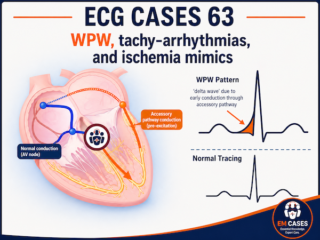
Ep 216 Cardiac Arrest Update: Beyond the 2025 ACLS Guidelines Part 2 – Medications, Airway, Termination and Post-ROSC Care

In this Part 2 or our 2-part EM Cases podcast series on Cardiac Arrest Update, Dr. Sheldon Cheskes and Dr. Rob Simard take us beyond the algorithms and into the real-world decision-making of cardiac arrest care. We answer questions like: Do vasopressin and steroids improve survival or just ROSC? Should we be giving amiodarone earlier—and is lidocaine just as good? When should we use calcium, bicarbonate, or magnesium, and when should we avoid them? What role does ketamine play in CPR-induced consciousness? How should we choose between supraglottic airways and endotracheal intubation? What are the pitfalls of waveform capnography (ETCO2) to help guide CPR quality, detect ROSC, and inform prognosis? What is the role of PoCUS and TEE during cardiac arrest? When should we terminate resuscitation—and how do ETCO2 and POCUS factor into that decision? Should we widen the criteria to consider thrombolytics and who should go to the cath lab, and should we be ordering whole-body CT after ROSC for everyone who isn't going to the cath lab or getting ECMO? And finally, what are the key post-ROSC targets that actually impact neurologic outcomes in cardiac arrest patients? and many more...Please consider a donation to EM Cases to support ongoing high quality Free Open Access Medical Education https://emergencymedicinecases.com/donation/
ECG Cases 61 ACLS Dysrhythmia Pitfalls Part 4: Stable Wide Complex Tachycardia

In this month's ECG Cases Dr. Jess McLaren explains how to differentiate various causes and mimics of Wide Complex Tachyardia: Artifact can mimic wide complex tachycardia, but have unaffected leads recorded at the same time, and regular narrow QRS complexes marching through the noise. Too wide or not fast enough? Consider hyperkalemia (empiric calcium) or sodium channel toxicity (empiric sodium bicarbonate). Regular wide complex tachycardia driven by P waves? Treat the secondary cause of sinus tachycardia. VT vs SVT? If the wide complex tachycardia is regular and not driven by P waves, and the differential is VT vs SVT, assume VT regardless of age or hemodynamic instability (eg fascicular VT in young patients) and much more...Please consider a donation to help ensure we continue to provide high quality Free Open Access Medical Education here: https://emergencymedicinecases.com/donation/
Ep 215 Cardiac Arrest Update: Beyond the 2025 Guidelines Part 1: CPR, Defibrillation and Ventilation

In this EM Cases update on cardiac arrest management, Dr. Sheldon Cheskes and Dr. Rob Simard join Anton to walk us through the evolving science and bedside practicalities of cardiac arrest management in the wake of the 2025 ACLS Guidelines. They answer questions such as: What are the most common failures in CPR quality, and how can we recognize and correct them in real time? Should we employ head up CPR, and if so how? How should we interpret ETCO₂ during cardiac arrest, and why shouldn’t we chase a single number? How can we minimize peri-shock pauses and optimize defibrillation success at the bedside? Is the traditional two-minute CPR cycle too rigid, and should we be shocking earlier in cases of refibrillation? What is the evidence behind dual sequential external defibrillation (DSED), and when should we use it? After 3 shocks or earlier? How does hyperventilation during cardiac arrest harm patients, and what strategies can reliably prevent it? What is compression-adjusted ventilation (CAV), and how can it improve ventilation consistency during resuscitation? What is the optimal dose of epinephrine in patient with Ventricular Fibrillation? and many more... Please donate to EM Cases to ensure ongoing Free Open Access Medical Education here: https://emergencymedicinecases.com/donation/ This is a deep dive into the critical inflection points in resuscitation where small changes in technique and decision-making may have the greatest impact on outcomes.
Ep 214 Bridging the Gap in Endometriosis Care: Recognition, Risk Stratification, and ED-Initiated Management

We walk you through what Emergency Physicians need to know to recognize, risk stratify, and manage endometriosis safely and pragmatically. We answer question such as: When should endometriosis rise to the top of the differential for pelvic pain? How do we distinguish an endometriosis flare from a  dangerous endometriosis complication? from Pelvic Inflammatory Disease? Why hemorrhagic cyst the most common misdiagnosis for endometriosis and how can we tell the difference between hemorrhagic cyst and endometrioma? Which hormonal therapy is safe, reasonable and effective to start in the ED? What are the most common life-threatening complications of endometriosis we should be on the lookout for in the ED? How do we discharge patients with suspected endometriosis safely and reduce repeat visits? and many more... Please consider a donation to EM Cases to ensure continued free open access medical education here: https://emergencymedicinecases.com/donation/
Ep 213 Update in Management of Status Epilepticus

Convulsive status epilepticus is one of the most morbid neurologic emergencies we manage in the ED, and outcomes depend far more on speed than drug selection. Like ventricular fibrillation, each minute of ongoing convulsions worsens hypoxia, acidosis, cardiovascular instability, and neuronal injury, while making seizures progressively harder to terminate. Modern definitions are intentionally time-compressed to force early, parallel, clock-anchored action. Any patient still convulsing when you reach the bedside should be treated as evolving status epilepticus. In this EM Cases podcast with Dr. Sara Gray, we take a practical, time-based approach to convulsive status epilepticus, focusing on early, adequately dosed benzodiazepines, avoiding common escalation and dosing pitfalls, anticipating post-ictal cardiovascular collapse, and knowing when to escalate to second-line agents, airway control, and anesthetic-dose therapy. We also address the transition to non-convulsive status epilepticus and how to recognize ongoing seizures when EEG is not immediately available. We answer questions such as: Why does time to first benzodiazepine matter more than the drug or route? What critical actions should occur in parallel with the first dose? What are 3 key actions to do in parallel with the first benzodiazepine? Why is underdosing second-line antiseizure medications—especially levetiracetam—a common and dangerous pitfall? When should persistent seizures trigger intubation and anesthetic-dose therapy? How can we identify non-convulsive status epilepticus once tonic-clonic activity stops? And many more (we also include a high yield status epilepticus management algorithm in the show notes!)... If you find EM Cases helpful in your clinical practice, please consider supporting our work so we can continue producing free, high-quality emergency medicine education for clinicians around the world. Make a donation here: https://emergencymedicinecases.com/donation/
ECG Cases 60 – ACLS arrhythmia pitfalls, part 3: unstable tachycardia, cardiovert?

This is the third in a series of blog posts on the pitfalls of ACLS algorithms for adults with a pulse, and how a systematic approach to 12-lead ECG can help with ECG acquisition, interpretation, and application. The first looked at unstable bradycardia, the second stable bradycardia, and this one will look at unstable tachycardia. The ACLS algorithm for unstable tachyarrhythmia is simple: immediate cardioversion. This works well if it is a primary tachyarrythmia that is causing the instability (eg SVT or VT), but there are a number of pitfalls in this assumption. ECG acquisition: is it actually a tachy-arrhythmias? Artifact can mimic a tachy-arrhythmia. This can be identified by unaffected leads recorded at the same time, and narrow QRS complexes marching through the noise ECG interpretation: is the tachy-arrhythmia a primary electrical problem? There are other tachycardias in unstable patients that may fail to respond to cardioversion: AF (irregularly irregular rhythm), where the patient’s instability may be related to a secondary cause Sinus tachycardia (in response to a secondary cause): can best be identified by upright P waves in II and biphasic P waves in V1. ECG application: Is the rhythm causing the instability, or is there a secondary cause – including one that might be revealed by the 12-lead, like hyperkalemia or occlusion MI? For live and highly interactive ECG courses to elevate your skills - including online courses, or an in-person pre-conference course at CAEP, go to www.heartsECGcourse.com

Ep 212 PECARN Febrile Young Infant Prediction Tool: When To Safely Forgo LP and Empiric Antibiotics

If you’ve been practicing EM for more than a decade, your approach to the febrile young infant has (appropriately) evolved. For years, the default was LP + empiric antibiotics + admission for almost everyone. That approach prevented missing meningitis, but at the cost of a lot of harm: invasive testing, unnecessary antibiotics, and hospitalization-related complications. The modern approach is a paradigm shift toward risk stratification, biomarkers, and shared decision-making, while still respecting one immutable truth: Missing neonatal bacterial meningitis can be catastrophic. This episode revisits the framework from a prior EM Cases episode and updates it with a landmark study that directly informs how far we can safely go—especially in the 0–28 day group, with the father of multiple well-known PECARN rules Dr. Nathan Kuppermann and lead author Dr. Brett Burstein...

Top 10 Best of EM Cases 2025

As we close the chapter on 2025, I want to extend a heartfelt thank you to the EM Cases community—our listeners and readers around the world—whose engagement, feedback, and trust continue to shape how we teach and learn Emergency Medicine. None of this would be possible without the extraordinary efforts of our podcast guest experts, the EM Cases content and production team, our partners at SREMI, our advisory board, the University of Toronto, and those who support us through donations and attending the EM Cases Summit. What follows is the Best of EM Cases 2025: a curated collection of the highest-impact emergency medicine education from the past year, chosen by learner engagement, feedback, and a few personal favorites...

Donate Subscribe
Go to Top