

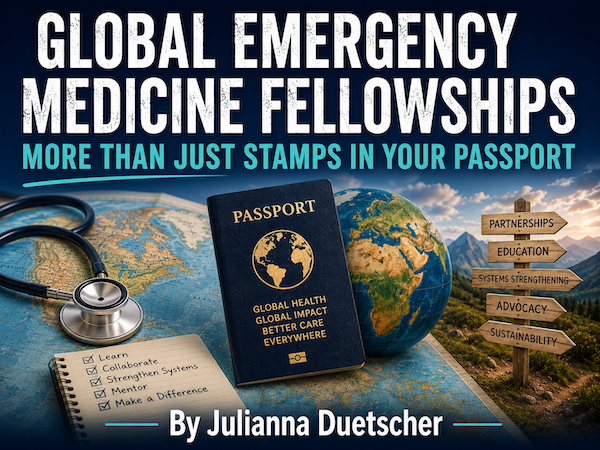
Written by Julianna Deutscher, edited by Navpreet Sahsi, Jodie Pritchard and Susan Bartels
If you’ve found yourself here, it means that at some point you’ve wondered what it might look like to broaden your emergency medicine career beyond your local ED. I’m here to guide you through what it means to complete a Global Emergency Medicine (GEM) fellowship. My name is Julianna, a staff emergency physician in Calgary and 2024 graduate of the Queen’s University GEM Fellowship. Since completing the fellowship, my global health work has focused on mentoring a team of physicians in the Republic of Moldova for the implementation of a trauma team program as a WHO consultant and continuing to contribute to emergency medicine teaching through the Toronto Addis Ababa Academic Collaboration in Ethiopia. In this post, I’ll share the factors I considered when choosing to spend two years as a GEM fellow and what the experience looked like for me.
So…what is global emergency medicine, anyway?
And No, it’s not just humanitarian work
A textbook would describe global emergency medicine as a sub-specialty exploring the intersection of public health and emergency care with a goal of reducing health inequities worldwide. GEM encompasses humanitarian work, medical education, systems strengthening, research, advocacy, policy making, and capacity building. For a deeper dive into this question, check out previous episodes from the EM Cases GEM Blog. A common misconception is that all global EM work is humanitarian medicine. While humanitarian work is an important pillar of GEM, you could spend an entire career in global emergency medicine without ever deploying to a disaster zone.
Humanitarian medicine is what happens in the setting of conflict, disaster, or displacement—it is, by definition, crisis response. Global health is what was happening before the crisis, what will happen after, and the long road in between. Humanitarian medicine is running toward the fire. Global health is figuring out why it was burning in the first place. What appealed to me personally about a GEM fellowship was the opportunity to push beyond my comfort zone while having mentors guide me through the process. I wanted to learn how to build partnerships responsibly, understand safety planning in field work, and develop resilience in unpredictable environments.
Global Emergency Medicine (GEM) doesn’t always need a boarding pass
And you don’t even have to own cargo pants
Importantly, not all GEM happens abroad. As Dr. Arjun Sithamparapillai pointed out in Episode 8, there is plenty of “global health” to be done in your own backyard. I use lessons learned from my fellowship daily on shifts in Calgary—whether it’s recognizing tropical disease presentations, understanding the health challenges faced by migrants and refugees, or appreciating how social determinants shape the health of our patients. More than ever, global is happening in your local ED. In an era of increasing attention to carbon footprints, shrinking global health funding, and near-universal internet access, GEM is increasingly happening remotely. Contributing to WHO guidelines, facilitating simulation sessions online, or mentoring EM trainees across the globe can all happen from your kitchen table. You can do GEM without ever owning cargo pants and hiking shoes. (Although many of us do love a good hike.)
What is the fellowship?
Choosing your own adventure, but with mentorship
Most GEM fellowships follow a “choose-your-own adventure” model. While structures vary, fellowships typically combine clinical work (both locally and internationally) with GEM training courses, medical education partnerships, research, advocacy, or system-based projects. Fellowships typically range between one to two years. Depending on the structure of your residency program, there may be options to begin fellowship training during residency, while others are completed post-residency. Two-year fellowships often require completion of a master’s degree—more on that later. For me, I completed the first year of the fellowship during my final year of emergency medicine residency.
Some fellowships have done the hard work of building long-standing partnerships, allowing fellows to engage in these sustainable programs for their field work. For example, the University of Toronto often sends fellows to Liberia on a two-month placement with Partners in Health. Dr. Amanda Collier, inaugural GEM fellow at Queen’s University, established a teaching collaboration with Haramaya University in eastern Ethiopia and the University of Toronto continues to sustain a 15+ year partnership with Addis Ababa University. These longitudinal partnerships matter. They promote continuity and bidirectional learning. They also help to reduce the risk of field work that benefits the visitor more than the host.
No two fellowships, and no two fellows, look the same
For proof, look at the alumni
Even within the same fellowship program, no two fellowships look alike. Take a look at past fellows of the Brigham and Women’s Hospital GEM Fellowship. Dr. Susan Bartels, now Program Director of the Queen’s University GEM Fellowship, focused much of her fellowship and subsequent career on gender-based violence prevention and migration health. Dr. Hiren Patel, now co-director of the University of Toronto GEM Fellowship, directed his early global health work toward trauma and humanitarian medicine. Some fellows even hybridize their training. Dr. Tia Warkentin is completing both GEM and POCUS fellowships—two areas that pair perfectly for global medical education and capacity building.
During my fellowship, I expanded my human trafficking prevention work beyond Canada and developed a second niche in trauma. Even before medical school I had been involved in human trafficking awareness initiatives in Canada, but the fellowship allowed me to explore the issue from a global perspective, particularly prevention and response for migrants and refugees. Alongside my emergency medicine shifts in Kingston, I worked as a trauma team leader in Toronto and spent a month on the trauma unit in Cape Town, South Africa. These clinical experience later translated into systems strengthening work when I was invited to lead the implementation of a trauma team program in the Republic of Moldova. The beauty of GEM fellowships is that they allow you to build your own niche (or with many of us, niches).
Building your global ‘street cred’
Networking is the main event
Networking isn’t a side benefit of doing a GEM fellowship- it’s the main event. Your GEM colleagues become your sounding board, your reality check, and occasionally your lifeline. These are the people you turn to when deciding which projects to take on, how to navigate unfamiliar situations, or how to survive the reverse culture shock that can follow time abroad (check out Episode 9 with Dr. Navpreet Sahsi). GEM is a small world, and much of it runs on word of mouth. That’s how it worked for me. Another Queen’s GEM alum, Dr. Jodie Pritchard, was working on a project with WHO in the Republic of Moldova. When the team identified the need for a trauma expert, she put my name forward. A few weeks later, I was on a flight to Chisinau.
GEM can get expensive— again, more on this later. Your GEM peers can help guide you on which of the endless list of available courses are worth your time and money. While the knowledge from courses was valuable, the communities are priceless. You know you’ve done GEM right when you have multiple WhatsApp and Telegram group chats with friends on six continents (and if you’ve got all seven, then even more impressive). These are the people I continue to turn to for a quick debrief, advice, collaboration, and of course for local intel on the best places to eat when travelling abroad.
To MPH or not to MPH
Learning to love epidemiology
Many fellowships require completion of a master’s, often facilitated through academic partnerships as part of the program. The most common is an MPH, though other options include med ed, global health, policy, or health systems. I admittedly did not fully understand what an MPH offered until I was in it. It provides a shared language with public health professionals and policymakers, and possibly most importantly, provides you with the tools to evaluate whether your work is actually making a difference. An MPH comes at a cost: time, tuition, and a renewed appreciation for the epidemiology you may have hoped to leave behind. For many, however, the MPH becomes one of the most practically useful tools from the fellowship.
Let’s talk about the money
Not the point of the fellowship, but still relevant
A GEM fellowship is not going to pay the same as your colleagues entering their first year of full-time practice, but it also doesn’t have to be pure volunteerism. Depending on the program, fellows may receive stipends, tuition support, or access to travel grants. Some are paid on a resident or fellow salary and others may be billing staff EM shifts just like their colleagues. While finances shouldn’t be the primary motivation, they are an important part of planning a sustainable career in GEM.
Scheduling flexibility
A rare career window
One of the most underappreciated benefits of a GEM fellowship is scheduling flexibility. Many fellows work part-time clinically, allowing blocks of protected time for travel, research, education, and project work. Early in your career, this can be a rare opportunity to step down from the full-time clinical load while still building skills and experiences that will strengthen your long-term practice.
Why a GEM fellowship makes you a better emergency doctor everywhere
Yes, even at home
The skills gained through GEM training translate directly back to high-resource settings. Resource stewardship, comfort with diagnostic uncertainty, troubleshooting equipment failures, and systems thinking are universal EM skills. After my time working with residents in Ethiopia, I observed how procedures can be done safely and successfully with half the amount of equipment or adapting materials to serve a different purpose. GEM fellows excel in caring for underserved populations, thrive in rural communities, and bring new perspectives to their home departments on how to strengthen our own fragile systems.
So is this GEM fellowship for you?
A quick reality check
A GEM fellowship isn’t for everyone. You need to be comfortable with last-minute pivots, slow-moving projects, and plans that fall through. I remember a night shift during my second year of fellowship when I received a message that my flight had been cancelled—the flight I needed in order to catch my connection to Uganda. Just the day before, I had been anxiously waiting for my passport to arrive back from the Embassy of the Democratic Republic of Congo after withdrawing a visa application that had been submitted weeks prior. Now passport in hand, I was suddenly scrambling to piece together a new route to Kampala.
After what felt like a game of trains, planes, and automobiles, I eventually landed in Uganda. My luggage didn’t make it. I woke up my Airbnb host in the middle of the night, slept for a few hours, and walked to the university compound the next morning. And yet, what could have been a miserable, exhausted morning left me feeling renewed. One of the side effects of global health work is that you slowly start to accumulate many places that feel like home. During my fellowship, there were moments when a colourful, bustling neighbourhood halfway across the world felt more familiar than my own bed back in Canada.
GEM also means online meetings after night shifts to accommodate time zones, last-minute shift trades when travel plans change or crisis deployments arise, and often explaining to family and friends why you’re flying halfway across the world yet again. You also need to be comfortable showing up and sometimes feeling like you’re doing nothing at all. That’s exactly how I felt the first time I rounded with the residents at Tikur Anbessa Specialized Hospital in Addis Ababa. After each patient, they would turn to me for final comments on the management plan. What could I possibly add to their already thoughtful discussions? But with time, you find your place and begin to see the impact that can happen on both sides. In Addis, that often meant supervising POCUS scans—and suddenly “sweep, sweep, sweep!” wasn’t just a Canadian curling reference.
Finally, on more serious note, healthcare workers are increasingly at risk, especially those working in areas of conflict. Understanding where your own comfort zone ends within the spectrum of global field work is not always straightforward—and it’s something I’m still figuring out. While I haven’t taken on placements that I would personally consider high-risk, I recognize that for someone else they may have been far beyond their own limits. And those limits aren’t fixed; they will shift over time as our lives evolve.
Embracing the detour in a GEM fellowship
The passport stamps fade, the people don’t
If you’re curious about education and capacity building—and not just sick patients or tropical infections—you’ll likely find GEM deeply rewarding. And while it’s fun to sneak in the little side excursions along the way, loving travel is not the driving factor to do GEM. GEM fellowships don’t narrow your career; they make it limitless. The skills last far beyond the fellowship. You don’t just join a program—you join a community. The passport stamps fade, but the people you meet, the perspectives you gain, and the emergency doctor that you become is something that will stay with you forever.

Leave A Comment