

Topics in this EM Quick Hits podcast
Amal Mattu on non-obstructive and non-thrombotic causes of ACS (0:54)
Andrew Tagg on diagnosing and treating threadworms (i.e. pinworms) (35:40)
Justin Morgenstern on NPO status in the ED (39:28)
Hans Rosenberg on approach to vaso-occlusive crisis in sickle cell disease (51:47)
Sara Gray & Katie Lin on coaching the EM mind part 4: imposter syndrome and shame (59:35)
Podcast: Play in new window | Download (Duration: 1:32:24 — 84.7MB)
Subscribe: Apple Podcasts
Podcast production, editing and sound design by Anton Helman
Podcast content, written summary & blog post by Sara Brade, edited by Anton Helman, November, 2026
Cite this podcast as: Helman, A. Mattu, A. Tagg, A. Morgenstern J. Rosenberg, H. Gray, S. Lin, K. EM Quick Hits 74 – Non-obstructive ACS, Threadworms, NPO Guidelines, Sickle Cell Disease, Coaching the EM Mind Part 4. Emergency Medicine Cases. November, 2026. https://emergencymedicinecases.com/em-quick-hits-74-nov-2026. Accessed November 10, 2026.
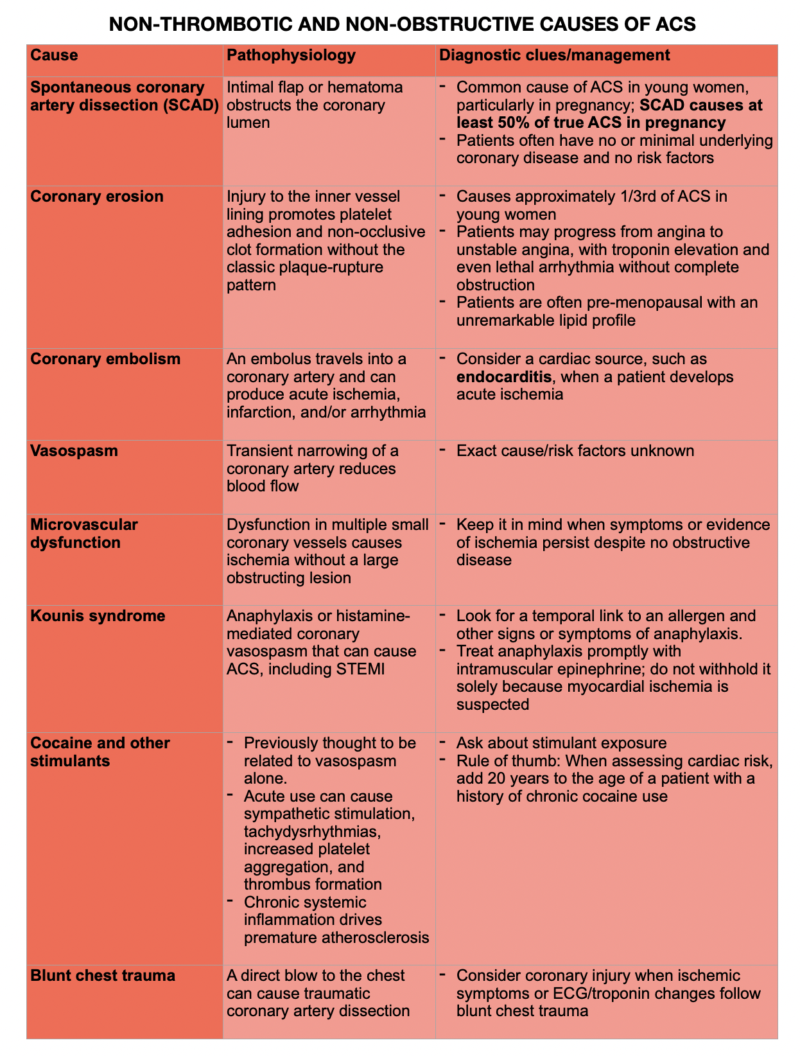
Non-thrombotic and non-obstructive causes of acute coronary syndrome (ACS)
Two categories of myocardial infarction (MI) with non-obstructive coronary arteries:
- Thrombotic but non-obstructive: MI in the setting of non-obstructive coronary artery plaque. Early plaques grow outward into the vessel wall (coronary remodelling), sparing the lumen. Patients can have significant coronary disease yet be asymptomatic. When these plaques rupture, they rupture into the lumen and can cause a STEMI, unstable angina or sudden death.
- Non-thrombotic and non-obstructive: the coronary is compromised by something other than thrombus (see table below). Non-thrombotic and non-obstructive causes of ACS often occur in younger patients, especially women, with no or few traditional risk factors for cardiovascular disease, and ECG findings may be subtle.
Thrombotic but non-obstructive MI: why a prior negative stress test, angiogram or “mild” coronary disease may not rule out ACS
- A completely normal recent cardiac catheterization is reassuring, but <50% lesions or “luminal irregularities” are still concerning in acute chest pain as two thirds of MIs occur from plaques <50% obstructive prior to the MI.
- Non-obstructive lesions can be asymptomatic with negative stress testing, so a recent negative stress test does not rule out ACS in the ED.
- Stress tests may lead to over-diagnosis, over-treatment, false reassurance, and missed diagnoses.
EM Cases Journal Jam on Evidence for Cardiac Stress Testing
Comparing coronary imaging modalities
- Coronary angiography remains the gold standard; allows for intervention at the time of diagnosis, but has it’s limitations as described above.
- Coronary CTA (CCTA) technology is advancing rapidly and may eventually visualize outward-bulging wall plaque and smaller branch vessels that angiography and older CCTA miss.
- CCTA is used in some acute chest pain protocols, particularly in the US, to further risk stratify intermediate-risk patients.
- It is not generally used in acute settings in Canada.
- American guidelines include CCTA as an alternative to stress testing.
- Use CCTA only in intermediate-risk patients (i.e. HEART score 4-6).
- In low-risk patients it leads to over-investigation/over-diagnosis; in high-risk patients, the results do not change management and may provide false reassurance.
- Optical coherence tomography (OCT) and intravascular ultrasound are non-interventional research tools used to investigate coronary remodelling, and may hold promise in the future.
Bottom line: Do not dismiss an HPI concerning for ACS (i.e. typical chest pain, worrisome associated symptoms) because a patient is young or lacks traditional risk factors. Consider non-obstructive causes of ACS.
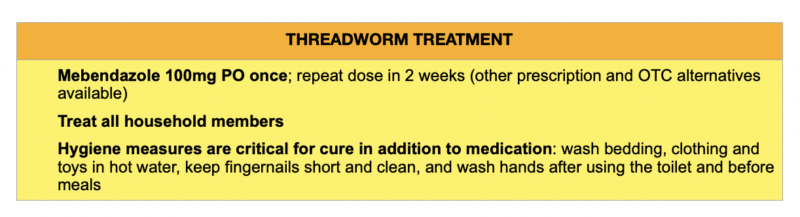
How to diagnose and treat threadworms (i.e. pinworms) in the ED
- Threadworms/pinworms are tiny intestinal parasites that mostly affect school-age children.
- Worms lay eggs around the anus at night, causing the classic nocturnal perianal itching, irritability and poor sleep.
- Girls may develop vulvovaginitis from worm migration.
- Eggs survive up to two weeks outside the body and spread via skin contact or contaminated bedding, toys and toothbrushes; outbreaks happen quickly in school and childcare settings.
- Auto-infection sustains the cycle: the child scratches, collects eggs under the fingernails and the child re-ingests them.
- Diagnosis is usually clinical. Parents may see tiny white threads at night around the anus, or you can use the “sticky tape test” across the anus.
- Threadworms are common and are not a reflection of hygiene or parenting.
Overuse of NPO status in the ED: why most ED patients should be encouraged to eat and drink 

NPO status in the ED is rarely indicated, since few patients go to the OR the same day and baseline aspiration risk is very low (about 1 in 10,000), yet most ED patients are made NPO by default and subjected to the harms of fasting.
Summary of the evidence: more liberal PO liquid administration preoperatively does not increase aspiration risk
- Physiology: Liquids leave the stomach quickly, and drinking water speeds gastric emptying.
- Procedural sedation: ACEP advises not delaying procedural sedation due to fasting time citing robust evidence showing no association between fasting time and adverse events.
- Operating room data:
- A Cochrane review found no difference in gastric volume, pH or aspiration risk between a shortened (2 hour) fluid fast and a standard fast.
- “Sip til send” (clear fluids until called to the OR) has been studied in tens of thousands of patients, with fasting times as short as a median of 17 minutes and no increase in aspiration.
- A large Dutch quality improvement study (76 451 patients across multiple sites) liberalized clear fluids until arrival in the OR and found no difference in regurgitation or aspiration.
- Fasting causes harm, even in surgical patients:
- longer fluid fasting is associated with perioperative hypotension, acute kidney injury, insulin resistance, delirium, nausea and vomiting, surgical complications and longer hospital stay, with some studies suggesting more infections and higher mortality.
- The evidence gap: nearly all the data are about liquids.
- Minimal evidence regarding solid food intake and aspiration risk.
- Aspiration of solids is potentially more harmful than fluids.
- Consider common sense principles: avoid large meals but light snacks in the ED are likely acceptable for most patients.
Anesthesia guidelines support clear fluids until 2 hours prior to surgery
- American Society of Anesthesiologists: clear fluids until 2 hours before surgery and a light meal up to 6 hours before elective surgery under general anesthesia.
- European Society of Anaesthesiology: encourage clear fluids until 2 hours before elective surgery; 6 hours for solids.
- Canadian Anesthesiologists’ Society: encourage adults to drink clear fluids until 2 hours and children until 1 hour before elective surgery.
- Until surgery has been consulted and the patient is scheduled for OR, almost all ED patients should be encouraged to eat and drink, and after that, the order should be “clear fluids until 2 hours prior to OR” rather than “NPO at midnight”.
- One ED that moved from “NPO at midnight” to following the ASA guidelines (solids until 6 hours and clear fluids until 2 hours before surgery) reported no adverse outcomes, less nursing frustration, fewer thirst and hunger complaints, better glucose control and fewer phone calls.
How to change practice in your ED: encouraging our patients to eat and drink
- Adopt a departmental policy: everyone eats and drinks unless there is a specific physician order to the contrary. Consider starting with a clear fluid policy only.
- Encourage, do not just allow: place easily accessible water dispensers in waiting rooms, offer healthy and affordable food, and use signage encouraging patients to look after their basic needs.
- Collaborate with anesthesia and surgery colleagues, who are already guided by the recommendation to encourage clear fluids until 1-2 hours before surgery.
Bottom line: Starving patients “just in case” causes clear harm with no clear benefit. All ED patients should eat and drink unless there is a clear order to the contrary.
CJEM Just the Facts: Emergency department approach to vaso-occlusive episodes in sickle cell disease
Sickle cell disease is a complex systemic vascular disorder. Vaso-occlusive episodes are the hallmark of the disease and result from an interplay of hemolysis, inflammation and endothelial dysfunction.
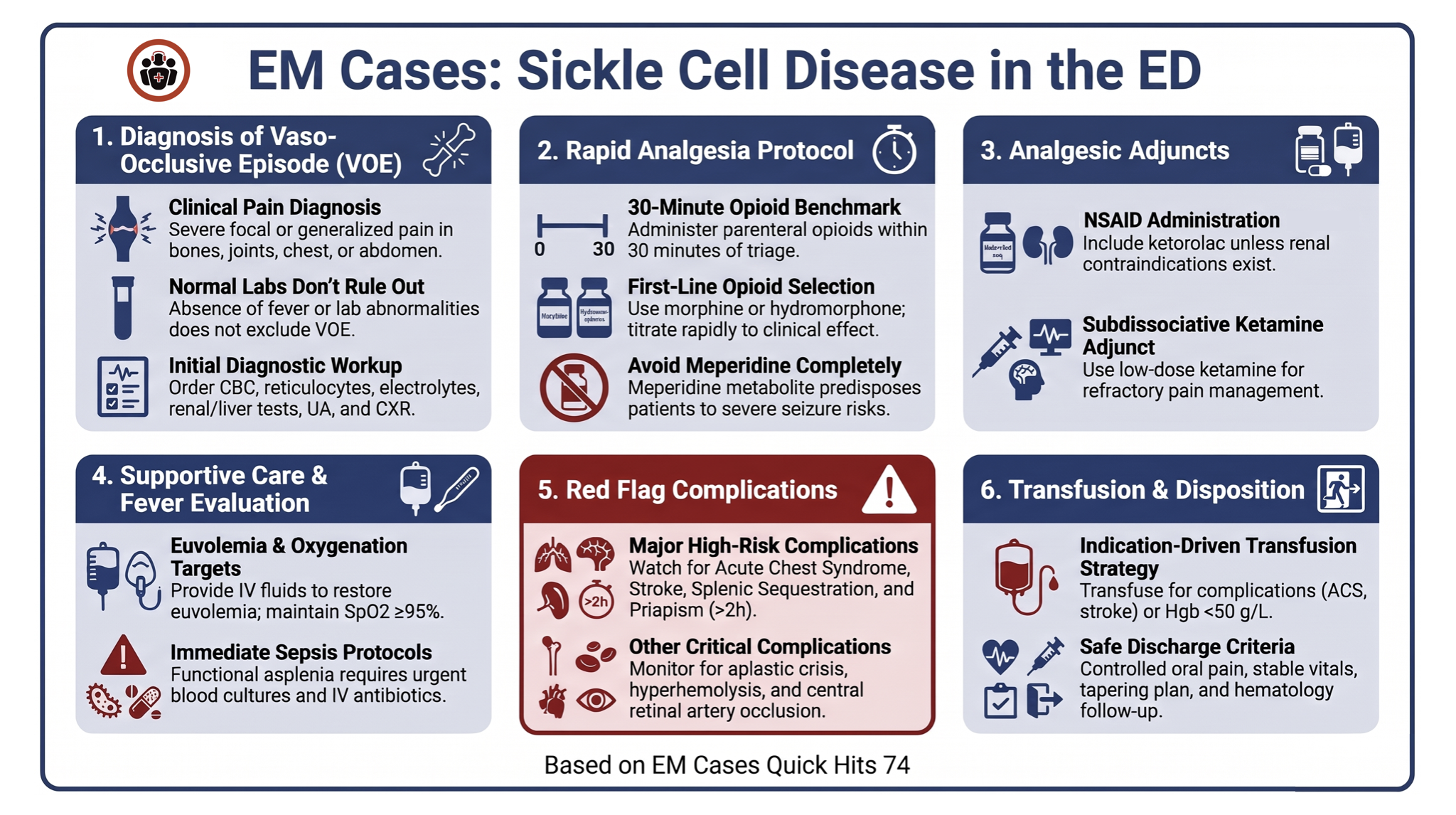
Treat pain early in vaso-occlusive episodes; do not wait for investigations
- Patients present with severe focal or generalized pain; precipitants include infection, dehydration, hypoxia, acidosis, cold and stress.
- International standards recommend parenteral opioid administration within 30 minutes of triage.
- A Canadian audit found only 5% compliance with the 30-minute benchmark and a median delay of almost 90 minutes; order sets and nurse-initiated dosing protocols markedly improved timeliness.
- Avoid meperidine: metabolite predisposes to seizures, particularly in renal impairment.
- Adjuncts: NSAIDs such as ketorolac if there is no renal contraindication; ketamine or regional anesthesia for refractory pain.
- Give IV fluids to restore euvolemia if volume depleted only (avoid overhydration) and supplemental oxygen to keep SpO2 ≥95%, since hypoxia drives HbS polymerization.
The diagnosis is clinical: there is no single investigation to diagnose a vaso-occlusive episode
Absence of fever or lab abnormalities does not exclude a vaso-occlusive episode; however, most patients should receive investigations including:
- CBC, reticulocytes, electrolytes, renal and liver function tests and urinalysis
- Blood cultures, especially if febrile
- ABG or VBG if hypoxic or in respiratory distress
- Chest X-ray for most patients, especially with fever or respiratory symptoms
- Advanced imaging as guided by the clinical picture (stroke, splenic or hepatic infarction, osteomyelitis, pulmonary embolism)
Fever in sickle cell disease: functional asplenia means increased sepsis risk
- Sepsis evaluation is mandatory for any patient with fever or signs of infection, including blood cultures and chest X-ray.
- Give prompt broad-spectrum IV antibiotics if there is no clear focus (for example, ceftriaxone or cefotaxime, with vancomycin added if severe), covering encapsulated organisms.
Assess for complications in sickle cell patients presenting with vaso-occlusive episodes
- Acute chest syndrome (ACS): new pulmonary infiltrate on imaging with fever, cough, dyspnea, chest pain or hypoxia. It is a leading cause of mortality in sickle cell patients
- Maintain SpO2 ≥95%
- Broad-spectrum antibiotics including coverage for atypical organisms
- Bronchodilators
- Incentive spirometry if indicated
- Consider simple or exchange transfusion in severe cases
- Stroke: any acute neurologic deficit or altered mental status.
- Needs urgent exchange transfusion to reduce HbS to <30% (with hematology and neurology involvement); thrombolysis in select cases.
- Splenic sequestration: LUQ pain or fullness, a sudden drop in hemoglobin of ≥30 g/L from baseline.
- Splenic sequestration is a surgical emergency.
- Priapism: if it lasts longer than 2 hours, consider corporal aspiration/irrigation with intracorporeal epinephrine;
- Involve urology if there is no response or the episode exceeds 4 hours.
- Involve hematology to assess for exchange transfusion.
- Other complications include: aplastic crisis, hyperhemolysis, and central retinal artery occlusion.
Obtain expert consultation in the ED regarding transfusion decisions in vaso-occlusive episodes
- Transfusion decisions should not be based on a hemoglobin threshold alone, should involve early hematology consultation, and are generally reserved for complications:
- Severe or symptomatic anemia (Hgb <50 g/L)
- Acute chest syndrome
- Stroke
- Weigh the benefits against the risks of alloimmunization and hyperhemolysis.
Disposition in vaso-occlusive episodes: when to admit and when to discharge
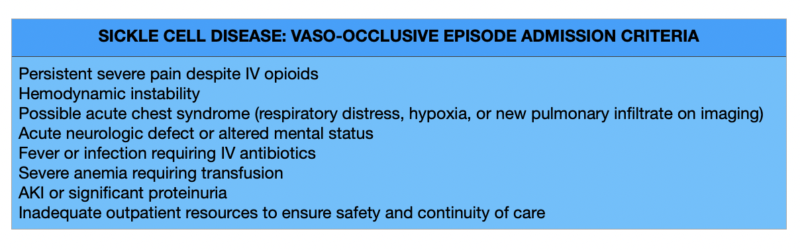
- Discharge is reasonable when pain is controlled on oral analgesics, vitals are stable, the patient can hydrate and has reliable follow-up. Pain can persist for days to weeks, so provide enough oral opioids and NSAIDs with clear tapering instructions, written return precautions and hematology follow-up.
Implicit bias and systemic racism harms patients with sickle cell disease
- Implicit bias, structural racism and the “drug-seeking” stereotype contribute to delayed analgesia, health care disparities and poor outcomes.
- Many patients delay coming to the ED because they expect stigma.
- Standardized pain order sets, nurse-initiated protocols, patient-specific protocols and educational interventions improve outcomes.
Bottom line: Prioritize rapid analgesia in vaso-occlusive episodes, and evaluate sickle cell patients in the ED for complications like acute chest syndrome, sepsis, stroke, splenic sequestration, and priapism.
EM Cases Main Episode Podcast on Sickle Cell Disease
Coaching the EM Mind Part 4: imposter syndrome and shame
Bad cases, perceived mistakes, or failures in the workplace can lead to self-doubt, imposter syndrome, and shame. This is common amongst ED physicians. Learning how to manage these experiences is essential to well-being for frontline healthcare professionals.
- Imposter syndrome: doubting your abilities and fearing exposure as a fraud despite adequate external evidence of success.
- More common in high achievers, perfectionists and underrepresented groups.
- Associated with self-doubt, perfectionism, depression and burnout.
- Shame: the painful belief that we are flawed or unworthy, often triggered by a real or perceived mistake.
- Shame is the emotion that commonly travels with imposter syndrome.
Strategies to counter imposter syndrome for ED physicians
- Prepare: studying, training and practicing improves confidence and decreases feelings of imposter syndrome.
- Counter the negativity bias: we often focus on mistakes/perceived failures.
- Purposely recalling successes can help counter this. For example, keep a list of compliments from colleagues/patients, or name one thing you did well after each shift.
- Practice assertive communication: speak up in meetings and offer your opinion; consider apologizing less, since excess apologies can undercut your own authority.
- Talk to your failure friends: identify safe and supportive friends, colleagues, or mentors who can talk through your experiences of real or perceived failure.
- Choose someone kind, discreet and familiar with your context.
- Start with a small issue and build trust gradually, and agree explicitly on the arrangement: “I need a failure friend. Can we talk about this case?”
- Tell them what you need: to vent, strategies, or reassurance and validation.
The shame spiral: how to recognize when we are amplifying shame
- Thoughts: self-criticism and “what if” thinking, and personalizing the mistake (“I am a terrible doctor” rather than “I made a mistake anyone could make”).
- Emotions: worthlessness, hopelessness, withdrawing from others.
- Body: racing heart, poor sleep, muscle tension.
Strategies to exit the shame spiral and practice self-compassion
- Call your failure friend to debrief. If you do not have one, turn to a therapist, mentor, work leader or faith leader.
- Learn about shame and the intersection of shame and healthcare research (e.g. the work of Brené Brown; selfcompassion.org)
Pitfalls to avoid when managing imposter syndrome and feelings of shame as a healthcare worker
- Staying silent perpetuates the shame spiral.
- Avoiding, denying or repressing the feelings of shame can lead to use of unhealthy coping mechanisms like substance use.
- Opening up to the wrong person who breaks confidentiality or shames you further.
Recovery from shame/imposter syndrome and returning to practice after a negative experience in the ED
- Expect the emotional reaction to trigger events and name the feelings.
- When you notice the self-critical phase, start positive self-talk and other strategies above to counter shame/imposter syndrome.
- Rebuild from the bottom of Maslow’s pyramid: be intentional about sleep, exercise, nutrition, time with loved ones and scheduling, then talk to your failure friends, and aim for acceptance, where you can look at the case objectively, learn from it, perhaps teach it or discuss it at M&M rounds.
- Cultivate a growth mindset (see work from Dr. Carol Dweck) that sees mistakes as opportunities to learn; a fixed mindset says “I’m either good at this or I’m not.” Stress and shame push us toward a fixed mindset.
- Cultivate positive self-talk: recognize your inner critic, then replace its message with a supportive phrase (“I’m trying my best,” “I am okay”) or a phrase of common humanity (“Everybody has made a mistake”).
System-level strategies for teams and leaders to build self-esteem and positive self-talk amongst team members in the ED
- Annual awards tied to group values and “Awesome and Amazing” rounds that celebrate what went well, alongside M&M rounds.
- Growth mindset workshops.
- Leaders who sponsor and mentor underrepresented voices.
- Build a culture where mistakes can be discussed and strengths celebrated, role modelled from the top down.
None of the authors have any conflicts of interest to declare



Leave A Comment