

Strategies for EM providers to enhance their performance on shift while living a healthy life outside the ED
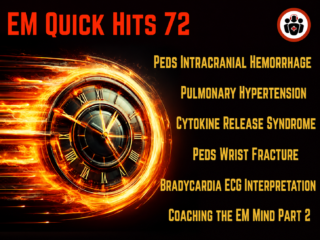
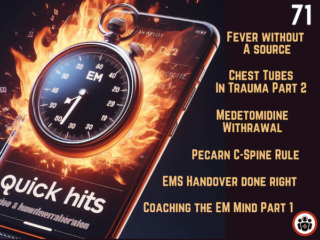
EM Quick Hits 71 EMC²: Fever Without a Source, Coaching the EM Mind Part 1, Traumatic Pneumothorax Part 2, PECARN C-spine Rule, Medetomidine Withdrawal, EMS Handover

In this month's EM Quick Hits Podcast we introduce not one, but two new series! First, "EMC²" - EM Cases Cases (we know, horrible name ;) where Anton or Katie discuss a knowledge building case with a special guest. And second, "Coaching the EM Mind" with Dr. Sara Gray a professional coach for EM providers, where Katie discusses with her the science and best expert advice on how to perform your best in the ED. Plus, a withdrawal syndrome that is new EDs, life-threatening and requires specific treatment - metetomadine withdrawal, EMS handover done right, why community ED docs should not use the PECARN C-spine Rule and Part 2 of Petro's tips on management of traumatic pneumothorax... Please consider a donation to ensure EM Cases continues to be Free Open Access here: https://emergencymedicinecases.com/donation/

Ep 207 Sleep Strategies for Shift Work

Discover evidence-based sleep strategies for shift workers. Optimize performance, recovery, and health with tips from sleep expert Dr. Michael Mak... If you find this beneficial please consider a donation to support EM Cases: https://emergencymedicinecases.com/donation/

Ep 205 Leading from the Inside Out: Building Teams, Trust and Purpose in Emergency Medicine

In this podcast, with Dr. Thom Mayer, Dr. Carolyn Snider and Dr. Howard Ovens, on leading from the inside out, we cover foundational principles, practical habits, and transformative insights that can make any member of an ED team a more effective, compassionate, and adaptive leader. Here, you’ll find tools, philosophy, and stories that just might transform how you think about your role in the ED to make your work more satisfying, make your teams work together better and improve patient outcomes... Please consider a donation to EM Cases to help ensure we continue to provide high quality Free Open Access medical education into the future https://emergencymedicinecases.com/donation/

EM Quick Hits 62 Optimizing RSI Medication Timing, ED Boarding of Older Patients, Prolonged Tourniquet Use, Rural Peer Support Programs, ECG Reciprocal Changes, Nutrition Tips for Shift Workers

On this month's EM Quick Hits podcast: Anand Swaminathan on optimizing RSI medication timing, Brittany Ellis on ED boarding challenges in older patients and solutions to ED crowding and flow, Dave Jerome on managing prolonged tourniquet application, Nour Khatib and Phil Gillick on a rural peer support case, Jesse McLaren on ECG reciprocal changes in acute coronary occlusion, and Melody Ng on practical nutrition tips for shift workers...

Ep 201 How EM Experts Think Part 2: Data Gathering, Diagnostic and Treatment Decision Making, Test Ordering and Interpretation, Documentation, Emotional Resilience

In this Part 2 of our 2-part podcast series on How EM Experts Think with Dr. Reuben Strayer, Dr. Mike Betzner and Dr. Scott Weingart we dive deep into the nuances of practicing smarter, faster, and better in the ED. We answer questions like: How should we employ hypothetico-deductive reasoning in our daily practice of Emergency Medicine? How can we best streamline thorough data gathering for each case so that we don't miss key data points? How do the master EM clinicians perform an efficient and targeted history and physical exam? How can the concept of heuristic cycling help you avoid outdated or faulty thinking? How can we document our clinical encounter in a way that considers a differential diagnosis that prioritizes dangerous conditions and improve our thinking around cases? How can we use the 2-10% rule for pre-test probabilities and the concept of preferred error to guide our decision making for tests and treatments in the ED? What strategies can we use to avoid anchoring bias and keep your mind open to all possibilities? What’s the role of shared decision-making when navigating diagnostic uncertainty? How does understanding the vigilance pendulum help us assess our risk tolerance better? How can post-shift decision journaling, conducting pre-mortems and meditation improve our decision making and boost our emotional resilience on shift? and many more...The accompanying blog An EM Expert Mindset - A Female Perspective is recommended reading with this podcast https://emergencymedicinecases.com/the-em-expert-mindset-a-female-perspective/ Please consider a small donation to EM Cases to ensure ongoing high quality FOAMed: https://emergencymedicinecases.com/donation/

The EM Expert Mindset – A Female Perspective

Dr. Patricia Lee is an EM physician in Calgary, Alberta and an Assistant Professor at the University of Calgary in the Department of Emergency Medicine. She reached out to me after listening to Episode 200 How EM Experts Think Part 1 as a longtime supporter of EM Cases, to highlight the importance of recognizing challenges that female-identifying EM physicians may face before, during and after ED shifts. She offers practical solutions to these challenges that may resonate with many EM Cases listeners...

Ep 200 How EM Experts Think: Strategies for Pre-Shift, Arrival Ritual, Staying Focused, Managing Interruptions, Cognitive Load & Negative Emotions, Resuscitation Mindset, Post-Resuscitation Recovery

Which elements of your current pre-shift preparation contribute most to your mental clarity and performance, and what new practices might further optimize your readiness? With interruptions shown to increase task errors and decision fatigue, how can you strike a balance between being approachable to colleagues and safeguarding your focus for patient care? When confronted with a particularly challenging or emotionally charged case, what strategies have you found most effective for maintaining professionalism and clear decision-making under pressure? How often do you debrief after high-stakes scenarios, and what impact has debriefing—whether formal or informal—had on your team’s learning, emotional recovery, and future preparedness? What strategies do you use to foster open communication and ensure all team members feel empowered to provide input during high-stakes situations? How do you mentally and emotionally shift from managing a critical resuscitation to treating lower-acuity patients without compromising your focus or energy? When faced with a complex case where diagnostic clarity is elusive, how do you prioritize your next steps while maintaining confidence in your decision-making process? How can apps, personalized workflows, or EMR tools be better utilized to minimize cognitive load and enhance clinical decision-making during shifts? These are just some of the questions we pose in this 2-part podcast series on How the Experts Think with Dr. Reuben Strayer, Dr. Scott Weingart and Dr. Mike Betzner...The accompanying blog An EM Expert Mindset - A Female Perspective is recommended reading with this podcast https://emergencymedicinecases.com/the-em-expert-mindset-a-female-perspective/ Please consider a donation to ensure EM Cases continues to provide you high quality Free Open Access Medical Education here: https://emergencymedicinecases.com/donation/
Ep 198 Understanding and Improving Culture in Emergency Medicine: Key Insights

In this EM Cases podcast Anton chats with Dr. Peter Brindley and Dr. Leon Byker who have a deep interest in the Culture of Medicine to explore what culture in medicine is, why culture is so important, and then drive home 10 strategies to improving the culture in our departments emphasizing the importance of human connection, empathy, open communication, and a willingness to learn from mistakes in creating a positive and fulfilling work environment, so that we love our work, we love our department, we love taking care of our patients and our patients have better outcomes... Support EM Cases and Free Open Access Medical Education by making a donation now: https://emergencymedicinecases.com/donation/
Compassionate Care to Improve Patient Outcomes and Your Career from EMU 2024

As a profession, we suck at compassion as it is trained out of us through medical school and beyond. Compassion in not simply innate; like any behaviour, it can be learned through deliberate practice. There is evidence that compassion may improve morbidity and/or mortality in patients after trauma, cardiac events, cancer, diabetes, back pain, migraine headache and other conditions, prevent physician burnout and reduces rates of medical error, reduce the rates of patient complaints and litigation, and improve physician efficiency and resource utilization by reducing non-essential test ordering. A cultural shift emphasizing the importance of compassion in patient care needs to occur to improve outcomes of our patients and our job satisfaction; as such, compassion should be part of our training and CME...

WTBS 28 I’m OK, How Are You? How can we innovate our way out of this crisis in EM and cope until we do?

In this month's Waiting to Be Seen blog Dr. Howard Ovens outlines challenges, innovations and coping strategies in the EM Crisis...

Donate Subscribe
Go to Top