special popluations in emergency medicine, geriatrics

Best Case Ever 61 Biohazard Preparedness: The Protected Code Blue

In anticipation of EM Cases Main Episode 100 on Disaster Medicine with Laurie Mazurik, David Kollek and Joshua Bezanson, Dr. Mazurik tells of her experience as a disaster medicine leader with keeping health care workers safe during the SARS era. If you were faced with a patient with suspected Ebola or drug resistant TB or any other biohazard patient who required intubation, would you know how to handle the situation so that you and your colleagues were safe...

Episode 87 – Alcohol Withdrawal and Delirium Tremens: Diagnosis and Management

Alcohol withdrawal is everywhere. We see over half a million patients in U.S. EDs for alcohol withdrawal every year. Despite these huge volumes of patients and the diagnosis of alcohol withdrawal seeming relatively straightforward, it’s actually missed more often than we’d like to admit, being confused with things like drug intoxication or sepsis. Or it’s not even on our radar when an older patient presents with delirium. What’s even more surprising is that even if we do nail the diagnosis, observational studies show that in general, alcohol withdrawal is poorly treated. So, to help you become masters of alcohol withdrawal management, our guest experts on this podcast are Dr. Bjug Borgundvaag, an ED doc and researcher with a special interest in emergency alcohol related illness and the director of Schwartz-Reismann Emergency Medicine Institute, Dr. Mel Kahan, an addictions specialist for more than 20 years who’s written hundreds of papers and books on alcohol related illness, and the medical director of the substance use service at Women’s College Hospital in Toronto, and Dr. Sara Gray, ED-intensivist at St. Michael's Hospital...

Best Case Ever 50 – Delirium Tremens

In anticipation of EM Cases Episode 87 on Alcohol Withdrawal Dr. Sara Gray describes her Best Case Ever of severe alcohol withdrawal and Delirium Tremens from Janus General. Also on this podcast Dr. Anand Swaminathan reacts to Episode 86 Emergency Management of Hyperkalemia and discusses the use of calcium in the setting of digoxin toxicity. Early recognition and treatment of Delirium Tremens - a rapid onset of severe alcohol withdrawal accompanied by delirium and autonomic instability about 3-10 days after the appearance of withdrawal symptoms - is key to preventing long term morbidity and mortality...

Episode 85 – Medical Clearance of the Psychiatric Patient

Psychiatric chief complaints comprise about 6 or 7% of all ED visits, with the numbers of psychiatric patients we see increasing every year. The ED serves as both the lifeline and the gateway to psychiatric care for millions of patients suffering from acute behavioural or psychiatric emergencies. As ED docs, besides assessing the risk of suicide and homicide, one of the most important jobs we have is to determine whether the patient’s psychiatric or behavioral emergency is the result of an organic disease process, as opposed to a psychological one. There is no standard process for this. With the main objective in mind of picking up and appropriately managing organic disease while improving flow, decreasing cost and maintaining good relationships with our psychiatry colleagues, we have Dr. Howard Ovens, Dr. Brian Steinhart and Dr. Ian Dawe discuss this controversial topic...

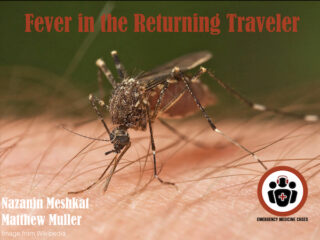
Episode 77 Fever in the Returning Traveler

In this EM Cases episode with Dr. Nazanin Meshkat, multinational ED doc and Dr. Matthew Muller, infectious disease specialist, we discuss the most common tropical disease killers that we see in patients who present with Fever in the Returning Traveler. Every year an increasing number of people travel abroad, and travelers to tropical destinations are often immunologically naïve to the regions they’re going to. It’s very common for travelers to get sick. In fact, about 2/3 of travelers get sick while they’re traveling or soon after their return, and somewhere between 3 and 19% of travelers to developing countries will develop a fever. Imported diseases, like Malaria, Dengue, Ebola, and Zyka can be acquired abroad and brought back to your ED in unsuspecting individuals. This is serious stuff - you might be surprised to learn that Malaria is responsible for more morbidity and mortality worldwide than any other illness. According to a study in CJEM most emergency physicians have minimal or no specific training in tropical diseases and emergency physicians indicated an unacceptably low level of comfort when faced with patients with tropical disease symptoms. In fact, 40% of the cases were incorrectly diagnosed or managed. And Canadian ED docs aren’t the only ones who’s skill isn’t stellar in this department - a similar 2006 study of UK physicians showed a 78% misdiagnosis rate. This misdiagnosis rate isn’t wholly because of lack of knowledge – it almost certainly also has to do with the vague presentations and huge amount of overlap between so many tropical disease. You might be thinking that it’s impossible to learn all the thousands of details of the dozens of different tropical diseases - true. However, in the ED, while we don’t need to know every detail of every tropical disease, and don’t necessarily need to make the exact diagnosis right away, we do need to have a rational, organized approach to diagnosing and managing fever in the returning traveler, so that we can identify some of the more common serious illnesses like Malaria, Dengue and Typhoid fever, and start timely treatment in the ED.

Episode 74 Opioid Misuse in Emergency Medicine

Pain leads to suffering. Opioid misuse leads to suffering. We strive to avoid both for our patients. On the one hand, treating pain is one of the most important things we do in emergency medicine to help our patients and we need to be aggressive in getting our patients' pain under control in a timely, effective, sustained and safe fashion. This was the emphasis 10-20 years ago after studies showed that we were poor at managing pain and our patients were suffering. On the other hand, opioid dependence, addiction, abuse and misuse are an enormous public health issue. Opioid misuse in Emergency Medicine has become a major problem in North America over the past 10 years at least partly as a reaction to the years that we were being told that we were failing at pain management. As Dr. Reuben Strayer said in his SMACC talk on the topic: “Opioid misuse explodes in our face on nearly every shift, splattering the entire department with pain and suffering, and addiction and malingering and cursing and threats and hospital security, and miosis and apnea and naloxone and cardiac arrest.” So how do we strike a balance between managing [...]

Best Case Ever 41 Opiate Misuse and Physician Compassion

Opiate misuse is everywhere. Approximately 15-20% of ED patients in the US are prescribed outpatient opiates upon discharge. In Ontario, about 10 people die accidentally from prescription opiates every week. Between 1990 and 2010, drug overdose deaths in the US increased by almost four fold, eclipsing the rate of death from motor vehicle collisions in 2009. This was driven by deaths related to prescription opiates, which now kill more people than heroin and cocaine combined. Opiates are the most prescribed class of medication in the US. In 2010, one out of every eight deaths among persons aged 25 to 34 years was opiate-related. Four out of 5 new heroin users report that their initial drug was a prescription opiate. In Ontario, three times the people died from opiate overdose than from HIV in 2011. Yet, we are expected to treat pain aggressively in the ED. Dr. Reuben Strayer, the brains behind the fantastic blog EM Updates tells his Best Case Ever, in which he realizes the importance of physician compassion in approaching the challenging drug seekers and malingerers that we manage in the ED on a regular basis. This Best Case Ever is in anticipation of an upcoming main episode in which Dr. Strayer and toxicologist Dr. David Juurlink discuss how to strike a balance between managing pain effectively and providing the seed for perpetuating a drug addiction or feeding a pre-existing drug addiction, and how we best take care of our patients who we suspect might have a drug misuse problem.

Episode 70 End of Life Care in Emergency Medicine

Most of us in North America live in cultures that almost never talk about death and dying. And medical progress has led the way to a shift in the culture of dying, in which death has been medicalized. While most people wish to die at home, every decade has seen an increase in the proportion of deaths that occur in hospital. Death is often seen as a failure to keep people alive rather than a natural dignified end to life. This is at odds with what a lot of people actually want at the end of their lives: 70% of hospitalized Canadian elderly say they prefer comfort measures as apposed to life-prolonging treatment, yet as many as ⅔ of these patients are admitted to ICUs. Quality End of Life Care in Emergency Medicine is not widely taught. Most of us are not well prepared for death in our EDs – and we should be. There’s no second chance when it comes to a bad death like there is if you screw up a central line placement, so you need the skills to do it right the first time. To recognize when comfort measures and compassion are what will be best for our patients, is just as important as knowing when to intervene and treat aggressively in a resuscitation. Emergency physicians should be able to recognize not only the symptoms and patterns that are common in the last hours to days of life, but also understand the various trajectories over months or years toward death, if they’re going to provide the high quality end of life care that patients deserve. So, with the help of Dr. Howard Ovens, a veteran emergency physician with over 25 years of experience who speaks at national conferences on End of Life Care in Emergency Medicine, Dr. Paul Miller, an emergency physician who also runs a palliative care unit at McMaster University and Dr. Shona MacLachlan who led the palliative care stream at the CAEP conference in Edmonton this past June, we'll help you learn the skills you need to assess dying patients appropriately, communicate with their families effectively, manage end of life symptoms with confidence and much more...

Episode 69 Obesity Emergency Management

Current estimates of the prevalence of obesity are that a quarter of adult Canadians and one third of Americans are considered obese with approximately 3% being morbidly obese. With the proportion of patients with a BMI>30 growing every year, you’re likely to manage at least one obese patient on every ED shift. Obese patients are at high risk of developing a host of medical complications including diabetes, hypertension, coronary artery disease, peripheral vascular disease, biliary disease, sleep apnea, cardiomyopathy, pulmonary embolism and depression, and are less likely compared to non-obese adults to receive timely care in the ED. Not only are these patients at higher risk for morbidity and mortality, but obesity emergency management is complicated by the patient’s altered cardiopulmonary physiology and drug metabolism. This can make their acute management much more challenging and dangerous. To help us gain a deeper understanding of the challenges of managing obese patients and elucidate a number of important differences as well as practical approaches to obesity emergency management, we welcome Dr. Andrew Sloas, the founder and creator of the fantastic pediatric EM podcast PEM ED, Dr. Richard Levitan, a world-famous airway management educator and innovator and Dr. David Barbic a prominent Canadian researcher in obesity in emergency medicine from University of British Columbia....

Health Equity, Trust and Data Collection in the Emergency Department

I view the emergency department as a safe refuge, a modern-day secular sanctuary. We are the one health-care service that never turns anyone away; we provide shelter to the homeless on cold winter nights, safety for battered women, and food for the hungry. I have always felt this “sanctuary” role was part of the core mission of the ED, one with a great potential for improving lives, or at least providing comfort.

Donate Subscribe
Go to Top