

Most Recent

Ep 184 Must Know Drug Interactions in Emergency Medicine
We miss potentially dangerous and even lethal drug interactions in EM more often than we realize. In this main episode EM Cases podcast with Dr. David Juurlink and Dr. Walter Himmel we review the common categories of drugs, the high risk patients and the key drug interactions that we need to know about in Emergency Medicine... Please support EM Cases by giving a donation: https://emergencymedicinecases.com/donation/

Global EM 4 Climate Change and the Impeding Impact on Emergency Medicine
With increasing forest fires, heat waves, floods, storms, vector-borne illnesses and heat waves, the emergency department is uniquely positioned to declare sentinel events, advocate on behalf of vulnerable populations and lead by example. Dr. Matt Douglas-Vail explains the need for Increased education on climate change and planetary health, Increased resource allocation in emergency departments for climate-related pathologies and increased disaster planning for climate-related emergencies on this month's Global EM blog...
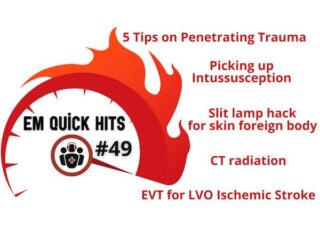
EM Quick Hits 49 Stroke Management Update, Intussusception, 5 Penetrating Trauma Tips, Skin Foreign Body Hack, CT Radiation Risk, Emergency Fund
On this month's EM Quick HIts podcast: Anand Swaminathan on EVT for large vessel occlusion strokes, Sarah Reid on picking up intussusception, Andrew Petrosoniak on 5 Penetrating Trauma Tips, Peter Toth on using a slit lamp to manage skin foreign body hack, Nour Khatib and Jonathan Wallace on CT Radiation Risk and Matt Poyner on setting up an emergency fund...

ECG Cases 43 – ECG Interpretation in Shortness of Breath
In this ECG Cases blog we look at 10 patients with shortness of breath, and discuss how the ECG can be used to help diagnose cardiac, respiratory and metabolic emergencies. We discover that for STEMI/OMI vs subendocardial ischemia, we should look for STEMI(-)OMI, subacute OMI, and OMI in the presence of LBBB and RBBB, and consider the differential for diffuse ST depression with reciprocal ST elevation in aVR. For RV strain, acute vs chronic, we should look for signs of acute RV strain and chronic pulmonary hypertension. for low voltages we should consider pericardial effusion and other causes, and for hyperkalemia we should look for multiple signs of hyperkalemia as a guide for empiric calcium...

Ep 183 STIs: Pelvic Inflammatory Disease and Genital Lesions – HSV, Syphilis and LVG
In this part 2 of our 2-part series on STIs with Dr. Catherine Varner and Dr. Robyn Shafer we answer such questions as: Why should we care about making the diagnosis of pelvic inflammatory disease (PID) in the ED? What combination of clinical features and lab tests should trigger a presumptive diagnosis and empiric treatment of PID? Which patients with PID require admission to hospital? What are the test characteristics of ultrasound for the diagnosis of PID and for Fitz-Hugh-Curtis Syndrome? When and how should we work up patients for syphilis in the ED? When should we suspect and empirically treat for lymphogranuloma venereum and granuloma inguinale? does an IUD need to be removed in patients with PID? and many more...

ECG Cases 42 – Approach to ECG Interpretation in Patients with Chest Pain: OMI, False Positive & Negative STEMI & Other Causes
In this ECG Cases blog we look at 10 cases of patients with chest pain, including false positive STEMI, false negative STEMI, and other causes to help hone your ECG interpretation skills in time-sensitive cases where those very ECG skills might save a life...
