

Ultrasound
Ep 219 Hip Emergencies: Recognition and Management
Hip complaints are bread-and-butter emergency medicine—but every so often they are anything but straightforward. The obvious shortened, externally rotated leg after a fall is one thing; the patient with acute hip pain, a normal x-ray, unremarkable blood work, and no clear diagnosis is another. Hip fractures are also far from benign, carrying a 30-day mortality of 6–7% and a 1-year mortality of about 20%, often triggering a cascade of pain, immobility, delirium, deconditioning, and death. But hip fractures are only the tip of the iceberg. In this EM Cases episode, Dr. Arun Sayal and Dr. Matt DiStefano go beyond “get an x-ray and call ortho” to tackle hip fractures, occult injuries, atraumatic hip pain, and hip dislocations. We answer questions like: Why do so many patients never return to baseline after a hip fracture? What can we do in the ED to avoid delaying surgery? What are the best pain management and delirium prevention strategies? Which physical exam findings help diagnose an occult hip fracture? How do we distinguish hip from pelvic fractures clinically? When is a normal x-ray not enough, and when should we proceed to CT or MRI? What is POCUS useful for in the painful hip? How should hip fractures be classified to change ED management? How should we approach atraumatic hip pain? How do native and prosthetic hip dislocations differ? What clinical position suggests posterior versus anterior dislocation? Which reduction technique should we choose? What is the Whistler technique? What are the nuances of post-reduction management? And much more. Please consider a donation to EM Cases to support ongoing high-quality Free Open Access Medical Education: https://emergencymedicinecases.com/donation/
Ep 216 Cardiac Arrest Update: Beyond the 2025 ACLS Guidelines Part 2 – Medications, Airway, Termination and Post-ROSC Care
In this Part 2 or our 2-part EM Cases podcast series on Cardiac Arrest Update, Dr. Sheldon Cheskes and Dr. Rob Simard take us beyond the algorithms and into the real-world decision-making of cardiac arrest care. We answer questions like: Do vasopressin and steroids improve survival or just ROSC? Should we be giving amiodarone earlier—and is lidocaine just as good? When should we use calcium, bicarbonate, or magnesium, and when should we avoid them? What role does ketamine play in CPR-induced consciousness? How should we choose between supraglottic airways and endotracheal intubation? What are the pitfalls of waveform capnography (ETCO2) to help guide CPR quality, detect ROSC, and inform prognosis? What is the role of PoCUS and TEE during cardiac arrest? When should we terminate resuscitation—and how do ETCO2 and POCUS factor into that decision? Should we widen the criteria to consider thrombolytics and who should go to the cath lab, and should we be ordering whole-body CT after ROSC for everyone who isn't going to the cath lab or getting ECMO? And finally, what are the key post-ROSC targets that actually impact neurologic outcomes in cardiac arrest patients? and many more...Please consider a donation to EM Cases to support ongoing high quality Free Open Access Medical Education https://emergencymedicinecases.com/donation/
EM Quick Hits 65 Occipital Nerve Block, PoCUS in Pulmonary Embolism, Myelopathy, Team Resuscitation, Incidental Neutropenia, Peer Programs
On this month's EM Quick Hits podcast: Dr. Mathew MacArther on Occipital Nerve Block, Dr. Ian Chernoff on PoCUS in Pulmonary Embolism, Dr. Hans Rosenberg on Myelopathy, Dr. Shawn Segeren on Team Resuscitation, Dr. Brit Long on Incidental Neutropenia and Dr. Kylie Booth on Peer Programs. Please help ensure continued Free Open Access of the entire EM Cases Learning System by donating here: https://emergencymedicinecases.com/donation/
Ep 204 High Risk Pulmonary Embolism Management
There are many nuances in the management of patients with pulmonary embolism in cardiac arrest, peri-arrest or simply in shock: We need to optimize oxygenation and airway management, hemodynamic support, acid/base management, thrombolysis and/or catheter-directed therapies that Anton dives into with guest experts Dr. Lauren Westafer, Dr. Bourke Tillmann and Dr. Justin Morgenstern... EM Cases is proudly FOAMEd - Please consider a donation: https://emergencymedicinecases.com/donation/
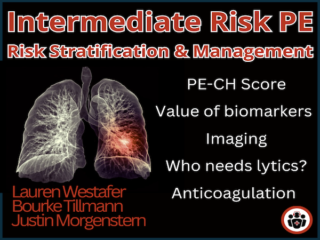
Ep 203 Intermediate Risk Pulmonary Embolism Risk Stratification, Management and Algorithm
How do you predict which intermediate-risk patients will suddenly deteriorate? What role do risk scores, biomarkers, imaging, and hemodynamics play in decision-making? Should these patients receive anticoagulation alone, or is thrombolysis warranted? When should you consider catheter-directed or surgical interventions? This podcast focuses us to think critically about risk stratification, early interventions and escalation in care in PE. We include an algorithm in the show notes. Not all patients fit neatly into classification boxes, making clinical judgment crucial. Join Dr. Lauren Westafer, Dr. Justin Morgenstern, Dr. Bourke Tillman and Anton as they explore the key decision points, pitfalls, and lifesaving strategies for managing intermediate-risk PE in the ED...
EM Quick Hits 48 – FAST in Pediatric Trauma, Multiple Myeloma, Drowning, AKA, Global EM
In this month's EM Quick Hits: Heather Cary on the use and misuse of abdominal FAST in pediatric trauma, Hans Rosenberg and Arleigh McCurdy on the diagnosis and management of Multiple Myeloma in the ED, David Jerome on practice tips for managing the drowning patient, Brit Long and Michael Gottlieb on the diagnosis and management of Alcohol-Induced Ketoacidosis, Navpreet Sahsi on his journey to becoming a humanitarian and global EM doctor...
