

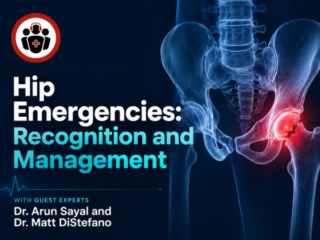
Ep 219 Hip Emergencies: Recognition and Management

Hip complaints are bread-and-butter emergency medicine—but every so often they are anything but straightforward. The obvious shortened, externally rotated leg after a fall is one thing; the patient with acute hip pain, a normal x-ray, unremarkable blood work, and no clear diagnosis is another. Hip fractures are also far from benign, carrying a 30-day mortality of 6–7% and a 1-year mortality of about 20%, often triggering a cascade of pain, immobility, delirium, deconditioning, and death. But hip fractures are only the tip of the iceberg. In this EM Cases episode, Dr. Arun Sayal and Dr. Matt DiStefano go beyond “get an x-ray and call ortho” to tackle hip fractures, occult injuries, atraumatic hip pain, and hip dislocations. We answer questions like: Why do so many patients never return to baseline after a hip fracture? What can we do in the ED to avoid delaying surgery? What are the best pain management and delirium prevention strategies? Which physical exam findings help diagnose an occult hip fracture? How do we distinguish hip from pelvic fractures clinically? When is a normal x-ray not enough, and when should we proceed to CT or MRI? What is POCUS useful for in the painful hip? How should hip fractures be classified to change ED management? How should we approach atraumatic hip pain? How do native and prosthetic hip dislocations differ? What clinical position suggests posterior versus anterior dislocation? Which reduction technique should we choose? What is the Whistler technique? What are the nuances of post-reduction management? And much more. Please consider a donation to EM Cases to support ongoing high-quality Free Open Access Medical Education: https://emergencymedicinecases.com/donation/
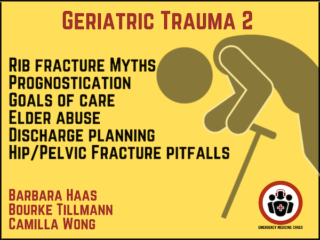
Ep 160 Geriatric Trauma 2 Rib Fractures, Pelvic Fractures, Prognostication, Elder Abuse, Discharge Planning

In Geriatric Trauma Part 2 we answer questions such as: what are the indications for transfer to a trauma center in older patients with rib fractures and why? Can we accurately prognosticate older trauma patients in the ED? How can we best engage family members in goals of care discussions for the older trauma patient? What are the risk factors for elder abuse that we need to be aware of in the ED? How can we best minimize the risk for recurrent falls and bounce backs for the older trauma patient who is discharged from the ED? and many more...

JJ 13 Regional Nerve Blocks for Hip Fractures

In this EM Cases Journal Jam podcast with Anton Helman, Justin Morgenstern, Rory Spiegel, and special guest Jacques Lee we explore the evidence for femoral nerve blocks and fascia iliaca blocks as well as discuss the practical implementation of them in your ED. We answer questions such as: Do regional nerve blocks for hip fractures effectively reduce pain? Do they decrease opioid use? Are they safe compared to standard pain management? Should the block be done prior to x-ray confirmation? and many more...

Episode 1: Occult Fractures and Dislocations

Dr. Arun Sayal and Dr. Natalie Mamen discuss the key diagnostic considerations in commonly missed occult fractures and dislocations. They review the indications and controversies for the use of Bone Scan, CT and MRI in occult fractures and dislocations and give you some great clinical pearls to use on your next shift. Missed occult fractures and dislocations, in general, may result in significant morbidity for the patient and law suites for you. Six cases are presented in this episode, ranging from common scaphoid fractures to rarer dislocations. Dr. Sayal & Dr. Mamen answer questions such as: Which fractures can mimic ankle sprains and how do you avoid missing them? What are the most reliable signs of scaphoid fracture? In which occult orthopaedic injuries should we anticipate limb threatening ischemia? Which is better to diagnose occult fractures - MRI or CT? Which calcaneus fractures require surgery and which ones can be managed conservatively? and many more......

Donate Subscribe
Go to Top