Best Case Ever is a mini podcast where an Emergency Medicine Cases guest expert describes a practice changing case, what they learned from it, and clinical pearls and pitfalls you can use on your next shift.

Best Case Ever 39 – Airway Strategy & Mental Preparedness in EM Procedures with Richard Levitan

I caught up with airway educator, innovator and self-described enthusiast Dr. Richard Levitan at SMACC in Chicago this past June. In this Best Case Ever on Airway Strategy and Mental Preparedness in EM Procedures, Dr. Levitan uses a great save of his in a penetrating trauma case as a basis for discussion on mental preparedness and how we've been thinking about our general approach to emergency procedures the wrong way. Rather than fixating on the final goal of a procedure, which can often be daunting and lead us astray, he suggests a methodical incrementalized and compartmentalized approach to EM procedures that reduces stress and fear, improves confidence and enhances success. He runs through several examples including intubation, cricothyrotomy and initial approach to hypoxia to explain his Simple Incremental Approach to EM Procedures. Could this be a paradigm shift in the way we think about procedures in EM?....

Best Case Ever 38 Sickle Cell Acute Chest Syndrome

Sickle Cell Acute Chest Syndrome remains the leading cause of death in patients suffering from Sickle Cell Disease. In his Best Case Ever, Dr. Richard Ward, a hematologist with a special interest in Sickle Cell Disease, describes a case of a Sickle Cell Disease patient who presents with what appears to be a simple pain crisis, but turns out to be a devastating Acute Chest Syndrome. He gives us the key clinical pearls and pitfalls to make this often elusive diagnosis early so that life-saving treatment can be initiated in a timely manner. This is in anticipation of the upcoming episode on The Emergency Management of Sickle Cell Pain Crisis with Dr. Ward and Dr. John Foote.

By |2019-11-11T16:55:02-05:00August 11th, 2015|Categories: Best Case Ever, Hematology|Tags: , , |0 Comments

Best Case Ever 37 Neonatal Lazy Feeder

On this EM Cases Best Case Ever Dr. Anthony Crocco, the Head and the Division Head of Pediatric EM at McMaster University and Medical Director of Pediatric Emergency Medicine at Hamilton Health Sciences Hosptial, discusses an approach to the neonatal lazy feeder and why we should abandon the use of codeine in pediatrics as well as in breastfeeding mothers. The approach to the neonatal lazy feeder should be considered as an approach to altered level of awareness with a wide differential diagnosis, and there is one question that should always be asked of the neontal lazy feeder....

Best Case Ever 36 Tracheo-innominate Fistula

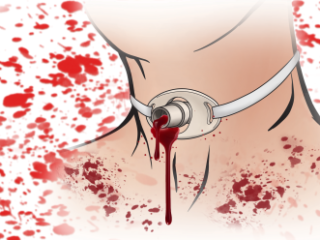
In this Best Case Ever with Dr. Scott Weingart, the brains behind EMcrit.org, we hear the devastating story of a tracheostomy gone bad. Dr. Weingart shares with us what he has learned about how to manage massive hemoptysis in tracheostomy patients, and in particlar, a step-wise approach to managing a tracheo-innominate fistula. We discuss the balance between providing maximal aggrressive critical care while maintaining a deep respect for the risks associated with the procedures we perform. Recorded at North York General's EM Update Conference 2015.

Best Case Ever 35: Taking Action in Emergency Medicine

In anticipation of our series of podcasts on Diagnostic Decision Making with Dr. Walter Himmel, Dr. Chris Hicks and Dr. David Dushenski we have Dr. Hicks presenting his Best Case Ever. Taking action in Emergency Medicine requires not only careful consideration of the best evidence, the experience of the clinician, the patient's values and the system that you work in, but also the will to act. Dr. Hicks describes a case of a patient who suffers a cardiac arrest, where the diagnosis is quite obvious to everyone in the room (and the required action is as well), yet a delay in treatment occurs nonetheless.

Best Case Ever 34: Inferior MI Presenting with Abdominal Pain

In a previous Best Case Ever, 'Thinking Outside the Abdominal Box', Dr. Brian Steinhart reviewed some important can't-miss-diagnoses that can present elusively with abdominal pain. In this Carr's Cases Series on Inferior MI Presenting with Abdominal Pain, we continue in the theme of 'Thinking Outside the Abdominal Box' with David Carr explaining how he figured out that a man presenting with classic biliary colic was diagnosed with an inferior MI with right ventricular extension.

Best Case Ever 33: Over-correction of Hyponatremia

Rapid over-correction of Hyponatremia can have devastating consequences: for one, osmotic demyelination syndrome (ODS) can result in destruction of the pons and a locked-in state. We don't see ODS very much as it's onset is delayed and usually sets in after the patient is admitted to hospital (or worse, sent home). Nonetheless, we need to know how to manage Hyponatremia in the ED so that we prevent ODS from ever happening. In this Best Case Ever, Dr. Melanie Baimel describes the case of a young woman who came in to the ED after drinking alcohol and taking Ecstasy, wanted to leave AMA after her Hyponatremia had inadvertently been corrected too rapidly, and the conundrum that ensues. In the upcoming episode, Dr. Baimel and the first ever Internal Medicine specialist on EM Cases, Dr. Ed Etchels, discuss a rational step-wise approach to managing Hyponatremia, tailored for the EM practitioner; when you might consider giving DDAVP in the ED, the best way to correct Hyponatremia, how to manage the patient who's Hyponatremia has been corrected too quickly, and an easy approach to the differential diagnosis. Get a sneak peak at the algorithm that will be explained and reviewed in the upcoming episode...... [wpfilebase tag=file id=577 tpl=emc-play /] [wpfilebase tag=file id=578 tpl=emc-mp3 /]

Best Case Ever 32 Carr’s Cases – Endocarditis and Blood Culture Interpretation

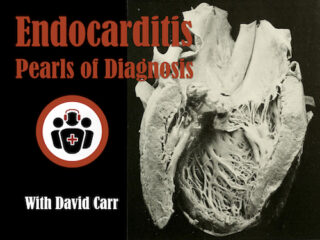
David Carr discusses his top 10 pearls on endocarditis and blood culture interpretation in this Carr's Cases Best Case Ever on EM Cases - Endocarditis and Blood Culture Interpretation. [wpfilebase tag=file id=560 tpl=emc-play /] [wpfilebase tag=file id=561 tpl=emc-mp3 /]

By |2019-11-11T17:30:25-05:00February 5th, 2015|Categories: Best Case Ever, Cardiology, EM Cases|Tags: , , , , |1 Comment

Best Case Ever 31: Emergency Pericardiocentesis

On this EM Cases Best Case Ever, Andrew Sloas, the brains behinds the fabulous PEM-ED podcast tells the tale of a pericardiocentesis gone bad and what he learned from it. Emergency pericardicentesis can be life saving, but it also carries risks. Dr. Sloas reviews the steps to take to ensure that the pericardiocentesis needle is the the correct place to minimize the risk of intubating the right ventricle of the heart. A discussion of errors of omission and ones of commission follows.... [wpfilebase tag=file id=540 tpl=emc-play /] [wpfilebase tag=file id=541 tpl=emc-mp3 /]

Best Case Ever 29: Drug Induced Aseptic Meningitis

Dr. David Carr presents his third of EM Cases' Carr's Cases. This series features potentially debilitating diagnoses that may be thought of as 'zebras', but actually have a higher incidence then we might think - and if diagnosed early, can significantly effect patient outcomes. Dr. Carr tells the story of young woman with an MRSA supra pateller abscess who was put on trimethoprim sulfamethoxazole and presents looking very ill with a severe headache. Not only has trimethoprim sulfamethoxazole been implicated in aseptic meningitis, but NSAIDS, immunomodulators and antibiotics have also been implicated. The reason this is so important for ED practitioners to know, is that case reports of drug-induced aseptic meningitis have shown that symptoms will resolve completely within 24 hours, once the offending drug has been stopped. Not only that, but if the patient receives the drug again in the future, they are at risk for a more severe case of drug induced aseptic meningitis.

Donate Subscribe
Go to Top