

Most Recent
EM Quick Hits 39 Overdiagnosis, Lytics for Submassive PE, Pericardial Effusion, Hemophilia Treatment
In this month's EM Quick Hits podcast Justin Morgenstern & Eddy Lang discuss the problem of overdiagnosis in EM, Anand Swaminathan's approach to indications and dosing of thrombolytics for submassive (intermediate risk) pulmonary embolism, Tahara Bhate's QI Corner on a patient with unexplained shortness of breath, Brit Long on emergency treatment of the bleeding hemophilia patient...
ECG Cases 32 Prehospital ECG pearls and pitfalls
In this ECG Cases blog we review 8 cases of patients with prehospital ECGs and explore prehospital ECGs for diagnosing STEMI, Occlusion MI, false STEMI, code STEMI, dynamic ischemic changes, truncated voltages. Can you avoid the pitfalls and spot the pearls that help to make the diagnosis?
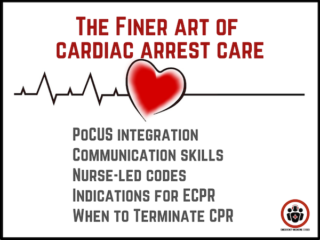
Ep 170 Cardiac Arrest – PoCUS Integration, Communication Strategies, E-CPR, Calling the Code
In this part 2 of our 2-part podcast series on Cardiac Arrest - The When, Why & How, we discuss some of the finer art of cardiac arrest care and answer questions such as: how should we best communicate to EMS, the ED team and the family of the patient to keep the team focused, garner the most important info and keep the flow of the code going? How should we integrate PoCUS into cardiac arrest care so we do not interrupt the core components, yet we gain valuable data? What are the indications for consideration of ECPR/ECMO in cardiac arrest? What factors need to be taken into consideration to decide on when to terminate resuscitation of the cardiac arrest patient - when to call the code? and many more...
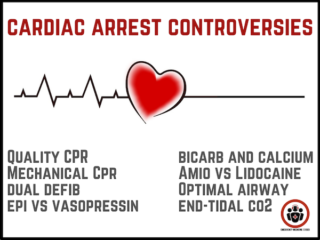
Ep 169 Cardiac Arrest Controversies – Chest Compressions, Dual Defibrillation, Medications and Airway
In this first part of our 2-part series on Cardiac Arrest Controversies Rob Simard, Bourke Tillman, Sara Gray and Scott Weingart discuss with Anton how best to ensure high quality chest compressions, the pros and cons of mechanical CPR, the literature on dual sequential defibrillation and optimizing pad placement, epinephrine vs vasopressin, amiodarone vs lidocaine, when to consider IV calcium and sodium bicarbonate, esmolol, airway considerations, sedation in cardiac arrest, the pros and cons of end-tidal CO2 and more...

ECG Cases 31 Is a 15 lead ECG better than 12? Diagnosing Posterior MI and RVMI
Is 15 lead ECG better than 12 lead for diagnosing posterior MI or right ventricular infarction? When do you need a 15 lead ECG? Jesse McLaren guides us through 8 cases to highlight the steps and pitfalls in diagnosing posterior MI and RVMI in light of recent ECG literature...
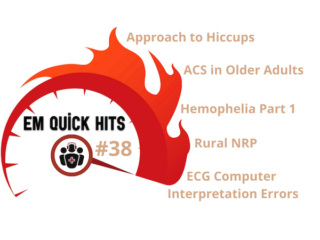
EM Quick Hits 38 ACS in Older Patients, Rural Neonatal Resuscitation, Hemophilia, Hiccups, ECG Computer Interpretation
On this month's EM Quick Hits: Christina Shenvi on ACS in older people, Nour Khatib on rural NRP, Jess McLaren on how not to get fooled by ECG computer interpretation, Brit Long on hemophilia recognition and workup, Maria Ivankovic on persistent and intractable hiccups from EM Cases Summit 2021...
