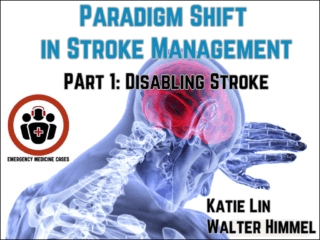
Ep 208 Paradigm Shift in Ischemic Stroke Management Part 1: Disabling Strokes

We are amidst a paradigm shift in the emergency management of acute ischemic stroke. The traditional way of categorizing ischemic strokes as 'minor' vs 'major' is no longer relevant to what we do in the ED. It's now about 'disabling' vs 'non-disabling' strokes. And this is no small change. This categorization dictates urgency of ED work-up and treatments, imaging choices, treatment decisions and goals of care. In this Part 1 or our 2-part main episodes EM Cases podcast series on management of ischemic stroke with Dr. Walter Himmel and Dr. Katie Lin, we answer questions like: How can we best rapidly determine if an ischemic stroke is disabling or non-disabling at the bedside? In what ways are 'wake up strokes' managed uniquely and what's the latest thinking on their pathophysiology? How should we best prioritize imaging depending on timing, geography and resources? How do we best predict large vessel occlusion amenable to endovascular therapy (EVT) at the bedside? How can we efficiently establish goals of care at the bedside to inform our emergency decision making around strokes? Which is better for thrombolysis in ischemic stroke - Tenecteplase or Alteplase? How have contraindications to IV thrombolysis changed over the last decade? When should we consider bridge therapy with EVT after IV thrombolysis? What are 4 key items the ED physician should have ready for the stroke neurologist on the first call? and many more... If you enjoy EM Cases content please consider a donation to help support ongoing FOAMed here: https://emergencymedicinecases.com/donation/
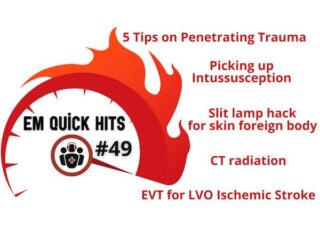
EM Quick Hits 49 Stroke Management Update, Intussusception, 5 Penetrating Trauma Tips, Skin Foreign Body Hack, CT Radiation Risk, Emergency Fund

On this month's EM Quick HIts podcast: Anand Swaminathan on EVT for large vessel occlusion strokes, Sarah Reid on picking up intussusception, Andrew Petrosoniak on 5 Penetrating Trauma Tips, Peter Toth on using a slit lamp to manage skin foreign body hack, Nour Khatib and Jonathan Wallace on CT Radiation Risk and Matt Poyner on setting up an emergency fund...

Ep 171 Posterior Stroke, EP Lead, HEAR Score, Ketamine for Suicidal Ideation, Peer Support Workers – Highlights from Calgary EM Hodsman Lecture Day

In this special edition main EM Cases podcast episode we feature the highlights from live podcasts recorded at Calgary EM during their annual Hodsman Lecture Day, covering a variety of current EM topics: The challenges of posterior circulation stroke (PCIS); Emergency Physician Lead to improve ED overcrowding, access block and job satisfaction; When not to order a troponin - The HEAR Score; Ketamine to relieve suicidal ideation and reduce acute risk; Peer Support Workers for ED patients with mental health issues and substance use disorder, plus a description of the Pathway to Peers program...

Ep 120 ED Stroke Management in the Age of Endovascular Therapy

In this EM Cases main episode podcast, a follow up to our episode on TIA released in November 2018 with Walter Himmel and David Dushenski, we’ll try to simplify the confusing time-based and brain tissue-based options for stroke management. We’ll answer the questions that have been plaguing us for a while now: Which patients are eligible for endovascular therapies? Which patients are the ones who’ll benefit from these therapies and how do we make that happen in our different practice environments? Which patients should be considered for lytic therapy? Which patients should be considered for both lytic and endovascular therapy? and many more...

Donate Subscribe
Go to Top