

Resuscitation
Ep 213 Update in Management of Status Epilepticus
Convulsive status epilepticus is one of the most morbid neurologic emergencies we manage in the ED, and outcomes depend far more on speed than drug selection. Like ventricular fibrillation, each minute of ongoing convulsions worsens hypoxia, acidosis, cardiovascular instability, and neuronal injury, while making seizures progressively harder to terminate. Modern definitions are intentionally time-compressed to force early, parallel, clock-anchored action. Any patient still convulsing when you reach the bedside should be treated as evolving status epilepticus. In this EM Cases podcast with Dr. Sara Gray, we take a practical, time-based approach to convulsive status epilepticus, focusing on early, adequately dosed benzodiazepines, avoiding common escalation and dosing pitfalls, anticipating post-ictal cardiovascular collapse, and knowing when to escalate to second-line agents, airway control, and anesthetic-dose therapy. We also address the transition to non-convulsive status epilepticus and how to recognize ongoing seizures when EEG is not immediately available. We answer questions such as: Why does time to first benzodiazepine matter more than the drug or route? What critical actions should occur in parallel with the first dose? What are 3 key actions to do in parallel with the first benzodiazepine? Why is underdosing second-line antiseizure medications—especially levetiracetam—a common and dangerous pitfall? When should persistent seizures trigger intubation and anesthetic-dose therapy? How can we identify non-convulsive status epilepticus once tonic-clonic activity stops? And many more (we also include a high yield status epilepticus management algorithm in the show notes!)... If you find EM Cases helpful in your clinical practice, please consider supporting our work so we can continue producing free, high-quality emergency medicine education for clinicians around the world. Make a donation here: https://emergencymedicinecases.com/donation/
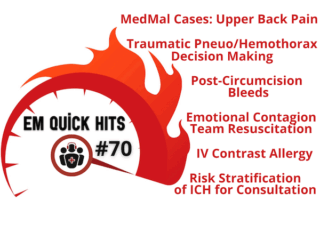
EM Quick Hits 70 MedMal Cases Upper Back Pain, Traumatic Pneumothorax/Hemothorax Decision Making, Risk Stratification of ICH for Consultation, Post-Circumcision Bleeds, IV Contrast Allergy, Emotional Contagion
In this month's EM Quick Hits podcast: Mike Weinstock discusses with Anton a case of upper back pain in this month's Medmal Cases, Andrew Petrosoniak on traumatic pneumothorax and hemothorax decision making: risk stratification, imaging cutoffs and chest tube choices, Justin Morgenstern on brain injury guidelines risk stratification for neurosurgical consult, repeat imaging and admission, Andrew Tagg on management of post-circumcision bleeding and when to escalate care, Hans Rosenberg & Ariel Hendin on evaluation and management of CT contrast allergy and why steroids are out, Shawn Seregren on emotional contagion in resuscitation teams: how tone, pace and volume of your voice and body language effect team rescucitation dynamics and outcomes...
Ep 211 Thyrotoxicosis and Thyroid Storm: Recognition and Management
In this Part 2 of our 2-part podcast series on thyroid emergencies Anton, Dr. George Willis and Dr. Alyssa Louis answer questions such as: When a patient presents with “sepsis without a source,” what bedside features should trigger you to prioritize thyrotoxicosis? How can PoCUS help you decide whether tachycardia is dangerous — or lifesaving — before starting β-blockade? Why can TSH and free T4 be falsely reassuring in a crashing patient, and what labs actually matter early? In which patients does propranolol increase the risk of cardiovascular collapse — and why is esmolol the safer first line medication? Why does the order β-blocker → thionamide → steroid → iodine matter, and what happens if you get it wrong? When is not giving a β-blocker the safest decision in thyroid storm, even in a profoundly tachycardic patient? In an agitated, hyperthermic patient with thyrotoxicosis, why might intubation be more dangerous than helpful in the first hour? How does amiodarone-induced thyrotoxicosis fundamentally change your management — and why can iodine make it worse? and many more...
Ep 210 Decompensated Hypothyroidism Recognition and Management
In the ED, we regularly care for sick patients presenting acutely with abnormal vital signs, altered mental status, and end organ dysfunction. Oftentimes, the culprit ends up being sepsis, or overdose, or organ failure. But it is important that we consider rarer endocrine presentations like decompensated hypothyroidism. In this Part 1 of this two-part podcast with Dr George Willis and Dr Alyssa Louis, we answer questions like: Why is the term myxedema coma a misnomer and should be abandoned? How can we differentiate between sepsis or environmental hypothermia or toxidrome from decompensated hypothyroidism at the bedside? When is it appropriate to order a TSH, a T4 and T3? What are the most important life-threatening triggers that need to be addressed in patients with decompensated hypothyroidism? Why is it important to test for cortisol levels and consider stress-dose steroids in all patients with decompensated hypothyroidism? Why is endotracheal intubation particularly dangerous in decompensated hypothyroidsm? What is the best way to manage hypothermia? Why is the order of medications for treatment of decompensated hypothyroidism so important? and many more... Please consider a donation to EM Cases to ensure continuing Free Open Access Medical Education: https://emergencymedicinecases.com/donation/
EM Quick Hits 68 Osteomyelitis, Tourniquet Technique, Pediatric Distal Radius Buckle Fractures, DSI RCT, AMS in ESRD & Dialysis, EM Leadership Spotlight #3
On this month's EM Quick Hits podcast: Dr. Isaac Bogoch on recognition and management of osteomyelitis in the ED, Dr. Anand Swaminathan on tourniquet tips and tricks. Dr. Andrew Tagg on managing pediatric distal radius buckle fractures & the FORCE trial. Dr. Justin Morgenstern on Delayed Sequence Intubation (DSI): RCT Takeaways. Dr. Brit Long on ESRD & Dialysis in the ED: altered mental status. Dr. Lisa Thurgur & Victoria Myers on leadership and medical education. Please consider a donation to EM Cases to ensure ongoing high quality free open access medical education here: https://emergencymedicinecases.com/donation/
EM Quick Hits 67 Tick Borne Illness Update, Pediatric ECG Interpretation, Nailbed Repair, Closed Loop Communication, ESRD, Leaders in EM Dr. Catherine Varner
On this EM Quick Hits podcast: Tick Borne Illness Update with Dr. Issac Bogoch, Pediatric ECG Interpretation with Dr. Kathleen Stephanos, Nailbed Repair with Dr. Matthew McArther, Closed Loop Communication with Dr. Shawn Segeren, ESRD with Dr. Brit Long, Leaders in EM Dr. Catherine Varner... Please consider donating to EM Cases here: https://emergencymedicinecases.com/donation/
