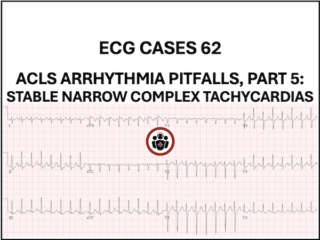
ECG Cases 62 – ACLS Arrhythmia Pitfalls, Part 5: Stable Narrow Complex Tachycardias

Stable narrow complex tachycardias are not always what they seem. In this ECG Cases, Dr. Jesse McLaren explores the key pitfalls in distinguishing sinus tachycardia, atrial fibrillation, atrial flutter, and SVT, with 8 real-world cases highlighting common ECG interpretation errors, secondary causes, and the crucial management decisions that can prevent patient harm... Please consider a donation to EM Cases to ensure continued Free Open Access Medical Education here: https://emergencymedicinecases.com/donation/

ECG Cases 61 ACLS Dysrhythmia Pitfalls Part 4: Stable Wide Complex Tachycardia

In this month's ECG Cases Dr. Jess McLaren explains how to differentiate various causes and mimics of Wide Complex Tachyardia: Artifact can mimic wide complex tachycardia, but have unaffected leads recorded at the same time, and regular narrow QRS complexes marching through the noise. Too wide or not fast enough? Consider hyperkalemia (empiric calcium) or sodium channel toxicity (empiric sodium bicarbonate). Regular wide complex tachycardia driven by P waves? Treat the secondary cause of sinus tachycardia. VT vs SVT? If the wide complex tachycardia is regular and not driven by P waves, and the differential is VT vs SVT, assume VT regardless of age or hemodynamic instability (eg fascicular VT in young patients) and much more...Please consider a donation to help ensure we continue to provide high quality Free Open Access Medical Education here: https://emergencymedicinecases.com/donation/

ECG Cases 60 – ACLS arrhythmia pitfalls, part 3: unstable tachycardia, cardiovert?

This is the third in a series of blog posts on the pitfalls of ACLS algorithms for adults with a pulse, and how a systematic approach to 12-lead ECG can help with ECG acquisition, interpretation, and application. The first looked at unstable bradycardia, the second stable bradycardia, and this one will look at unstable tachycardia. The ACLS algorithm for unstable tachyarrhythmia is simple: immediate cardioversion. This works well if it is a primary tachyarrythmia that is causing the instability (eg SVT or VT), but there are a number of pitfalls in this assumption. ECG acquisition: is it actually a tachy-arrhythmias? Artifact can mimic a tachy-arrhythmia. This can be identified by unaffected leads recorded at the same time, and narrow QRS complexes marching through the noise ECG interpretation: is the tachy-arrhythmia a primary electrical problem? There are other tachycardias in unstable patients that may fail to respond to cardioversion: AF (irregularly irregular rhythm), where the patient’s instability may be related to a secondary cause Sinus tachycardia (in response to a secondary cause): can best be identified by upright P waves in II and biphasic P waves in V1. ECG application: Is the rhythm causing the instability, or is there a secondary cause – including one that might be revealed by the 12-lead, like hyperkalemia or occlusion MI? For live and highly interactive ECG courses to elevate your skills - including online courses, or an in-person pre-conference course at CAEP, go to www.heartsECGcourse.com

ECG Cases 19 Tachycardias – Approach, WIDER Mnemonic for Wide SVT DDx, VT vs SVT

In this ECG Cases blog Jesse McLaren review an approach to tachycardia, explore the WIDER mnemonic for wide SVT differential diagnosis, and how to distinguish VT from SVT with 10 cases...

EM Cases Best of 2018 Top 10

2018 was the most successful year in EM Cases 9 year history with 1,777,303 podcast downloads reaching a total download count of nearly 8 million to date, as well as more than 1 million webpage views. Based on a blend of the number of podcast downloads, webpage views, social media engagement, number of positive emails and comments that I received, and my own favs, I'm pleased to bring you the EM Cases Best of 2018 Top 10...

Donate Subscribe
Go to Top