ECG Cases 61 ACLS Dysrhythmia Pitfalls Part 4: Stable Wide Complex Tachycardia

In this month's ECG Cases Dr. Jess McLaren explains how to differentiate various causes and mimics of Wide Complex Tachyardia: Artifact can mimic wide complex tachycardia, but have unaffected leads recorded at the same time, and regular narrow QRS complexes marching through the noise. Too wide or not fast enough? Consider hyperkalemia (empiric calcium) or sodium channel toxicity (empiric sodium bicarbonate). Regular wide complex tachycardia driven by P waves? Treat the secondary cause of sinus tachycardia. VT vs SVT? If the wide complex tachycardia is regular and not driven by P waves, and the differential is VT vs SVT, assume VT regardless of age or hemodynamic instability (eg fascicular VT in young patients) and much more...Please consider a donation to help ensure we continue to provide high quality Free Open Access Medical Education here: https://emergencymedicinecases.com/donation/
ECG Cases 60 – ACLS arrhythmia pitfalls, part 3: unstable tachycardia, cardiovert?

This is the third in a series of blog posts on the pitfalls of ACLS algorithms for adults with a pulse, and how a systematic approach to 12-lead ECG can help with ECG acquisition, interpretation, and application. The first looked at unstable bradycardia, the second stable bradycardia, and this one will look at unstable tachycardia. The ACLS algorithm for unstable tachyarrhythmia is simple: immediate cardioversion. This works well if it is a primary tachyarrythmia that is causing the instability (eg SVT or VT), but there are a number of pitfalls in this assumption. ECG acquisition: is it actually a tachy-arrhythmias? Artifact can mimic a tachy-arrhythmia. This can be identified by unaffected leads recorded at the same time, and narrow QRS complexes marching through the noise ECG interpretation: is the tachy-arrhythmia a primary electrical problem? There are other tachycardias in unstable patients that may fail to respond to cardioversion: AF (irregularly irregular rhythm), where the patient’s instability may be related to a secondary cause Sinus tachycardia (in response to a secondary cause): can best be identified by upright P waves in II and biphasic P waves in V1. ECG application: Is the rhythm causing the instability, or is there a secondary cause – including one that might be revealed by the 12-lead, like hyperkalemia or occlusion MI? For live and highly interactive ECG courses to elevate your skills - including online courses, or an in-person pre-conference course at CAEP, go to www.heartsECGcourse.com

ECG Cases 59 – ACLS Dysrhythmia Pitfalls Part 2: Stable Bradycardia? Or Dangerous Bradycardia Requiring Pacemaker?

Five patients presented with bradycardia and normal blood pressure. How does ECG interpretation change management? Despite apparent stability, which require immediate treatment and which require admission for a pacemaker?...

ECG Cases 57 Art of Occlusion MI Part 5 – Clinical-ECG-POCUS Triptych

In this ECG Cases with Dr. Jesse McLaren we guide you through 6 cases to explore his Clinical-ECG-PoCUS triptych in the identification of Occlusion MI...

ECG Cases 55 The Art of Occlusion MI Part 3 – Impression

In this ECG Cases blog Dr. Jesse McLaren guides us through 6 illustrative cases delving into overall impression in identifying occlusion MI. He discusses how using multiple OMI findings such as acute Q wave, subtle STE, reciprocal STD, hyperacute T waves, and reciprocal TWI to contribute to your overall impression, can double the sensitivity of STEMI criteria for acute coronary occlusion...

By |2025-04-22T11:41:56-04:00April 22nd, 2025|Categories: Cardiology, ECG Cases, EM Cases|Tags: , , , , |0 Comments

ECG Cases 52 – ECGs falsely labeled “normal”

In this ECG Cases Dr. Jesse McLaren outlines why not to trust the ECG interpretation, even if normal, because it can miss critical findings. He explores how to independently and systematically interpret every ECG so that when the computer ECG interpretation says "normal" you don't miss key findings... Please consider donating to EM Cases to ensure it stays Free Open Access https://emergencymedicinecases.com/donation/
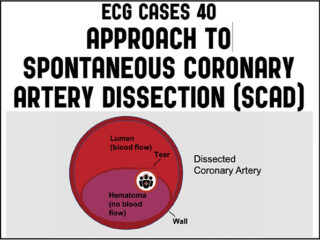
ECG Cases 40 – Approach to Spontaneous Coronary Artery Dissection (SCAD)

Dr. Jesse McLaren on when to consider Spontaneous Coronary Artery Dissection (SCAD), which patients are at risk for reocclusion, and the challenges of diagnosing SCAD in patients who have nonischemic ECGs despite silent occlusion, occlusions perfused by collaterals, or from non-occlusive MI on this ECG Cases...

ECG Cases 22: T-wave INVERSION mnemonic

The differential for T-wave INVERSION includes: Incorrect lead placement, No bundle (RBBB, LBBB), Ventricular hypertrophy (LVH, RVH), Embolism, Reciprocal/refractory/reperfused occlusion MI, Sudden death (ARVD), Iatrogenic (digoxin), Obtunded (eg SAH), and Normal variant. Jesse McLaren runs through 10 cases of patients who present to the ED who have T-wave inversions on their ECGs...

EMU365 Amal Mattu on Killer ECGs and Pericardial Effusions

This EMU365 video features EM cardiology guru Dr. Amal Mattu on killer ECGs associated with pericardial effusions. He eloquently explains the utility of electrical alternans, specific lead and voltage criteria required to make the diagnosis of low voltage and more...

Donate Subscribe
Go to Top