emergency medicine orthopedics

Ep 219 Hip Emergencies: Recognition and Management

Hip complaints are bread-and-butter emergency medicine—but every so often they are anything but straightforward. The obvious shortened, externally rotated leg after a fall is one thing; the patient with acute hip pain, a normal x-ray, unremarkable blood work, and no clear diagnosis is another. Hip fractures are also far from benign, carrying a 30-day mortality of 6–7% and a 1-year mortality of about 20%, often triggering a cascade of pain, immobility, delirium, deconditioning, and death. But hip fractures are only the tip of the iceberg. In this EM Cases episode, Dr. Arun Sayal and Dr. Matt DiStefano go beyond “get an x-ray and call ortho” to tackle hip fractures, occult injuries, atraumatic hip pain, and hip dislocations. We answer questions like: Why do so many patients never return to baseline after a hip fracture? What can we do in the ED to avoid delaying surgery? What are the best pain management and delirium prevention strategies? Which physical exam findings help diagnose an occult hip fracture? How do we distinguish hip from pelvic fractures clinically? When is a normal x-ray not enough, and when should we proceed to CT or MRI? What is POCUS useful for in the painful hip? How should hip fractures be classified to change ED management? How should we approach atraumatic hip pain? How do native and prosthetic hip dislocations differ? What clinical position suggests posterior versus anterior dislocation? Which reduction technique should we choose? What is the Whistler technique? What are the nuances of post-reduction management? And much more. Please consider a donation to EM Cases to support ongoing high-quality Free Open Access Medical Education: https://emergencymedicinecases.com/donation/
EM Quick Hits 68 Osteomyelitis, Tourniquet Technique, Pediatric Distal Radius Buckle Fractures, DSI RCT, AMS in ESRD & Dialysis, EM Leadership Spotlight #3

On this month's EM Quick Hits podcast: Dr. Isaac Bogoch on recognition and management of osteomyelitis in the ED, Dr. Anand Swaminathan on tourniquet tips and tricks. Dr. Andrew Tagg on managing pediatric distal radius buckle fractures & the FORCE trial. Dr. Justin Morgenstern on Delayed Sequence Intubation (DSI): RCT Takeaways. Dr. Brit Long on ESRD & Dialysis in the ED: altered mental status. Dr. Lisa Thurgur & Victoria Myers on leadership and medical education. Please consider a donation to EM Cases to ensure ongoing high quality free open access medical education here: https://emergencymedicinecases.com/donation/
EM Quick Hits 60 Post-Tonsillectomy Hemorrhage, Post-CABG Infections, Bougie Tips, Pelvic Fracture Bleeds, Debriefing: Why, When & How

On this month's EM Quick Hits podcast: Kevin Wasko on post-tonsillectomy hemorrhage management, Brit Long on assessment and management of post-CABG surgical incision infections, Anand Swaminathan on evidence, pitfalls and tips on using Bougies, Leah Flannigan on when to suspect vascular injury in patients with low energy mechanism pelvic fractures, Andrew Petrosoniak on debriefing after cases: why, when and how... Do you learn a lot from EM Cases? Please consider a donation to ensure EM Cases continues to provide you high quality Free Open Access Medical Education here: https://emergencymedicinecases.com/donation/

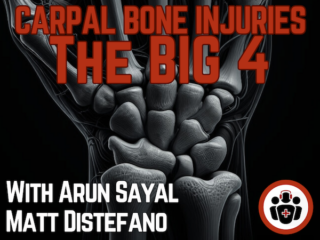
Ep 190 Carpal Bone Injuries – The Big 4

Triquetrum chip fractures, scapholunate injuries, hook of the hamate fractures, and of course, scaphoid fractures can be easily missed with serious consequences for our patients. In this part 2 of our 2-part podcast series on wrist injuries we highlight the "Big 4" most commonly missed and mismanaged carpal bone injuries, elucidating the key historical, physical exam and x-ray findings, as well as management strategies...

Ep 189 Commonly Missed and Mismanaged Wrist Injuries

In this part 1 or our 2-part podcast series on wrist injuries Dr. Arun Sayal and Dr. Matt DiStefano answer such questions as:when should we suspect a DRUJ injury, why is it important to pick up DRUJ injuries in the ED, and how does it change our management? Why is the lateral x-ray view so important in picking up commonly missed wrist injuries? When it comes to distal radius fractures, how are Colles vs Barton's vs Smith's fractures managed differently in the ED? What are the 2 key x-ray signs we should look for on the AP and the 2 key x-ray signs we should look for on the lateral for every wrist injury? and many more...

EM Quick Hits 51 – Methylene Blue in Septic Shock, TMJ Dislocation, Crohn’s Disease, Analgesia for Renal Colic, Inhaled Steroids for Asthma, Hypocalcemia in Bleeding Trauma Patients

On this month's EM Quick Hits podcast: Anand Swaminathan on the role of methylene blue in septic shock, Nour Khatib on jaw dislocation reduction techniques, Hans Rosenberg on a phenotypic approach to Crohn's disease emergencies, Gil Yehudaiff on evidence based analgesics in renal colic, Brit Long on the importance of inhaled steroids for asthma, and Andrew Petrosoniak on the "lethal diamond" in polytrauma patients and the current state of hypocalcemia in bleeding trauma patients... Please support EM Cases with a donation: https://emergencymedicinecases.com/donation/

Journal Club 4 PoCUS or X-ray for Distal Forearm Fractures

You are working the ambulatory section of your ED and evaluating a 6-year boy with a possible distal radius injury. He lives with autism spectrum disorder and is uncomfortable in X-ray rooms, and you wonder if there is a role for PoCUS to help exclude a fracture. With expert clinical commentary by Dr. Arun Sayal and Research Methodology Hot Take by Dr. Shelley Mcleod...

Ep 176 Orthopedic X-rays Master Class – Pitfalls in Obtaining and Interpreting MSK X-rays

Do not let a negative X-ray rule the day! Like almost all medical tests X-rays are far from perfect and should be ordered and interpreted only in the context of a thorough history and physical exam. In this 2nd part of our 2-part series on orthopedic x-rays with Dr. Arun Sayal and Dr. Yatin Chadha we discuss the pitfalls of obtaining and interpreting orthopedic X-rays, when orthopedic X-ray decision tools lead us astray, how understanding the concept of central ray helps dictate how we should order X-rays and interpret them, how the ring structure concept of the forearm and lower leg can remind us where to look for a second injury, when we need 3 views vs 2 views, when extra views like the clenched fist view and weight bearing views are indicated, why we should always look at the lateral view first, the limitations of ultrasound and CT in long bone and joint injuries and more... Please support EM Cases by giving a donation: https://emergencymedicinecases.com/donation/

Ep 175 Emergency Orthopedics Differential: SCARED OF Mnemonic – When X-rays Lie

In this main episode podcast, Dr. Arun Sayal creator of the CASTED course and Dr. Yatin Chadha a radiologist with a fellowship in MSK radiology, join Anton for Part 1 of 2 podcasts on Emergency Orthopedic Injuries. This episode focuses on a differential diagnosis of MSK injuries that are occult to X-ray with the help of the SCARED OF mnemonic. It ensures we pick up all the “can’t miss” diagnoses that can be easily overlooked when we do not integrate a pointed history and physical exam with the X-ray in front of us. Essentially, we discuss ‘when X-rays lie’ and offer up a variety of clinical pearls and pitfalls in assessing patients in the ED with MSK presentations…

EM Quick Hits 30 Scaphoid Fracture, Therapeutic Hypothermia, HEADS-ED, Pelvic Trauma, Kratom, Femoral Lines

In this month's EM Quick Hits podcast: Arun Sayal on the nuances of assessment for scaphoid fractures, Justin Morgenstern on the evidence for therapeutic hypothermia post-arrest and the TTM2 trial, Sarah Reid on HEADS-ED mental health screening tool for children, youth and young adults, Andrew Petrosoniak on pelvic trauma and pelvic binder tips and pitfalls, Michelle Klaiman on what we need to know about Kratom and Anand Swaminathan on why femoral lines are often a great central line choice...

Donate Subscribe
Go to Top