

Special Populations
Global EM 12 – Global Health Redefined: Making an Impact Abroad Without Leaving Home
Global health doesn’t always require a passport or months working abroad. EM physician Dr. Dinesh Krishna’s journey shows how telemedicine, research, grant writing, fundraising and international partnerships can create meaningful global health impact from home—and help bring rehabilitation and disability services to more than 215,000 people without spending extended periods of time away from home in this month's Global EM blog...
EM Quick Hits 72 EMC²: Peds Neurocritical Care, Pulmonary Hypertension, Cytokine Release Syndrome, Peds Wrist Fracture, Bradycardia ECG Interpretation, Coaching the EM Mind Part 2
In this month’s EM Quick Hits Podcast, Amna Karabegovic joins us for an EMC² case of pediatric altered LOA and neurocritical care, Anand Swaminathan simplifies the high-risk management of pulmonary hypertension and right ventricular failure, and Brit Long reviews how to recognize and treat Cytokine Release Syndrome. Plus, Andrew Tagg on whether uncomplicated pediatric distal radius fractures need reduction, Jesse McLaren on a systematic approach to ECG interpretation in the bradycardic patient, and Sara Gray and Katie Lin return for Part 2 of “Coaching the EM Mind,” with practical strategies for managing stress and optimizing psychological safety on shift… Please consider a donation to ensure EM Cases continues to be high quality Free Open Access Medical Education here: https://emergencymedicinecases.com/donation/
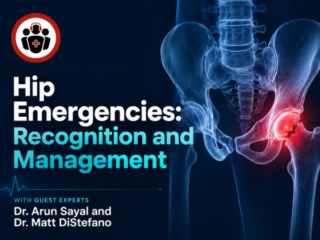
Ep 219 Hip Emergencies: Recognition and Management
Hip complaints are bread-and-butter emergency medicine—but every so often they are anything but straightforward. The obvious shortened, externally rotated leg after a fall is one thing; the patient with acute hip pain, a normal x-ray, unremarkable blood work, and no clear diagnosis is another. Hip fractures are also far from benign, carrying a 30-day mortality of 6–7% and a 1-year mortality of about 20%, often triggering a cascade of pain, immobility, delirium, deconditioning, and death. But hip fractures are only the tip of the iceberg. In this EM Cases episode, Dr. Arun Sayal and Dr. Matt DiStefano go beyond “get an x-ray and call ortho” to tackle hip fractures, occult injuries, atraumatic hip pain, and hip dislocations. We answer questions like: Why do so many patients never return to baseline after a hip fracture? What can we do in the ED to avoid delaying surgery? What are the best pain management and delirium prevention strategies? Which physical exam findings help diagnose an occult hip fracture? How do we distinguish hip from pelvic fractures clinically? When is a normal x-ray not enough, and when should we proceed to CT or MRI? What is POCUS useful for in the painful hip? How should hip fractures be classified to change ED management? How should we approach atraumatic hip pain? How do native and prosthetic hip dislocations differ? What clinical position suggests posterior versus anterior dislocation? Which reduction technique should we choose? What is the Whistler technique? What are the nuances of post-reduction management? And much more. Please consider a donation to EM Cases to support ongoing high-quality Free Open Access Medical Education: https://emergencymedicinecases.com/donation/
Ep 218 Substance Use Disorder in the ED – Stigma, Compassion and System Change
Emergency physicians pride themselves on recognizing and treating life-threatening illness under pressure. Yet one of the most lethal, common, and treatable conditions presenting to our EDs still often receives fragmented, stigmatized care: substance use disorder. The opioid crisis has evolved into an era of increasingly toxic and unpredictable drug supplies, including ultra-potent synthetic opioids such as nitazenes. Between 2016 and 2021, more than 27,000 Canadians died from opioid toxicity, while opioid-related ED visits continue to rise sharply. Patients discharged with untreated opioid use disorder face mortality rates approaching 5% within 12 months. Despite this, substance use disorder is still not consistently approached with the same urgency and systems-based care as other chronic high-risk illnesses. In this episode, Dr. Bjug Borgundvaag, Tish Mizon and Kari Herbert discuss how stigma affects care in the ED and how trauma-informed communication, person-first language, compassionate care, peer navigators and Bridge-style addiction programs can improve outcomes for both patients and clinicians. Please support EM Cases ongoing Free Open Access Medical Education learning platform with a donation here: https://emergencymedicinecases.com/donation/

Global EM 11 – Global Emergency Medicine Fellowships: More than Just Stamps in Your Passport
Global Emergency Medicine fellowships are far more than humanitarian deployments. In this personal reflection, Dr. Julianna Deutscher explores how GEM training combines mentorship, education, systems strengthening, advocacy, and global partnerships to broaden an emergency medicine career. From Ethiopia to Moldova to the local ED in Calgary, she shares how GEM shaped her approach to patient care, resource stewardship, trauma systems, and caring for underserved populations at home and abroad...
Ep 217 Pediatric Agitation: Assessment and Management
Pediatric agitation in the Emergency Department is one of those presentations that can escalate quickly and leave even experienced clinicians feeling on edge. It is high-risk, resource-intensive, and often unfolds in an already overstimulating environment where small missteps can make things worse. At the same time, agitation is not a diagnosis, it is a clinical presentation that may reflect anything from psychiatric illness to delirium, intoxication, trauma, or simply a child overwhelmed by the ED itself. So how do we approach these patients in a way that is safe, systematic, and effective? In this episode with guest experts, Dr. Susan Duffy and Dr. Thomas Chun, we tackle the questions that come up at the bedside: How do we rapidly distinguish mild, moderate, and severe agitation in a way that actually changes what we do next? Which patients are most likely to escalate, and how can we intervene early to prevent that? When should we be worried about a medical or toxicologic cause rather than assuming this is “behavioural”? What does effective verbal de-escalation actually look like in a busy ED, and why does it so often fail? When is a "code white" for emergency security measures truly indicated, and how do we avoid turning it into an escalation trigger? How should we be thinking about medications: what to choose, when to give them, and how to avoid over-sedation? And once the patient is finally calm, how do we make sure we aren't missing the underlying diagnosis? and many more... Please consider a donation to EM Cases to support ongoing high quality Free Open Access Medical Education https://emergencymedicinecases.com/donation/
