emergency medicine education

ECG Cases 38 – ECG Interpretation in Cocaine Chest Pain

Dr. Jesse McLaren discusses some key aspects of cocaine chest pain ECG interpretation in this month's blog including: Patients with cocaine-associated chest pain require benzodiazepines +/- nitroglycerine for symptom relief, aspirin and ECG to look for signs of occlusion and reperfusion. In patients with chest pain + ST elevation, consider false positive STEMI including early repolarization, LVH and Brugada-pattern. In patients with cocaine chest pain who are STEMI negative, beware STEMI(-)OMI including subtle ST elevation, hyperacute T waves, reciprocal change, and refractory ischemia. For cocaine chest pain patients who's chest pain has resolved, look for reperfusion T wave inversion, as this may put them at risk for reocclusion.

WTBS 28 I’m OK, How Are You? How can we innovate our way out of this crisis in EM and cope until we do?

In this month's Waiting to Be Seen blog Dr. Howard Ovens outlines challenges, innovations and coping strategies in the EM Crisis...

EMC Journal Club 1 – Does Treating Fever Make A Difference?

In this first EMC Journal Club (where we take the "boring" out of journal clubs and deliver clear, concise, practical practice changing critical appraisal knowledge based on an Emergency Medicine journal article that may have passed your radar - not too detailed and not too brief), Dr. Rohit Mohindra, an Emergency Physician at North York General in Toronto and SREMI researcher works his critical appraisal magic on the article "Fever therapy in febrile adults: systematic review with meta-analyses and trial sequential analyses" by Holgersson et al. Plus, for the EBM keeners, we have Dr. Shelley McLeod, clinical epidemiologist at SREMI give us a research methodology hot take on the difference between a traditional meta-analysis and a network meta-analysis and why it matters...

Journal Jam 21 Laceration Management – Does Timing of Closure, Irrigation, Gloves Type, Eversion Matter?

In this Journal Jam podcast Anton and Justin welcome special guest Dr. Haley Cochrane. We dive deep into the evidence for timing of closure and infection rate, fluid choice, volume and pressure of irrigation of lacerations, glove type and infection rate, how eversion of wound edges effects cosmetic outcomes and much more. You might be surprised to discover that the evidence for many things we do for lacerations that are considered "standard of care", is either weak or non-existent. But do not fret - we deliver practical bottom line practical recommendations to help improve outcomes, save time and decrease resource utilization...

Global EM 1: Practicing EM in Bangladesh – Build It and They Will Come

Dr. Navpreet Sahsi describes the challenges of building an Emergency Department in Bangladesh and how the experience has shaped his outlook on Emergency Medicine practice in North America on EM Cases' first Global EM blog...

Ep 176 Orthopedic X-rays Master Class – Pitfalls in Obtaining and Interpreting MSK X-rays

Do not let a negative X-ray rule the day! Like almost all medical tests X-rays are far from perfect and should be ordered and interpreted only in the context of a thorough history and physical exam. In this 2nd part of our 2-part series on orthopedic x-rays with Dr. Arun Sayal and Dr. Yatin Chadha we discuss the pitfalls of obtaining and interpreting orthopedic X-rays, when orthopedic X-ray decision tools lead us astray, how understanding the concept of central ray helps dictate how we should order X-rays and interpret them, how the ring structure concept of the forearm and lower leg can remind us where to look for a second injury, when we need 3 views vs 2 views, when extra views like the clenched fist view and weight bearing views are indicated, why we should always look at the lateral view first, the limitations of ultrasound and CT in long bone and joint injuries and more... Please support EM Cases by giving a donation: https://emergencymedicinecases.com/donation/

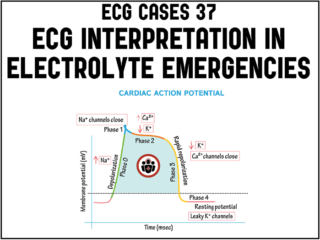
ECG Cases 37 ECG interpretation in electrolyte emergencies

While most of us have a clear algorithm in our minds for the management of life-threatening hyperkalemia, the same may not be said about the other life-threatening electrolyte abnormalities. In this ECG Cases blog Dr. Jesse MacLaren gives us an approach to potassium, calcium and magnesium abnormalities including risk factor assessment, ECG interpretation and management pearls...

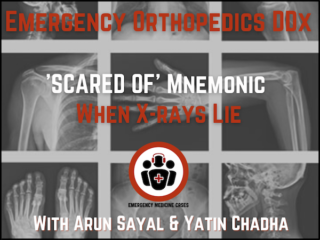
Ep 175 Emergency Orthopedics Differential: SCARED OF Mnemonic – When X-rays Lie

In this main episode podcast, Dr. Arun Sayal creator of the CASTED course and Dr. Yatin Chadha a radiologist with a fellowship in MSK radiology, join Anton for Part 1 of 2 podcasts on Emergency Orthopedic Injuries. This episode focuses on a differential diagnosis of MSK injuries that are occult to X-ray with the help of the SCARED OF mnemonic. It ensures we pick up all the “can’t miss” diagnoses that can be easily overlooked when we do not integrate a pointed history and physical exam with the X-ray in front of us. Essentially, we discuss ‘when X-rays lie’ and offer up a variety of clinical pearls and pitfalls in assessing patients in the ED with MSK presentations…

EM Quick Hits 43 Pediatric Cannabis Poisoning, Esophageal Perforation, Brugada, Career Transitions in EM

On this month's EM Quick Hits podcast: Best of University of Toronto EM with Yaron Finkelstein on pediatric cannabis poisoning pitfalls, Brit Long on recognition and management of esophageal perforation, Jesse McLaren on 3 questions to diagnose Brugada Syndrome, Tahara Bhate on QI Corner, Constance Leblanc on maintaining wellness in career transitions from CAEP 2022...

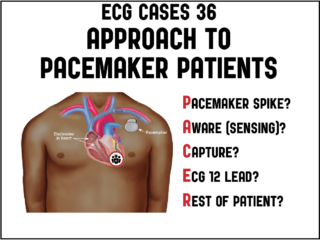
ECG Cases 36 – PACER Mnemonic for Approach to Pacemaker Patients

In this month's ECG Cases blog Dr. McLaren explains the PACER mnemonic approach to patients with pacemakers: Pacemaker spike: is it appropriately presence/absent, is there pacemaker-mediated tachycardia (apply magnet) or is there failure to pace (apply magnet to stop sensing, cardio consult)? Aware (sensing): is it normal, is there oversensing (underpacing: apply magnet) or undersensing (treat reversible causes, cardio consult). Capture: if there are pacemaker spikes is there capture, or failure to capture (treat reversible causes, cardio consult). ECG 12 lead: are there signs of hyperkalemia (extra wide QRS, peaked T) or Occlusion MI (Modified Sgarbossa Criteria) that need immediate treatment. Rest of patient: is there a complication of pacemaker insertion related to the pocket (hematoma, infection), lead (pneumothorax, DVT), or heart (pericardial perforation), or is there an emergency unrelated to the pacemaker (eg dehydration, sepsis, GI bleed)...

Donate Subscribe
Go to Top