EM Cases Main Episodes are round table in-depth discussions with 2 or more EM Cases guest experts, inherently peer reviewed, and edited for a podcast.
Ep 166 Pericarditis and Cardiac Tamponade

Why should pericarditis be considered a diagnosis of exclusion? Which clinical features are most useful in the diagnosis of pericarditis? What are the most common pitfalls in the ECG interpretation? What are the best ways to differentiate the ECG of pericarditis from that of MI and early repolarization? How is uncomplicated viral pericarditis treated differently compared to pericarditis with other etiologies? Why is it so important to include colchicine as part of the treatment of pericarditis? Which patients with pericarditis require admission? and many more...

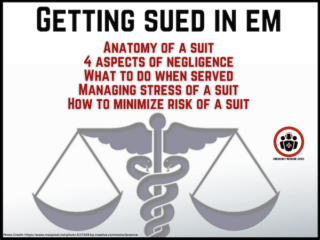
Ep 165 Getting Sued in Emergency Medicine – Practical Tips

How many civil actions against Emergency Physicians does CMPA handle and what have been the outcomes? What are the 4 aspects of medical negligence and the anatomy of a legal action against physicians in Canada? What are the 3 stages of civil action in a medicolegal law suit in Canada? How should you respond when you are served with a medicolegal action? How can you minimize the stress associated with getting sued? What is the role of expert evidence in medical negligence actions? What strategies can we use to lower the risk of getting sued for medical negligence based on CMPA data and ED chiefs' opinions...

Ep 164 Cardiogenic Shock Simplified

What is the preferred order of vasopressors and ionotropes in the management of cardiogenic shock? In which patients would dobutamine be preferred over milrinone and vice versa? How can we best pick up occult cardiogenic shock before it floured shock kicks in? What are the best strategies to efficiently get the patient in cardiogenic shock to definitive care, whether that be the cath lab or the operating room? What is the evidence for intra-aortic balloon pumps, percutaneous ventricular assist devices and ECMO in the patient with cardiogenic shock? Which patients with acute heart are safe to send home in general? How useful is the Ottawa Heart Failure Risk Score in aiding in disposition decisions?...

Ep 163 Acute Heart Failure ED Management – PoCUS, Oxygenation Strategies, Medication Strategies, PPV HAVoC and SCAPE

In this Part 1 of our two-part series on acute heart failure, Anton is joined by Dr. Tarlan Hedayati and Dr. Bourke Tillman to answer such questions as: how does PoCUS compare with clinical assessment and CXR in diagnostic accuracy for acute heart failure? How do we best integrate PoCUS in the our assessment and management of the patient with acute heart failure? What is PPV HAVoC and how can we use it to optimize acute heart failure management goals? What should be our specific goals of management in the acute heart failure depending on the underlying cause? How does high flow nasal cannula (HFNC) compare to non-invasive positive pressure ventilation (NIPPV) in the management of acute heart failure? How should we interpret the C3PO trial in the context of the world's literature on NIPPV in acute heart failure? How should we dose nitroglycerin to maximize its effects without dumping the blood pressure in patients with SCAPE and those without SCAPE? How should we best time and dose furosemide in the acute heart failure patient with renal insufficiency? Is there any role for morphine or ACEi in the ED management of acute heart failure? What are best anxiolytic medication choices in acute heart failure? Is there any role for second line diuretics in the management of acute heart failure in the ED? and many more...

Ep 162 Managing Adversity with Walter Himmel

I asked Dr. Walter Himmel to give a talk at EM Cases Summit 2021 on what he has learned in 40 years of practice. Herein lies his profoundly thoughtful answer, that is especially relevant during the COVID pandemic -  a special edition EM Cases video podcast of his live presentation at The Summit...

Ep 161 Red Flag Headaches: General Approach and Cervical Artery Dissections

In this Part 1 or our two part podcast series on Red Flag Headaches we discuss a general approach, tips and tricks to assessing patients who present with headache followed by a deep dive into cervical artery dissections. With the help of Dr. Roy Baskind and Dr. Amit Shah we answers questions such as: what are the big 4 headache diagnoses that are not routinely picked up on plain CT or LP? Why are the symptoms of cervical artery dissection often fluctuating? Why do the symptoms of cervical artery dissection sometimes seem to not fit an anatomical distribution? What are the key clinical features that would trigger you to suspect cervical artery dissection? How do you decide which patients require a CT angiogram? What is the evidence for a causal relationship between chiropractic manipulation and cervical artery dissections?  What is evidence for antiplatelet agents, anticoagulants and thrombolysis in the management of cervical artery dissection? Which patients with cervical artery dissection can be safely discharged from the ED and many more...

Ep 160 Geriatric Trauma 2 Rib Fractures, Pelvic Fractures, Prognostication, Elder Abuse, Discharge Planning

In Geriatric Trauma Part 2 we answer questions such as: what are the indications for transfer to a trauma center in older patients with rib fractures and why? Can we accurately prognosticate older trauma patients in the ED? How can we best engage family members in goals of care discussions for the older trauma patient? What are the risk factors for elder abuse that we need to be aware of in the ED? How can we best minimize the risk for recurrent falls and bounce backs for the older trauma patient who is discharged from the ED? and many more...

Ep 159 Geriatric Trauma Part 1: The Under-Triaging Problem, Resuscitation, Airway, Head and C-spine Imaging, Clearing the C-spine

Just as pediatric patients are not small adults, geriatric patients are not just old adults. In this Part 1 of our 2-part EM Cases podcast series on Geriatric Trauma, Dr. Barbara Haas, Dr. Camilla Wong and Dr. Bourke Tillman answer questions such as: why are older patients under-triaged to trauma centers and how does that affect outcomes? What is the utility of the Shock Index in older patients? How should we adjust airway management for the older trauma patient? Which older patients do not require head or c-spine imaging after a ground level fall? Why is it challenging, yet of utmost importance, to clear the c-spine of a geriatric trauma patient as soon as possible? When can anticoagulation medications be safely resumed after an older person has sustained a minor head injury? and many more...

Ep 158 Management of Primary Spontaneous Pneumothorax

In this main episode podcast we discuss the conservative management of large spontaneous pneumothorax, when a pigtail chest tube with Heimlich valve is indicated, detection of persistent air leak, removal of chest tube, surgical indications for spontaneous pneumothorax, management pitfalls and more...

Ep157 Neuromuscular Disease for Emergency Medicine

There is a long list of rare neuromuscular diseases. Nonetheless, there are a few that you are likely to see in the ED, that are relevant to Emergency Medicine because they require timely diagnosis and treatment. In this Part 2 of our 2-part series on acute motor weakness with Roy Baskind and George Porfiris, we keep it short and simple by limiting our discussion to the key clinical clues and management strategies of two of the more common acute life-threatening neuromuscular diseases, myasthenia gravis and Guillain Barré syndrome, and how to distinguish them from their mimics...

Donate Subscribe
Go to Top