emergency medicine education

Episode 62 Diagnostic Decision Making in Emergency Medicine

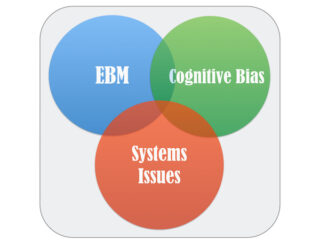
This is Part 1 of EM Cases' series on Diagnostic Decision Making with Walter Himmel, Chris Hicks and David Dushenski discussing the intersection of evidence-based medicine, cognitive bias and systems issues to effect our diagnostic decision making in Emergency Medicine. In this episode we first discuss 5 strategies to help you master evidence-based diagnostic decision making to minimize diagnostic error, avoid over-testing and improve patient care including: 1. The incorporation of patients' values and clinical expertise into evidence-based decisions 2. Critically appraising diagnostic studies 3. Understanding that diagnostic tests are not perfect 4. Using the concept of test threshold to guide work-ups 5. Understanding that the predictive value of a test depends on the prevalence of disease We then go on to review some of the factors that play into the clinician’s and patient’s risk tolerance in a given clinical encounter, how this plays into shared decision making and the need to adjust our risk tolerance in critical situations. Finally, we present some strategies to prevent over-testing while improving patient care, patient flow and ethical practice.

Best Case Ever 35: Taking Action in Emergency Medicine

In anticipation of our series of podcasts on Diagnostic Decision Making with Dr. Walter Himmel, Dr. Chris Hicks and Dr. David Dushenski we have Dr. Hicks presenting his Best Case Ever. Taking action in Emergency Medicine requires not only careful consideration of the best evidence, the experience of the clinician, the patient's values and the system that you work in, but also the will to act. Dr. Hicks describes a case of a patient who suffers a cardiac arrest, where the diagnosis is quite obvious to everyone in the room (and the required action is as well), yet a delay in treatment occurs nonetheless.

Episode 61 Whistler’s Update in EM Conference 2015 Highlights Part 1

This EM Cases episode is Part 1 of The Highlights of The University of Toronto, Divisions of Emergency Medicine, Update in EM Conference from Whistler 2015 with Paul Hannam on Pearls and Pitfalls of Intraosseus Line Placement, Anil Chopra on who is at risk and how to prevent Contrast Induced Nephropathy, and Joel Yaphe on the Best of EM Literature from 2014, including reduction of TMJ dislocations, the TRISS trial (on transfusion threshold in sepsis), PEITHO study for thrombolysis in submassive PE, Co-trimoxazole and Sudden Death in Patients Receiving ACE inhibitors or ARBs, the effectiveness and safety of outpatient Tetracaine for corneal abraisons, chronic effects of shift work on cognition and much more...

Best Case Ever 34: Inferior MI Presenting with Abdominal Pain

In a previous Best Case Ever, 'Thinking Outside the Abdominal Box', Dr. Brian Steinhart reviewed some important can't-miss-diagnoses that can present elusively with abdominal pain. In this Carr's Cases Series on Inferior MI Presenting with Abdominal Pain, we continue in the theme of 'Thinking Outside the Abdominal Box' with David Carr explaining how he figured out that a man presenting with classic biliary colic was diagnosed with an inferior MI with right ventricular extension.

Episode 60: Emergency Management of Hyponatremia

In this EM Cases episode Dr. Melanie Baimel and Dr. Ed Etchells discuss a simple and practical step-wise approach to the emergency management of hyponatremia: 1. Assess and treat neurologic emergencies related to hyponatremia with hypertonic saline 2. Defend the intravascular volume 3. Prevent further exacerbation of hyponatremia 4. Prevent rapid overcorrection 5. Ascertain a cause Dr. Etchells and Dr. Baimel answer questions such as: What are the indications for giving DDAVP in the emergency management of hyponatremia? What is a simple and practical approach to determining the cause of hyponatremia in the ED? How fast should we aim to correct hyponatremia? What is the best fluid for resuscitating the patient in shock who has a low serum sodium? Why is the management of the marathon runner with hyponatremia counter-intuitive? What strategies can we employ to minimize the risk of Osmotic Demyelination Syndrome (OSD) and cerebral edema in the emergency management of hyponatremia? and many more...

Best Case Ever 33: Over-correction of Hyponatremia

Rapid over-correction of Hyponatremia can have devastating consequences: for one, osmotic demyelination syndrome (ODS) can result in destruction of the pons and a locked-in state. We don't see ODS very much as it's onset is delayed and usually sets in after the patient is admitted to hospital (or worse, sent home). Nonetheless, we need to know how to manage Hyponatremia in the ED so that we prevent ODS from ever happening. In this Best Case Ever, Dr. Melanie Baimel describes the case of a young woman who came in to the ED after drinking alcohol and taking Ecstasy, wanted to leave AMA after her Hyponatremia had inadvertently been corrected too rapidly, and the conundrum that ensues. In the upcoming episode, Dr. Baimel and the first ever Internal Medicine specialist on EM Cases, Dr. Ed Etchels, discuss a rational step-wise approach to managing Hyponatremia, tailored for the EM practitioner; when you might consider giving DDAVP in the ED, the best way to correct Hyponatremia, how to manage the patient who's Hyponatremia has been corrected too quickly, and an easy approach to the differential diagnosis. Get a sneak peak at the algorithm that will be explained and reviewed in the upcoming episode...... [wpfilebase tag=file id=577 tpl=emc-play /] [wpfilebase tag=file id=578 tpl=emc-mp3 /]

Episode 57: The Stiell Sessions 2 – Update in Atrial Fibrillation 2014

In this bonus EM Cases podcast, The Stiell Sessions 2, we have Dr. Ian Stiell discussing an update in Atrial Fibrillation 2014 management including the age-old question of rate control vs rhythm control, the new CHADS-65 algorithm for oral anticogulant therapy, the need to initiate anticoagulant therapy in the ED, the more aggressive use of the Ottawa Aggressive Protocol, the dangers of attempting to cardiovert unstable patients who are in permanent Atrial Fibrillation, the new 150 rule to help determine the likelihood of successful cardioversion and much more. Thanks to all the listeners who did the survey on clinical decision rules and the post-listen survey.

Episode 56 The Stiell Sessions: Clinical Decision Rules and Risk Scales

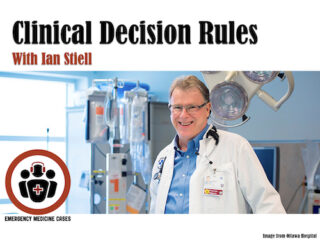
There are hundreds of clinical decision rules and risk scales published in the medical literature, some more widely adopted than others. Ian Stiell, the father of clinical decision rules, shares with us his views and experiences gained from co-creating some of the most influential CDRs and risk scales to date. He explains the criteria for developing a CDR, the steps to developing a valid CDR, how best to apply CDRs and risk scales to clinical practice, and the hot-off the-press new Ottawa COPD Risk Score and Ottawa Heart Failure Risk Score for helping you with disposition decisions. It turns out that in Canada, we discharge about two thirds of the acute decompensated heart failure patients that we see in the ED, while the US almost all patients with decompensated heart failure are admitted to hospital. Dr. Stiell's new risk scores may help physicians in Canada make safer disposition decisions while help physicians in the US avoid unnecessary admissions.

Episode 55: Fluids in Sepsis, Post-intubation Analgesia and Sedation

In this second part of the Weingart-Himmel Sessions on critical care pearls for the community ED on the EM Cases podcast, we discuss the many controversies and recent changes in fluid management in severe sepsis and septic shock. With the recently published ARISE trial, and some deviations from Early Goal Directed Therapy, we are changing the way we think about fluids in sepsis: the type of fluid, the volume of fluid, the rate of fluid administration, the timing of introducing vasopressors and the goals of fluid resuscitation. In the next section of the podcast we discuss the PAD mnemonic for post-intubation analgesia and sedation, the prevention of delirium, and medication choices to minimize time on the ventilator, and improve prognosis.

Journal Jam 2: Small Bore Chest Tube and Outpatient Management of Pneumothorax

It makes sense that the treatment of primary spnontaneous pneumothorax would lend itself well to outpatient management, since patients are usually young and otherwise healthy, and the mortality and morbidity from these air leaks are really very low. Most patients would rather be managed as an outpatient rather than admitted to hospital and sending these patients home would probably end up saving the system resources and money. In this month's Journal Jam Podcast on small bore chest tube and outpatient management of pneumothorax, the highlighted article that Anton Helman and Teresa Chan discuss is Voison et al. on the “Ambulatory Management of Large Spontaneous Pneumothorax With Pigtail Catheters.” We hear from Michelle Lin, Seth Trueger, Heather Murray and the lead author himself, Stephan Jouneau. Questions posed include: In what ways is the use of small bore catheters with Heimlich valves for spontaneous pneumothorax better than needle aspiration? Is it necessary to repeat a CXR after placement of the catheter? Who should follow up these patients after they are discharged from the hospital? How can we minimize kinking and dislodgement of the catheter? and many more..... [wpfilebase tag=file id=523 tpl=emc-play /] [wpfilebase tag=file id=524 tpl=emc-mp3 /]

Donate Subscribe
Go to Top