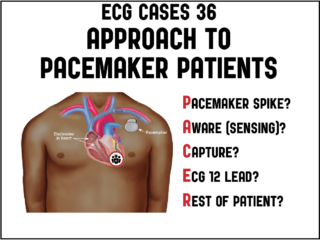
ECG Cases 36 – PACER Mnemonic for Approach to Pacemaker Patients

In this month's ECG Cases blog Dr. McLaren explains the PACER mnemonic approach to patients with pacemakers: Pacemaker spike: is it appropriately presence/absent, is there pacemaker-mediated tachycardia (apply magnet) or is there failure to pace (apply magnet to stop sensing, cardio consult)? Aware (sensing): is it normal, is there oversensing (underpacing: apply magnet) or undersensing (treat reversible causes, cardio consult). Capture: if there are pacemaker spikes is there capture, or failure to capture (treat reversible causes, cardio consult). ECG 12 lead: are there signs of hyperkalemia (extra wide QRS, peaked T) or Occlusion MI (Modified Sgarbossa Criteria) that need immediate treatment. Rest of patient: is there a complication of pacemaker insertion related to the pocket (hematoma, infection), lead (pneumothorax, DVT), or heart (pericardial perforation), or is there an emergency unrelated to the pacemaker (eg dehydration, sepsis, GI bleed)...

ECG Cases 33 Brugada Syndrome: 3-Step Approach to Diagnosis and Management

Jesse McLaren guides us through 7 cases and explains his 3-step approach to diagnosing and managing Brugada syndrome in this month's ECG Cases blog...

ECG Cases 30 Beware Computer Interpretation Errors

Computer interpretation of the ECG has been called a double-edged sword: when correct, it increases physician accuracy, but when incorrect it increases errors. This is especially problematic in the emergency department, where computer accuracy drops as clinical significance increases—with common errors for arrhythmias and ischemia. Jesse McLaren guides us through 10 cases where the computer interpretation misguides us and how to avoid these pitfalls...

Ep 166 Pericarditis and Cardiac Tamponade

Why should pericarditis be considered a diagnosis of exclusion? Which clinical features are most useful in the diagnosis of pericarditis? What are the most common pitfalls in the ECG interpretation? What are the best ways to differentiate the ECG of pericarditis from that of MI and early repolarization? How is uncomplicated viral pericarditis treated differently compared to pericarditis with other etiologies? Why is it so important to include colchicine as part of the treatment of pericarditis? Which patients with pericarditis require admission? and many more...

ECG Cases 28 Approach to Atrial Fibrillation

Jesse McLaren explains his AFIB mnemonic for approach to atrial fibrillation that involves 4 questions: 1. Is it atrial fibrillation? 2. If it is atrial fibrillation and there is rapid ventricular response, is it fast from a secondary cause? 3. If it is atrial fibrillation with a rapid ventricular response without a secondary cause, what is the intervention? 4. Does the patient need an anticoagulant started in the ED? and runs through 10 cases to elucidate the nuances of atrial fibrillation management on this ECG Cases blog...

By |2022-02-28T10:29:20-05:00February 28th, 2022|Categories: ECG Cases|Tags: , , |2 Comments

ECG Cases 25: ‘Late STEMI’ – How acute is the coronary occlusion?

In this ECG Cases blog we look at 10 patients with potentially ischemic symptoms. Which had a coronary occlusion, and how acute were they? Jesse McLaren explains 'Late STEMI' and how reperfusion strategies should not be based on time of symptom onset...

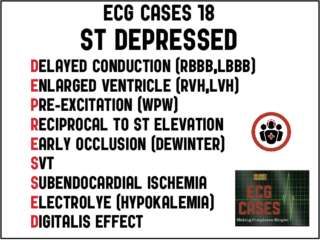
ECG Cases 18 – ST DEPRESSED Mnemonic and Occlusion MI

In this ECG Cases blog we look at 10 patients who presented with potentially ischemic symptoms and ST depression. Which had occlusion MI?

ECG Cases 10 – Hyperkalemia: The Great Imitator

Which of the following 9 patients had hyperkalemia? Can you estimate how high their serum potassium was based on the ECG? Jesse MacLaren guides us through 9 ECGs underscoring the fact that while the ECG cannot rule out hyperkalemia, significant hyperkalemia often produces ECG changes in the heart rate (bradycardia, junctional rhythm), electrical conduction (PR prolongation or loss of P waves, QRS prolongation, pacemaker delays), and ST/T waves (Brugada phenocopy, peaked T waves that are narrow/pointy) that can be easily recognized. He suggests when you might pull the trigger on giving empiric calcium treatment based on the ECG finding in this month's ECG Cases...

By |2020-06-15T21:35:47-04:00June 15th, 2020|Categories: ECG Cases, Uncategorized|Tags: , , , , |4 Comments

ECG Cases 3: Can you find the subtle inferior MI?

In this ECG Cases blog we look at 8 patients with potentially ischemic symptoms, to highlight pearls and pitfalls of inferior MI. Can you identify which ones had acute coronary occlusion?...

Donate Subscribe
Go to Top